

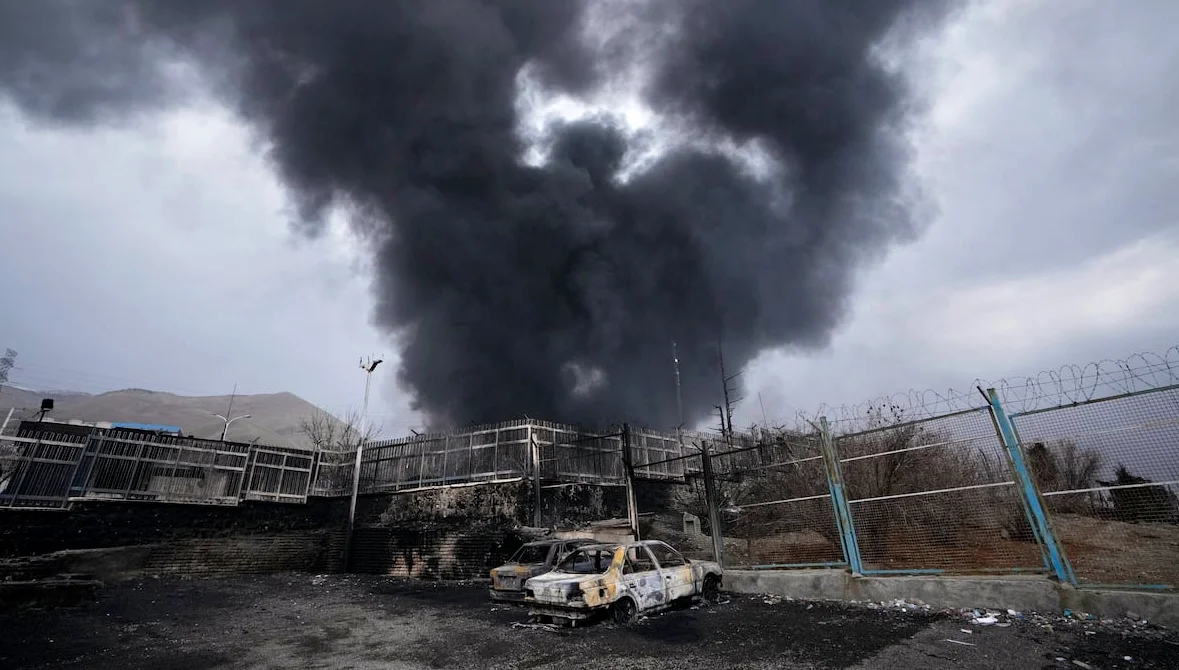
President Donald Trump has sent conflicting signals about the end of the 11-day-old war with Iran, touting progress in military operations while warning of harsher responses if the conflict escalates further. The U.S. military said it has struck more than 5,000 targets in Iran so far and damaged or destroyed more than 50 Iranian vessels as Trump touted progress in the conflict.
Trump’s Contradictory Stance
In a phone call with CBS News on Monday, Trump said, ‘the war is very complete.’ However, at a later event with Republican lawmakers in Miami, he struck a more open-ended tone, stating the U.S. still needed to achieve ‘ultimate victory.’
‘I will not allow a terrorist regime to hold the world hostage and attempt to stop the globe’s oil supply,’ Trump said Monday. ‘And if Iran does anything to do that, they’ll get hit at a much, much harder level.’
In a late-night post on social media, Trump echoed that warning, telling Iran it would be hit ‘TWENTY TIMES HARDER’ if it tried to disrupt global energy supplies. His comments came as oil prices briefly hit nearly $120 a barrel on Monday before falling back after Trump suggested the war might end soon.
Escalating Regional Tensions
Iran launched drones and rockets across the Gulf countries on Tuesday, while Israel’s military said it conducted strikes against the financial infrastructure of the Iran-backed organization Hezbollah in Lebanon. The strikes targeted assets and storage facilities tied to the Al-Qard Al-Hassan Association, which finances weapons purchases and provides salaries for Hezbollah.
More than 1,200 people have been killed in Iran, nearly 500 in Lebanon and 11 people in Israel, according to figures from Iranian and Lebanese health officials and Israeli authorities. Seven U.S. soldiers have died in the war so far, the Pentagon says.
Iran’s Major Guard Corps (IRGC) said Tuesday that Iran, not the U.S., would have the final say on the end of the war. ‘Iran will determine when the war ends,’ IRGC spokesperson Ali Mohammed Naini told Iranian state media.
In an interview with PBS Newshour on Monday, Iran’s foreign minister, Abbas Araghchi, said he did not believe negotiating with the United States would ‘be on the table’ again. ‘We have a very bitter experience of talking with Americans,’ he said, pointing to indirect nuclear talks that were underway before the war and then collapsed once the fighting began.
Regional Responses and Diplomatic Moves
Lebanon’s president, Joseph Aoun, said Tuesday that Lebanon was ready to enter direct talks with Israel to put an end to the fighting there. An official briefed on the matter, speaking on condition of anonymity to discuss diplomatic affairs, told NPR that Israel saw positive signs from the Lebanese government in its approach to Hezbollah, but that the war would continue.
Iran’s missile and drone attacks continued across the Gulf on Tuesday. Saudi Arabia’s defense ministry said it intercepted and destroyed two drones over the kingdom’s oil-rich eastern region. Kuwait’s National Guard said it downed six drones in areas north and south of the country.
The United Arab Emirates also condemned what it called a drone attack targeting its consulate general in Iraq’s Kurdistan region, saying it caused material damage but no injuries. Iraq’s military said an airstrike killed at least five members of an Iran-linked militia in the city of Kirkuk, located near the border with Iran.
It wasn’t immediately clear who was behind the strikes. Turkey’s Defense Ministry said that a U.S. Patriot air defense system was deployed to its Malatya province as NATO takes steps to boost Turkey’s air defense amid missile threats from Iran.
Trump said Monday he was ‘disappointed’ that Iran had named Mojtaba Khamenei, the son of the slain Ayatollah Ali Khamenei, as its new supreme leader, arguing it would mean ‘more of the same problem’ for the country. Asked whether the new leader had ‘a target on his back,’ Trump said it would be ‘inappropriate’ to comment.
In an interview with CNN Monday, Israel’s foreign minister, Gideon Sa’ar, declined to rule out assassination plans targeting Khamenei, saying Israel would not disclose operational steps in advance. ‘We never in a war declare what will be our operational steps or actions for that kind of thing,’ Sa’ar told CNN. ‘You will have to wait and see.’
Australia has granted humanitarian visas to five members of Iran’s women’s soccer team, after they sought protection over fears of reprisals for refusing to sing Iran’s national anthem during a match. The women, who were visiting Australia for a tournament when the war broke out, were later labeled ‘traitors’ on Iranian state television, fueling concerns about their safety if they returned home.
The announcement came after calls from rights groups in Australia and by President Trump for the Australian government to help the women. On Tuesday, Australian police said five of the women were transferred ‘to a safe location’ after they made asylum requests. It wasn’t immediately clear whether the other 21 team members would be returning to Iran.






Comments
No comments yet
Be the first to share your thoughts