

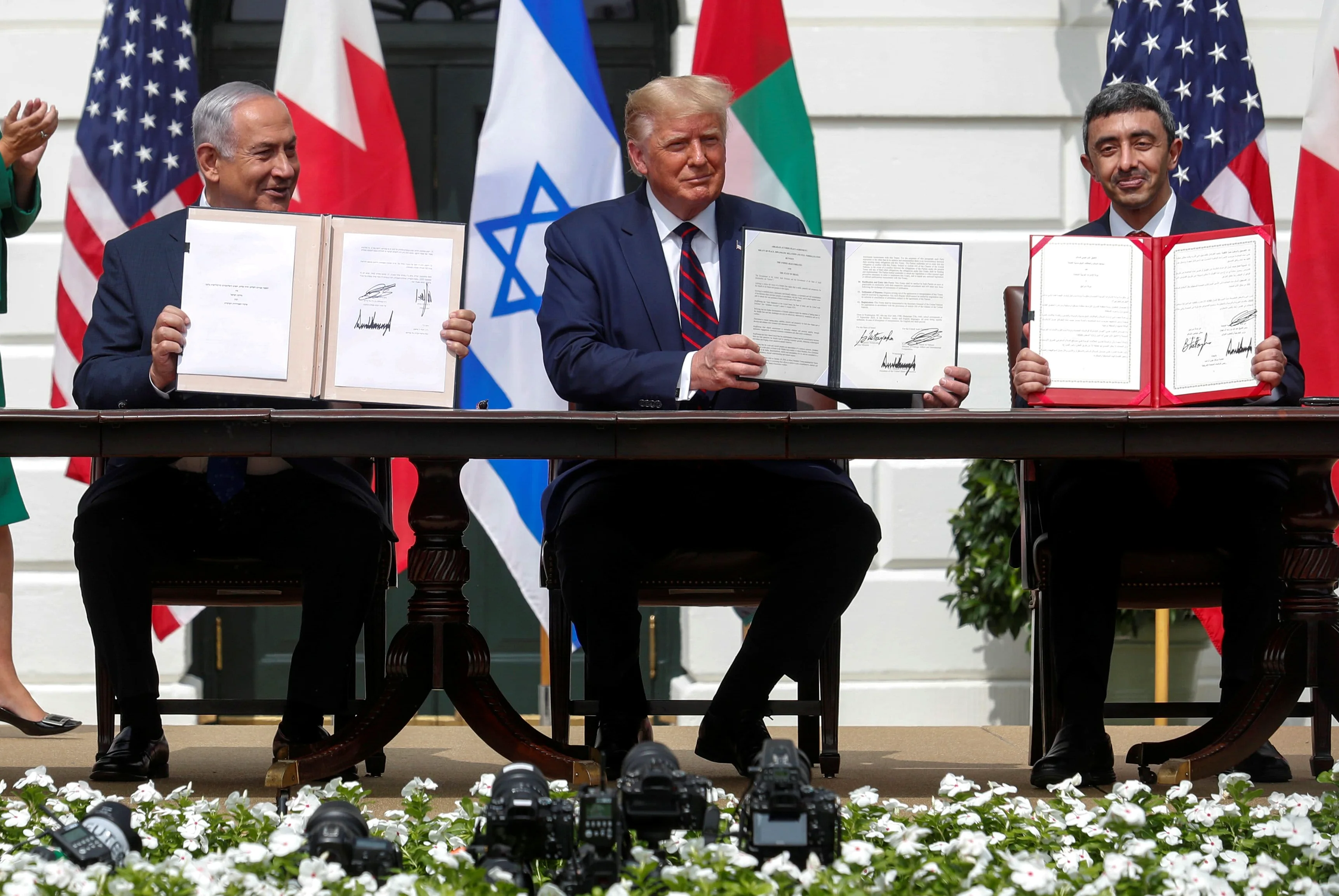
U.S. President Donald Trump said on Monday that he asked Saudi Arabia, Qatar, Pakistan, Turkey, Egypt and Jordan to join the Abraham Accords en masse to normalize relations with Israel as he tries to negotiate an agreement to end the war with Iran. Pakistan rejected the proposal. None of the other countries has so far publicly reacted to Trump’s demand and a positive response was unlikely when the public mistrust of Israel in these Muslim nations remains high over the scale of its military offensive in Gaza.
Trump’s diplomatic outreach and regional tensions
Trump said he spoke on Saturday to leaders of those countries, as well as the United Arab Emirates and Bahrain, which have already signed the accords, a set of agreements to normalize relations with Israel. “I am mandatorily requesting that all Countries immediately sign the Abraham Accords, and that, if Iran signs its Agreement with me, as President of the United States of America, it would be an Honor to have them also be part of this unparalleled World Coalition,” Trump wrote in a post on Truth Social. He cited “all the work done by the United States to try and pull this very complex puzzle together.”
Trump’s statement reflected an attempt to use Iran ceasefire diplomacy for a wider push around the Abraham Accords, according to a Pakistani source familiar with the matter, who also said the two issues were “not interlinked and cannot be made so.” “Pakistan is under no compulsion to adhere to any such demand,” the source said. Israeli Prime Minister Benjamin Netanyahu’s office also did not immediately respond to a request for comment on Trump’s post.
Kasakhstan to join Abraham Accords
Separately, U.S. President Donald Trump announced that Kazakhstan will join the Abraham Accords. The agreements, negotiated during Trump’s first term, aim to normalize relations between Israel and predominantly Muslim countries. “Heute stehen immer mehr Nationen Schlange, um durch meine Abraham-Abkommen Frieden und Wohlstand zu erreichen,” Trump wrote on Truth Social. With regard to Kazakhstan, he added: “Wir werden bald eine feierliche Unterzeichnungszeremonie ankündigen, um es offiziell zu machen – und viele weitere Länder wollen diesem Club der Stärke beitreten.”
The announcement followed a phone call between Trump, Israeli Prime Minister Benjamin Netanyahu, and Kazakhstan’s President Kassym-Schomart Tokayev. The Kazakh government stated the matter is in the final phase of negotiations. “Unser geplanter Beitritt zu den Abraham-Abkommen ist eine natürliche und logische Fortsetzung des außenpolitischen Kurses Kasachstans – basierend auf Dialog, gegenseitigem Respekt und regionaler Stabilität,” said the government in a statement.
Regional military dynamics and Trump’s strategy
Meanwhile, Israel and the U.S. have been engaged in military operations against Iran. On February 28, Israel and the U.S. launched a joint attack on Iran, which responded with counterattacks on Israel and U.S. military bases in the region. Ayatollah Ali Khamenei, Iran’s long-time leader, was killed in the attacks. His son, Mojtaba Khamenei, has become Iran’s new political and spiritual leader.
The U.S. and Iran agreed on a two-week ceasefire on April 8. The U.S. suspended its attacks under the condition that Iran open the Strait of Hormuz. Since April 13, the U.S. military has blocked Iranian ports at the Strait of Hormuz. On April 21, Trump announced an extension of the ceasefire until Iran proposes an end to the war. All negotiations so far have failed.
Israeli Prime Minister Benjamin Netanyahu has also announced an escalation of attacks on the pro-Iranian Hezbollah militia in Lebanon. He stated Israel is in a “Krieg mit der Hisbollah,” and aims to “zerschlagen” the group. Hezbollah has been attacking Israel with various types of drones, Netanyahu added. A special team is working to address the issue.






Comments
No comments yet
Be the first to share your thoughts