

 The Guardian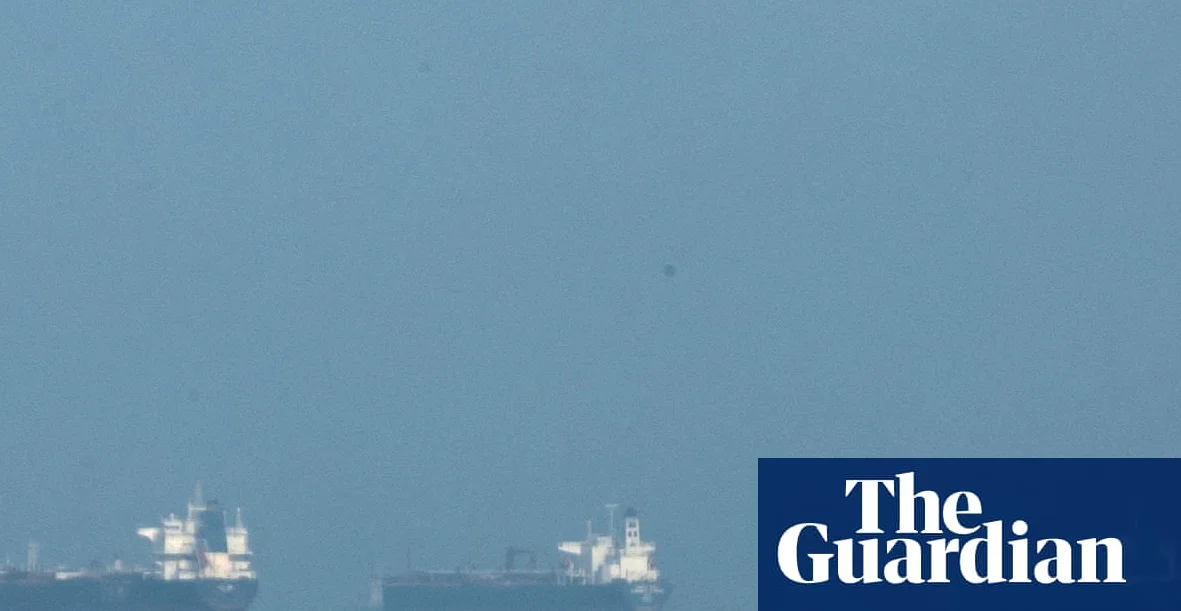
Only two vessels not linked to Iran or Russia have braved the ‘chicken run’ through the Strait of Hormuz since US President Donald Trump announced his commitment to ensure the ‘free flow of energy to the world,’ according to maritime records. The Strait of Hormuz, a critical global chokepoint, has seen a dramatic decline in shipping activity following the escalation of tensions between the US, Israel, and Iran.
Shipping Activity Remains Sparse Despite Trump’s Promises
Maritime tracking data indicates that since Trump’s announcement on Friday, only two non-Iranian and non-Russian vessels have attempted the perilous journey through the Strait of Hormuz. One of these, the Shenlong, a Chinese-built vessel operated by Greece’s Dynacom Tankers Management under a Liberian flag, crossed the strait on Friday and switched off its transponder as it approached the area. It reactivated its transponder near India’s coastline on Monday as it headed toward Mumbai.
A second vessel, the Sino Ocean, a bulk carrier also flying a Liberian flag, signaled it was Chinese-owned and crewed as it passed through the strait after loading cargo at the UAE’s Mina Saqr port. Both vessels have taken measures to avoid detection and potential attacks, highlighting the ongoing risks in the region.
Iran’s Closure of the Strait Has Severe Implications
The Strait of Hormuz, which handles about 20% of the world’s petroleum consumption and roughly one-fifth of the world’s liquefied natural gas daily, has effectively been closed by Iran in response to US and Israeli military actions. According to records, only eight other vessels have entered or exited the Gulf through the strait over the weekend, and all are linked to Iran or Russia.
Among these are the Dalia, an oil tanker flying the Iranian flag, and the Parimal, an oil/chemical tanker identified by US authorities as having transported Iranian oil. On Monday, the Cume, a tanker previously hit with US sanctions for shipping Iranian crude, left the Gulf through the strait. Two liquefied petroleum gas (LPG) carriers, Danuta I and HH Glory, also passed through the strait, both linked to Iran or Russia.
The limited movement of vessels highlights the strategic importance of the Strait of Hormuz and the impact of the ongoing conflict. Before the attacks, the strait handled a massive volume of global energy trade, and its current state has led to a sharp increase in oil prices, which surged to $119 a barrel, the highest since 2022, before dropping below $90 following Trump’s remarks that the war with Iran could end ‘very soon.’
Trump’s Insurance Plan Fails to Attract Shipowners
On Friday, Trump announced a $20 billion reinsurance scheme to revive shipping through the strait, stating it would come into effect immediately. He also urged shipowners to ‘show some guts’ by sailing through the war zone. However, despite the promise of financial backing, only a handful of vessels have attempted the journey.
Matthew Wright, lead freight analyst at Kpler, noted that while high freight rates could incentivize shipping, the primary concern for shipowners remains the risk of missile or drone attacks. ‘Even record-high freight rates have failed to break the deadlock,’ Wright said. ‘Shipowners are primarily concerned with the risk of missile or drone attacks, and until there is a material improvement in the security environment, flows are likely to remain extremely limited.’
Wright further explained that Iran’s ability to strike targets and vessels remains a significant concern. ‘A diplomatic solution would get flows back in the next one, two, maybe three weeks. China would be the main negotiator there, because the Asian economies are at huge risk. Otherwise, we are looking for more than a month to wait for a deterioration of the Iranian capability.’
He also warned that if Iran adopts a more decentralized warfare approach, akin to the tactics used by the Houthi rebels in Yemen, it could significantly prolong the standoff. ‘This could take months, which is particularly concerning from an energy flows point of view.’
Meanwhile, G7 finance ministers convened on Monday to discuss measures to support global energy supply but left without a consensus on releasing strategic crude reserves. Such a move would mark the first release of such reserves since 2022, following Russia’s full-scale invasion of Ukraine.
The situation highlights the complex interplay between geopolitical tensions, energy security, and economic stability. As the conflict continues, the world watches closely to see whether diplomatic efforts can restore the free flow of energy through one of the most critical global shipping lanes.






Comments
No comments yet
Be the first to share your thoughts