

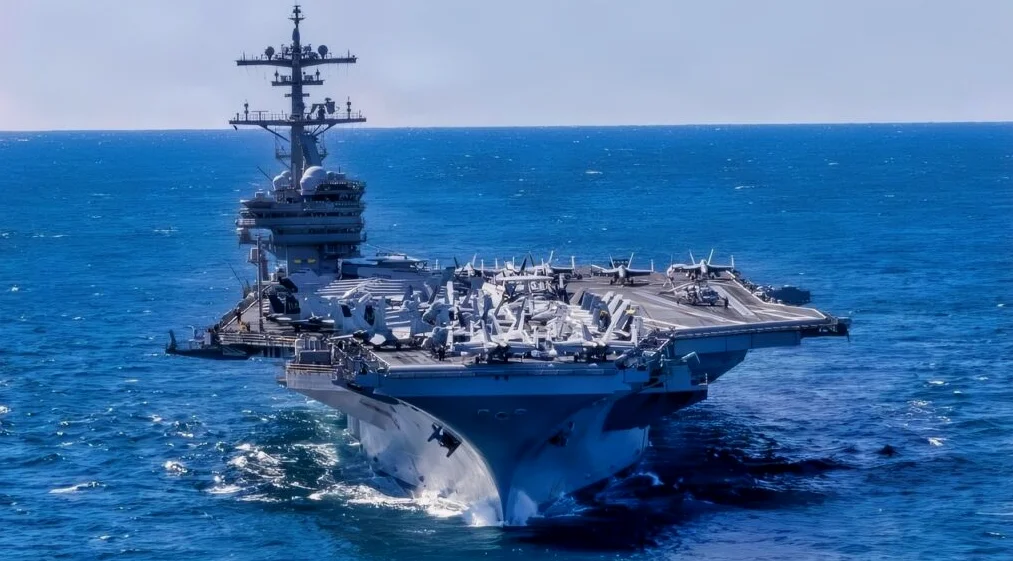
Two U.S. aircraft carrier strike groups have begun assembling near Iranian waters, signaling a potential escalation in the region. This buildup comes amid reports that the Iranian regime executed over 35,000 protesters and bystanders, prompting President Donald Trump to declare the United States ‘locked and loaded’ and ready for action. However, critics argue that the administration’s strategy lacks clarity, risking a repeat of the failed 2025 Operation Rough Rider in Yemen.
Strategic Ambiguity and Past Failures
Unlike previous U.S. military interventions, which had clear objectives such as liberating Kuwait or establishing democracy in Iraq, the current approach to Iran remains nebulous. Analysts question whether the goal is regime change, pressure for a nuclear deal, or simply to deter further violence against protesters. If regime change is the aim, the administration must address what comes next — a task that has proven difficult in past conflicts.
Former President George H.W. Bush and Barack Obama faced similar challenges when their calls for regime change in Iraq and Syria, respectively, failed to materialize into sustained political transitions. Trump has sought to differentiate himself, but critics argue that his rhetoric without concrete plans risks repeating history.
Regime Change Challenges and Leadership Vacuum
Experts warn that without securing a viable transitional leader like former Crown Prince Reza Pahlavi or seizing key infrastructure such as the Kharg Oil Terminal, Iran may simply wait for a shift in U.S. political leadership. The regime, led by Supreme Leader Ali Khamenei, has demonstrated a willingness to endure pressure, believing it can outlast Trump’s administration.
Reza Pahlavi, a prominent opposition figure, has not yet emerged as a unifying force. His office remains in disarray, and his supporters appear more focused on internal disputes than on challenging the regime. Even if Pahlavi were to return to Iran, it is unclear if he could handle the complex security landscape without being targeted by regime loyalists.
Former CIA attempts to install alternative leaders in Iraq, such as Nizar al-Khazraji and Majid al-Khoei, ended in failure. Similarly, figures like Ayad Allawi failed to gain widespread support. These precedents suggest that regime change in Iran may be fraught with challenges, particularly without a clear successor to Khamenei.
Military Precision and Humanitarian Concerns
The Pentagon has demonstrated the capability to conduct precise strikes, such as targeting prison guard towers or walls. However, the effectiveness of such actions in preventing mass executions of protesters remains uncertain. If the Iranian regime were to escalate violence, the U.S. may find itself in a difficult position, unable to intervene without ground troops.
War games have considered scenarios in which Iran might attack its own infrastructure to blame the United States and provoke international outrage. Given the regime’s history of using such tactics, the U.S. must prepare for potential provocations that could justify further military action.
Trump has not yet clarified whether he would target the Islamic Major Guard Corps (IRGC), a key pillar of the regime. The IRGC is not a monolithic entity, with provincial units carrying out much of the regime’s dirty work. Securing arms caches across Iran’s vast territory without boots on the ground presents a logistical challenge.
Moreover, the administration’s failure to coordinate with local forces in Yemen during Operation Rough Rider has raised concerns about the effectiveness of current strategies. The deal Trump struck with the Houthis allowed them to continue targeting international shipping, benefiting China and Russia at the expense of Western allies.
If Trump is willing to make similar concessions in Iran, the regime may conclude that it can avoid a full-scale conflict. While Israel seeks to eliminate an existential threat, Trump may prioritize securing a Nobel Peace Prize over a thorough resolution to the crisis.
The Iranian leadership is likely calculating that the U.S. may not be willing to escalate beyond airstrikes or limited sanctions. This perception could embolden Khamenei to continue his crackdown on dissent, knowing that the U.S. may not be able to stop it without a ground invasion.
As the military buildup continues, the administration must clarify its objectives and prepare for the long-term consequences of its actions. Without a coherent strategy, the risk of failure remains high, with potential repercussions for U.S. credibility and regional stability.




Comments
No comments yet
Be the first to share your thoughts