

 BBC
BBC 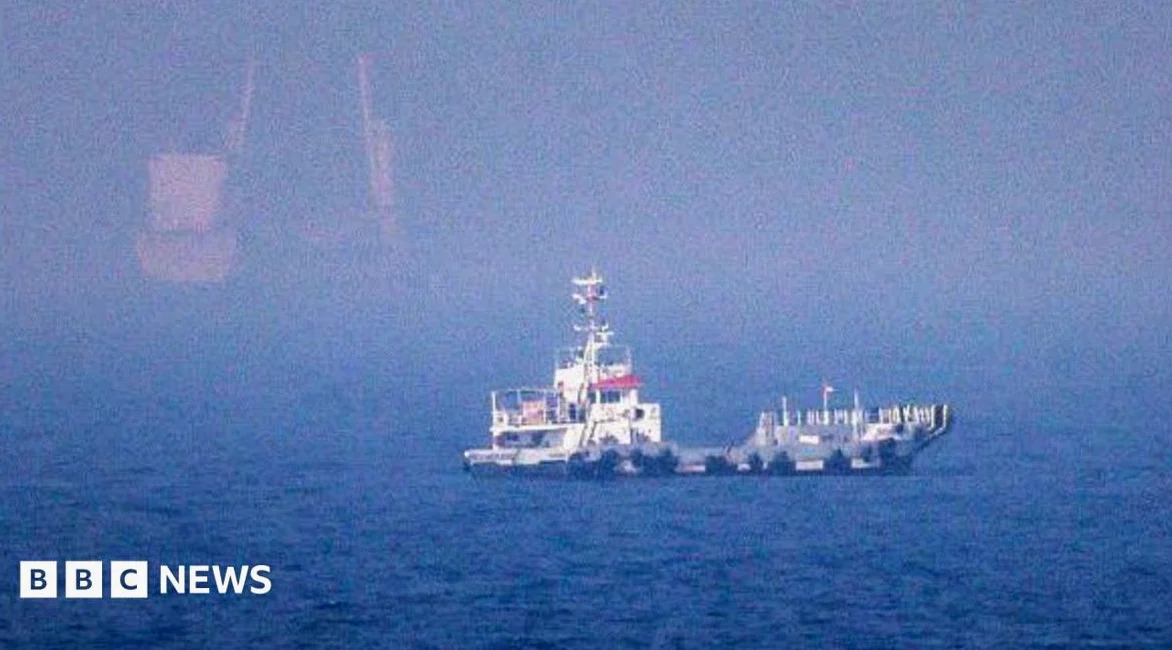
The United Arab Emirates (UAE) accused Iran of a ‘brazen’ attack on two tankers in the Strait of Hormuz on Monday, killing one crew member and wounding eight others, according to the BBC. The attack occurred as US President Donald Trump announced a new 20% charge as part of a naval blockade on the waterway.
UAE Condemns Attack, Iran Claims Defense
According to the UAE Ministry of Defence, an Indian crew member was killed and eight others—six Indian and two Ukrainian—were injured, with four in serious condition. The UAE condemned the attack as a ‘serious violation and a clear breach of international law,’ according to a statement on X.
In response. Iran’s Islamic Major Guard Corps (IRGC) confirmed the strikes via Telegram, claiming the tankers had ignored warnings, turned off navigation systems, and attempted to pass through a mined route. The IRGC said it had ‘disabled’ the tankers in response, and warned that ‘co-operation with the aggressor enemy’ would lead to further delays and a global energy crisis.
Trump Announces Blockade, Oil Prices Rise
Trump announced on Truth Social that the US would reinstate a naval blockade of Iranian ports and impose a 20% charge on all cargo shipped through the Strait of Hormuz. The blockade. Which went into effect at 16:00 Eastern Time (20:00 GMT) on Tuesday, aims to prevent ‘Iran’s ships or customers’ from using the waterway, while allowing ‘all other countries’ ‘fair and open use.’.
Trump said the US was ‘hitting them very hard’ and ‘controlling the Strait,’ and added that a peace deal was still possible. US Central Command (Centcom) confirmed that strikes were launched at 16:45 Eastern Time on Monday, targeting military sites in Iran, including Bushehr, Chah Bahar, Jask, Konarak, Abu Musa, and Bandar Abbas, in an effort to ‘further degrade Iran’s ability to attack commercial shipping.’
In response. Iran’s army reportedly targeted US military assets in Kuwait, and the IRGC said it destroyed weapons depots, a satellite communications center, and a building housing US forces in Bahrain. The IRGC also confirmed it had launched attacks on an air base in Jordan with ballistic missiles.
Oil prices rose in Asian trade on Tuesday, as Brent crude climbed 0.7% to $83.87 a barrel, and US-traded oil increased by 0.9% to $79.04; that followed a 9% jump in Brent prices on Monday as tensions escalated.
International Reactions and Legal Concerns
Iranian Foreign Minister Abbas Araghchi responded to Trump’s announcement by stating, ‘POTUS is absolutely right. Whoever provides secure and safe passage of commercial vessels through the Strait of Hormuz should be compensated for this service.’ However, he added that ‘20% is of course too much. We will be fair.’
The International Maritime Organization (IMO), the UN agency regulating global shipping, stated that it ‘stands firmly against charging fees for passage through straits used for international navigation.’ A spokesperson added that ‘there is no legal basis through which to introduce mandatory tolls simply to transit through a strait.’
Iran’s military headquarters had previously warned that it would not allow the US to ‘interfere in the management’ of the Strait of Hormuz. Ebrahim Zolfaghari. A spokesperson for Khatam al-Anbiya. Said that US actions in the strait have ‘seriously endangered regional security, international trade, and the passage of oil tankers and commercial vessels.’.
Trump’s announcement has raised questions about the legality of the 20% charge, particularly in the context of international law. The Strait of Hormuz, which handles about 25% of the world’s oil and 20% of global liquefied natural gas, lies within Iran and Oman’s territorial waters at the narrowest point. The US first imposed a naval blockade in April, redirecting 100 commercial vessels and disabling four under the blockade; the blockade was lifted in June as part of a ceasefire agreement, but disputes over the strait have resurfaced.

Comments
No comments yet
Be the first to share your thoughts