

 BBC
BBC 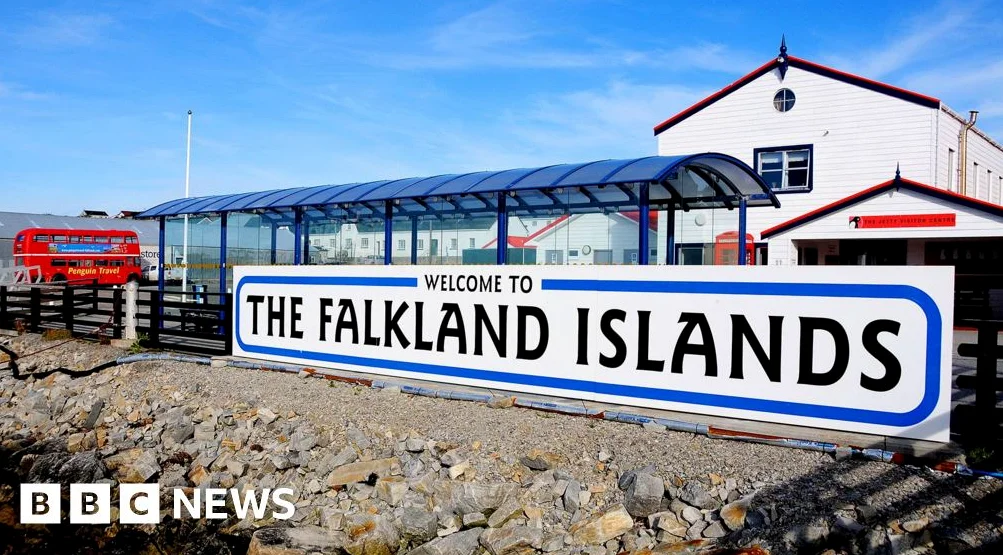
Sovereignty of the Falkland Islands “rests with the UK,” Downing Street has said, following a report the US could review its position on Britain’s claim to the territory. An internal Pentagon email reported by Reuters suggested the US was considering options to punish Nato allies it believed had failed to support its war on Iran.
US Considers Pressing Nato Alliances
A Pentagon spokesperson did not comment on the email’s existence, but said it would “ensure that the president has credible options to ensure that our allies are no longer a paper tiger and instead do their part.” “As President [Donald] Trump has said, despite everything that the United States has done for our Nato allies, they were not there for us,” the spokesperson added.
The Falkland Islands. A British overseas territory in the south-west Atlantic Ocean, remain the subject of a sovereignty dispute between Britain and Argentina. Asked about the report, a No 10 spokesman on Friday said: “The Falkland Islands have previously voted overwhelmingly in favour of remaining a UK overseas territory, and we’ve always stood behind the islanders’ right to self-determination and the fact that sovereignty rests with the UK.”
Historical and Current Positions
The prime minister’s official spokesman also said the government “could not be clearer about the UK’s position,” and that “sovereignty rests with the UK and the islanders’ right to self-determination is paramount.” He continued: “We’ve expressed this position previously clearly and consistently to successive US administrations and nothing is to change that.”
Lord West, who was an officer commanding HMS Ardent during the Falklands War, went on to describe US Defence Secretary Pete Hegseth as “thick” and accused him of having a total lack of understanding about Nato. “Hegseth talks about the fact that Nato’s never done anything for America, America’s done so much for Nato, but the only time that Article 5 was invoked was by Nato and it was to defend the United States,” he said. “I’m afraid he’s thick actually, and he doesn’t seem to have a very good knowledge of a lot of these things, but to say that is stupid.”
Under Nato’s Article 5, an armed attack against one or more members is considered an attack against all, and in response each other member would take “such action as it deems necessary, including the use of armed force, to restore and maintain the security of the North Atlantic area.” The only time Article 5 has been invoked was after the 9/11 attacks on the US in 2001.
Political Reactions and Diplomatic Tensions
Previous US administrations have formally recognised the UK’s de facto administration of the islands, but have not taken a formal position regarding sovereignty. “The Falkland Islands has complete confidence in the commitment made by the UK government to uphold and defend our right of self-determination,” the islands’ government said in a statement.
Conservative leader Kemi Badenoch said the reported US stance on the Falkland Islands was “absolute nonsense,” adding: “We need to make sure that we back the Falklands. They are British territory.” Reform UK’s Nigel Farage said: “This is utterly non-negotiable. There is no way we’re even going to have a debate about the sovereignty of the Falkland Islands.” He also said he would raise the issue with Argentina’s President Javier Milei when he meets him later this year.
Liberal Democrat leader Sir Ed Davey has once again called for the King’s forthcoming visit to the US to be cancelled. “This unreliable, damaging president cannot keep insulting our country,” Sir Ed said. The report emerged three days before King Charles III and Queen Camilla are due to travel to the US and meet Trump at the White House.
While the White House is yet to comment on the report, it could prove to be another point of friction between the US and UK at a time of diplomatic tension. Trump has previously said he is “not happy” with the level of support offered by the UK during its war in Iran, while Sir Keir Starmer has repeatedly said Britain will not be drawn into a wider conflict.
Meanwhile, an official from Nato – responding to the suggestion in the report that the US could push for Spain’s expulsion from the military alliance – said its founding treaty “does not foresee any provision for suspension of Nato membership, or expulsion.” Earlier, Spain’s Prime Minister Pedro Sanchez said: “We do not work based on emails. We work with official documents and official positions taken, in this case, by the government of the United States.”






Comments
No comments yet
Be the first to share your thoughts