

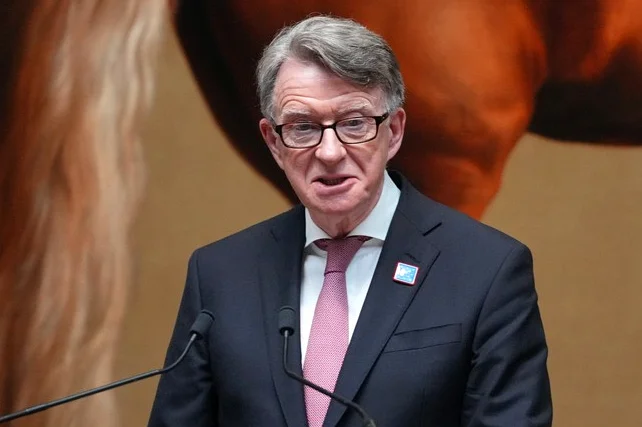
Peter Mandelson, a former UK government minister, was arrested in connection with a scandal involving the leaking of sensitive information, as the nation’s political landscape faces mounting pressure. According to the London Metropolitan Police, the 72-year-old was taken into custody on suspicion of misconduct in public office. While the force did not name Mandelson in its official statement, video footage of the arrest circulated widely, raising questions about the practicality of the UK’s legal tradition of not publicly naming suspects.
Impact on Political Stability
The arrest comes amid a turbulent period for the UK’s Labour Party, with Prime Minister Keir Starmer facing increasing scrutiny over his leadership. Analysts suggest that the scandal could further erode public confidence in the government, especially as the nation prepares for upcoming elections. The situation is reminiscent of previous scandals involving high-profile figures, including the recent controversy surrounding Prince Andrew.
Ed Morrissey, a political commentator, noted that the timing of the arrest coincides with a broader political reckoning in the UK. ‘The more unpredictability one creates, the more disincentives one creates for investors,’ he said, highlighting the potential impact on both the economy and the political climate.
Market Volatility and Economic Concerns
The financial markets also experienced turbulence, with the Dow Jones Industrial Average dropping about 1.6%, or more than 800 points, in afternoon trading. Major financial institutions such as American Express, Goldman Sachs, and JPMorgan saw significant declines. The drop was attributed, in part, to concerns about the economic fallout from artificial intelligence, as reported by Citrini Research.
Ed Morrissey suggested that the market’s reaction reflects a broader demand for stability and predictability. ‘This isn’t a massive drop, but it is a signal that investors would like to see more stability and predictability,’ he said, noting that the White House may need to address these concerns as it handles upcoming political challenges.
Political Rhetoric and Public Perception
In a separate development, California Governor Gavin Newsom faced criticism for remarks that many interpreted as racially insensitive. The comments, which assumed that Black individuals had lower SAT scores and reading abilities, were met with widespread condemnation. However, Newsom did not directly address the criticism, instead choosing to deflect by claiming he was being criticized for being dyslexic.
John Hinderaker, a political analyst, noted that Newsom’s response was ineffective. ‘Newsom is running for President, Trump isn’t. And Trump has never done anything as overtly racist as Newsom’s insulting remarks in Georgia,’ he said, emphasizing the contrast between the two politicians’ approaches to criticism.
Ed Morrissey added that Newsom’s attempt to reframe the issue as a personal struggle with dyslexia did little to mitigate the perception of condescension. ‘Newsom knows precisely where his birth certificate is: in the records of the county in which he was born,’ he said, highlighting the absurdity of Newsom’s claims.
The controversy over Newsom’s remarks is part of a broader pattern seen in the campaigns of other Democratic candidates, including Hillary Clinton and Kamala Harris. According to Axios, internal Democratic officials concluded that Kamala Harris lost significant support due to the Biden administration’s handling of the Israel-Gaza conflict. The report, which remains confidential, was compiled after closed-door conversations with pro-Palestinian groups.
Activists from the IMEU Policy Project argued that the Biden-Harris administration’s support for Israel alienated some young voters and progressives. However, critics of this analysis suggest that the administration’s stance on the conflict may have also alienated those who supported a stronger response to the Hamas-led attacks on Israel.
Meanwhile, tensions within the Republican Party continue to escalate. According to Eli Lake of The Free Press, Donald Trump has grown increasingly frustrated with Tucker Carlson’s critical stance on Israel. Trump has privately urged Carlson to end his feud with pro-Israel MAGA influencers, warning that the division is harming the party’s chances in upcoming elections.
Despite these efforts, Carlson’s recent interview with Mike Huckabee, the U.S. ambassador to Israel, did not lead to a reconciliation. Instead, it opened a new front in the ongoing conflict, further complicating Trump’s political strategy. Ed Morrissey suggested that Trump should consider distancing himself from Carlson, particularly after the contentious interview.
As the political landscape continues to shift, the implications for both the UK and the United States remain unclear. With elections looming and public sentiment increasingly polarized, the next few months will be critical in determining the trajectory of both nations’ political and economic futures.

Comments
No comments yet
Be the first to share your thoughts