

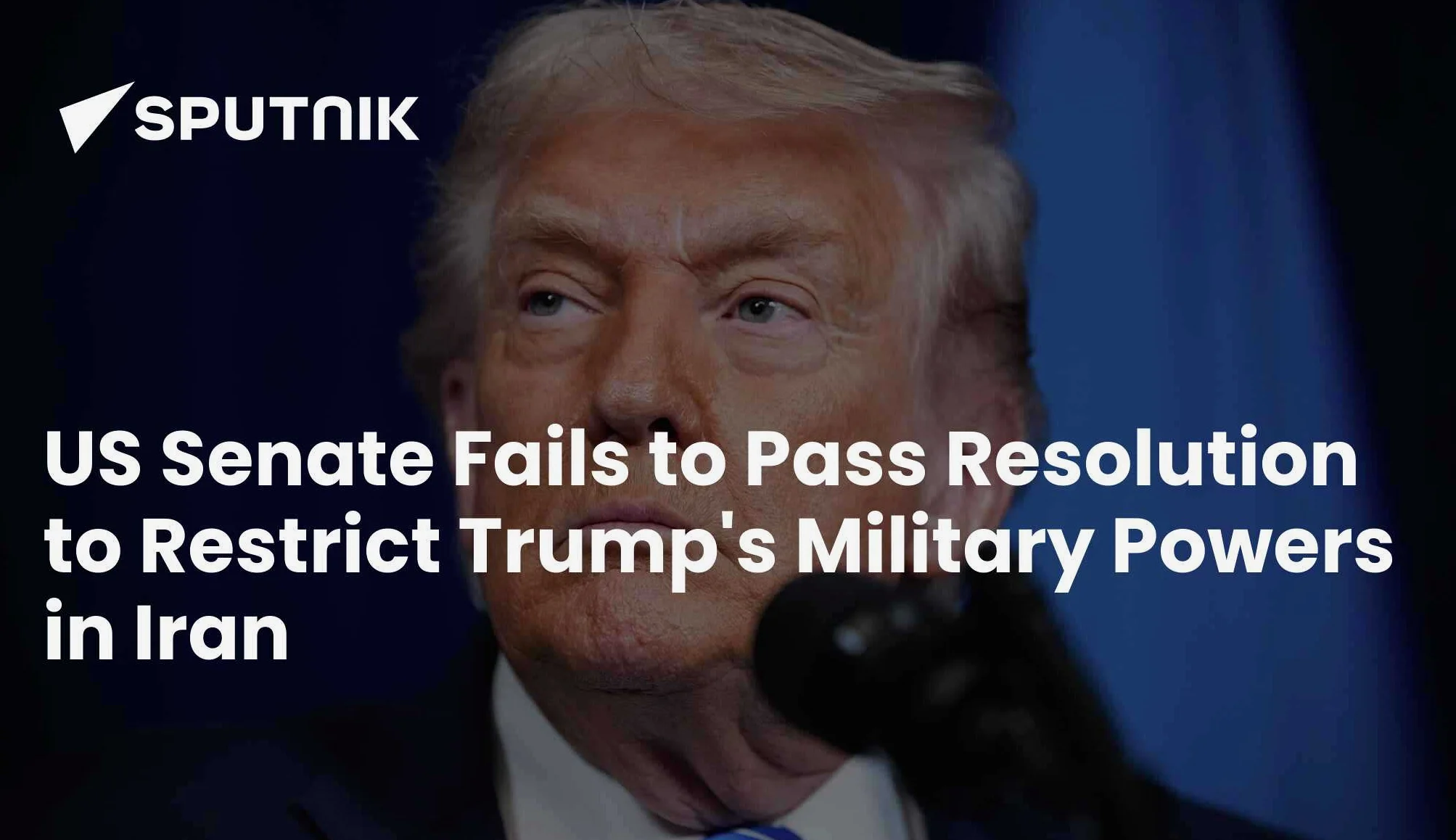
The US Senate has failed to pass a resolution aimed at restricting President Donald Trump’s military powers in Iran, with 47 senators supporting the measure and 53 opposing it. The proposed legislation would have prohibited the use of US military force against Iran without explicit congressional approval, requiring the president to end any unauthorized military involvement within 30 days unless it was to repel an imminent threat or direct attack on the United States, its territories, citizens, or military.
Background on the Resolution
The draft resolution, which was recently reviewed by Sputnik, sought to impose stricter checks on presidential authority in matters of war and military engagement, particularly in the context of Iran. It would have required the president to seek congressional approval before launching any military action against Iran, a move that Democrats had argued was necessary to uphold constitutional checks and balances.
According to the resolution, any unauthorized military involvement by American forces in Iran would have to be terminated within 30 days unless it was in direct response to an imminent threat or attack on the US. This would have effectively placed a time limit on any unapproved military operations, a key point of contention between the executive and legislative branches.
Recent Strikes and Political Fallout
The resolution comes in the wake of recent US and Israeli strikes on Iran, which took place on February 28 and targeted multiple locations, including Tehran. The attacks reportedly caused damage and civilian casualties, prompting Iran to retaliate with strikes on Israeli territory and US military bases across the Middle East.
In the aftermath of the strikes, dozens of congressional Democrats sharply criticized the Trump administration for escalating risks and bypassing constitutional requirements. They demanded clear justification for the operation’s objectives and greater transparency before both Congress and the American public.
Democrats argued that the administration’s actions lacked the necessary legal and political justification, and that the absence of congressional approval violated the separation of powers outlined in the US Constitution. The resolution was seen as a direct response to these concerns, aiming to prevent future unilateral military actions without legislative backing.
What’s Next for Congress and the Administration
With the Senate’s failure to pass the resolution, the issue of presidential military authority in Iran is likely to remain a contentious point in the coming months. Analysts suggest that the debate could resurface during the next session of Congress, particularly if further military engagements occur or if the administration faces increasing pressure from lawmakers.
According to political observers, the outcome of this vote highlights the growing divide between the executive and legislative branches over the conduct of foreign policy and the use of military force. The resolution, while not passed, may still influence future legislative efforts aimed at curbing presidential power in matters of war.
Senators who supported the resolution argued that the current situation highlights the need for stronger legislative oversight in foreign policy decisions, particularly when it comes to military actions that could have significant consequences for US citizens and global stability.
Meanwhile, the Trump administration has yet to comment on the Senate’s decision, though it is expected to continue defending its approach to Iran as a matter of national security and strategic interest.
As tensions in the Middle East continue to evolve, the debate over the balance of power between the executive and legislative branches is likely to remain a central issue in US politics, with implications for both domestic and international policy.





Comments
No comments yet
Be the first to share your thoughts