

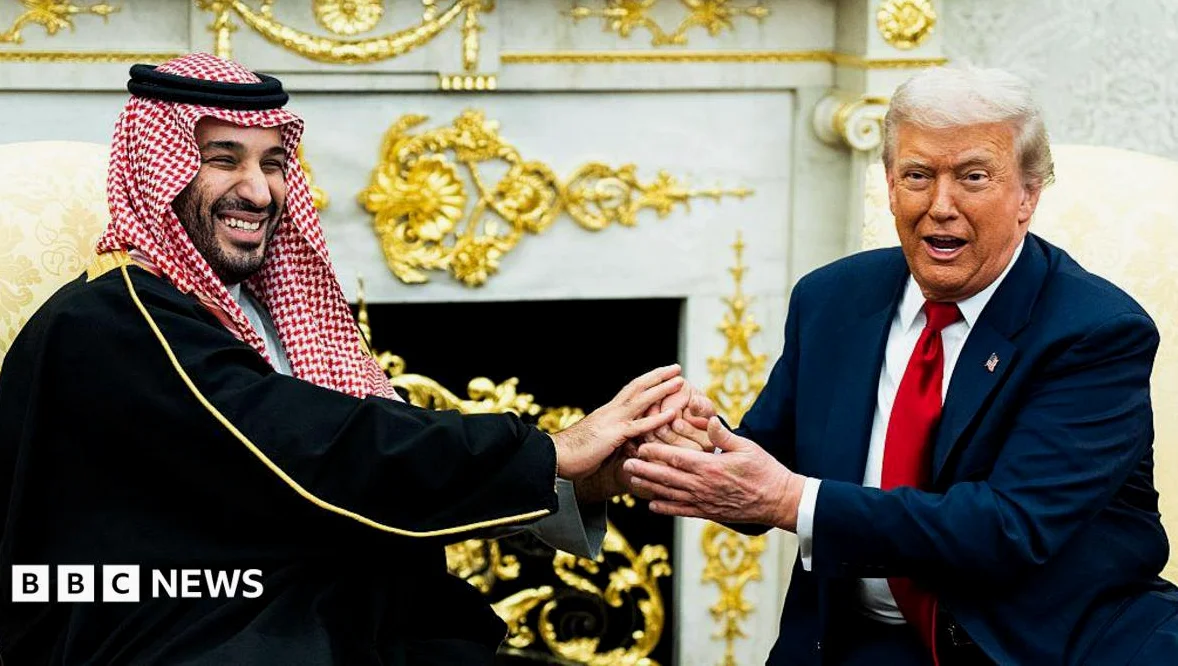
The U.S. signed a landmark nuclear cooperation agreement with Saudi Arabia on Wednesday, the Energy Department announced on X. U.S. Secretary of Energy Chris Wright and Saudi Minister of Energy HRH Prince Abdulaziz bin Salman signed a peaceful nuclear cooperation agreement, commonly known as a 123 agreement, alongside an accompanying bilateral safeguards agreement. These agreements lay the legal foundation for a decades-long, multi-billion-dollar partnership that advances several priority economic and strategic objectives, including nuclear nonproliferation.
According to Wright. These agreements uphold the highest standards of nuclear safety and nonproliferation, while relying on the world’s best nuclear technology and scientists, designed right here in the United States. A senior administration official told NBC News that President Donald Trump had approved the deal, as the U.S. will support creating a nuclear power program and American companies will build the program in the kingdom under the agreement.
The deal is not expected to require the most rigorous level of U.N. inspections or include a ban on uranium enrichment or reprocessing of spent nuclear fuel, according to three people familiar with the agreement. The pact would allow U.S. companies to build a uranium enrichment facility in Saudi Arabia pending a joint U.S.-Saudi study examining whether such a step would be feasible. The text of the deal has not been released, and the administration has not publicly outlined its details.
Strategic Considerations and Congressional Review
A civil nuclear deal with Saudi Arabia has been in the works for years during both Donald Trump’s first administration and that of former president Joe Biden. No deal has come together before now, in part because of warnings from nonproliferation groups who say that it could offer Saudi Arabia a path to develop a nuclear weapon. The deal will be submitted to Congress for review, where it could face opposition among lawmakers who fear a lack of monitoring safeguards to restrict Saudi Arabia’s uranium enrichment.
Saudi Arabia has in the past said it would need a nuclear weapon if Iran acquired one, an intention Iran has repeatedly denied. But in lengthy talks stretching over more than one administration, the U.S. also feared that Riyadh would look elsewhere for nuclear technology if the U.S. did not provide what it wanted. Saudi Arabia has long said if it does not partner with the U.S., it could partner with China or Russia which have different proliferation standards.
Regional Implications and Israeli Statements
Israeli Prime Minister Benjamin Netanyahu told the U.N. General Assembly on Friday that Israel is “at the cusp” of a historic breakthrough leading to a peace agreement with Saudi Arabia, without outlining a clear path over the significant obstacles facing such an accord. He displayed contrasting maps showing Israel’s isolation at the time of its creation in 1948 and the six countries that have normalized relations with it, including four that did so in 2020 in the so-called Abraham Accords.
There are several hurdles in the way of such an agreement, including the Saudis’ demand for progress in the creation of a Palestinian state — a hard sell for Netanyahu’s government, the most religious and nationalist in Israel’s history. The Saudis are also seeking a defense pact with the United States and want help in building their own civilian nuclear program, which has fueled fears of an arms race with Iran. Saudi Arabia’s Crown Prince Mohammed bin Salman said in an interview with Fox News this week that the two sides are getting closer to an agreement, without providing much detail about the U.S.-led negotiations.
Economic and Energy Objectives
According to the U.S. energy department, the Saudi partnership agreed on Wednesday is expected to expand American nuclear technology exports, create “high-paying” U.S. jobs, and “strengthen America’s energy and national security posture.” The U.S. administration urged support for the U.S.-Saudi nuclear deal in a report to Congress earlier this year, in part to “prevent strategic competition from seizing an opportunity to undermine United States national security interests for decades to come.”
The report also argued that the U.S. must seize the opportunity to expand nuclear cooperation to “re-establish our leadership in the global civilian nuclear energy market and reap the benefits of expanded influence in foreign countries hosting our reactors.” This strategic shift aligns with broader efforts to back U.S. influence in the Middle East while addressing long-standing concerns about regional stability and proliferation risks.




Comments
No comments yet
Be the first to share your thoughts