

 BBC
BBC 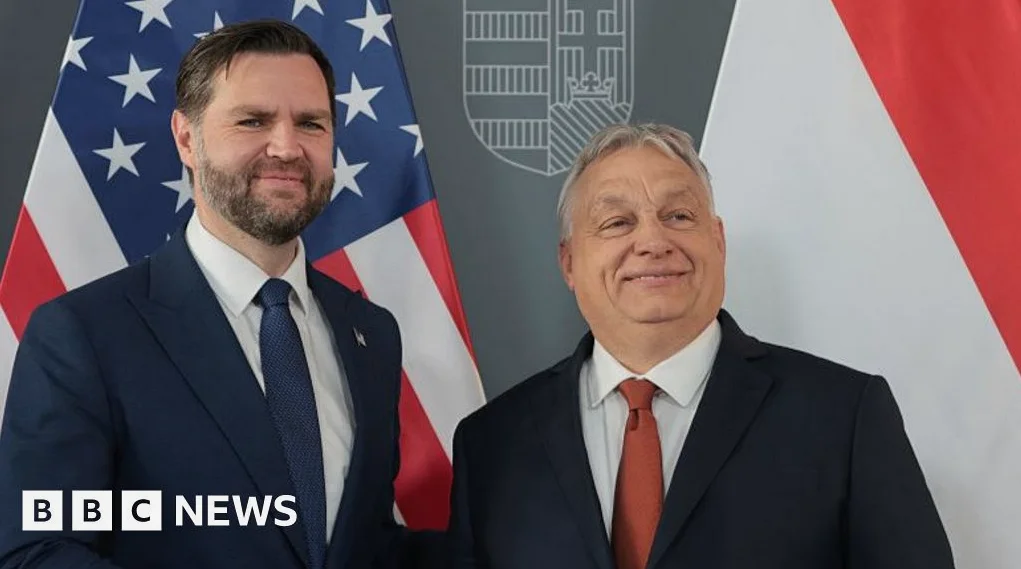
US Vice-President JD Vance has made a high-profile visit to Budapest just five days before Hungarians are set to vote in an election that could end Viktor Orbán’s 16-year rule, according to the BBC. During his visit. Vance expressed strong support for Orbán, stating he was there to help the Hungarian prime minister in his campaign cycle, although he added the US would work with whoever wins the election.
Vance’s Support for Orbán Amid Political Challenges
Vance’s visit marks the first top-level US engagement with Hungary in 20 years and comes as Orbán faces his toughest challenge in a political career spanning nearly four decades. The Hungarian leader. Who has won four consecutive elections since 2010, is now locked in a tight race against his main rival, Péter Magyar, who is well ahead in most opinion polls.
Orbán is a key European ally of the Trump administration and maintains close ties with Russian President Vladimir Putin, making him a strategic partner for the US in Europe. During his visit. Vance and his wife Usha were welcomed by Hungarian Foreign Minister Péter Szijjártó, who credited Orbán’s friendship with Donald Trump for creating a ‘new golden age’ in bilateral relations.
Péter Magyar responded to the visit by stating that his Tisza party welcomed Vance to Budapest and emphasized that if his party comes to power, the US would be considered a prominent partner, both as a NATO ally and an economic partner.
Criticism of the EU and Ukraine
Vance launched a sharp critique of the European Union and Ukraine following his talks with Orbán. He accused the EU of ‘one of the worst examples of foreign election interference that I have ever seen or ever even read about… because they hate this guy,’ according to the BBC. He also stated that part of the reason for his visit was to highlight ‘interference that’s come from the bureaucracy in Brussels has been truly disgraceful.’
EU leaders have been frustrated for weeks over Orbán’s decision to veto billions of euros in essential funding for Ukraine, despite agreeing to it in December. German Chancellor Friedrich Merz referred to the move as ‘a gross act of disloyalty,’ but EU officials have avoided direct involvement in the Hungarian election campaign.
Vance’s remarks echoed a speech he gave in Munich in February 2025, in which he accused European leaders of restricting freedom of speech; he also repeated unsubstantiated claims that Ukrainian intelligence services had interfered in the Hungarian election, without providing any evidence.
Orbán has made opposition to Ukraine and its president, Volodymyr Zelensky, a central theme of his campaign. When explosives were found near the TurkStream gas pipeline, close to the border with Hungary, Orbán and pro-government media labeled the incident a terror attack on Hungary’s energy supply. Ukraine quickly denied any involvement, suggesting it was a ‘Russian false-flag operation.’
Trump’s Endorsement and Energy Ties
Vance’s visit follows a long-standing relationship between Trump and Orbán, dating back to 2016 when Orbán was the first and only EU leader to support Trump in the US presidential election. Orbán strongly backed Trump for re-election in 2024 and visited Washington last October to secure an exemption for Hungary from US sanctions on Russian oil giants Rosneft and Lukoil.
Trump later indicated that the exemption was a personal deal between himself and Orbán, suggesting that if Orbán lost the election, his successor would have to re-apply for the exemption. Hungary has been almost alone among EU countries in resisting calls to reduce its reliance on Russian fossil fuels.
In Washington. Orbán committed to increasing imports of US liquefied natural gas (LNG), as well as US nuclear technology and fuel; However, Hungary relies heavily on Russian oil through the Druzhba pipeline from the east and Russian gas through the TurkStream pipeline from the south. Both sources are now problematic. As no oil has reached Hungary through the Druzhba pipeline since the end of January.
Orbán blames Ukraine for failing to restore the pipeline after a Russian attack on oil infrastructure in western Ukraine on 27 January. To prevent shortages, Hungary has had to release fuel reserves and import non-Russian oil through an alternative pipeline from Croatia.
Recent scandals, including leaked private conversations between Foreign Minister Szijjártó and top Russian officials, have also dented Orbán’s popularity. Transcripts suggest that Szijjártó regularly informed the Russian government about confidential discussions at EU summits and lobbied to have Russian officials removed from sanctions lists at Moscow’s request. Szijjártó has defended the calls as ‘normal diplomacy.’
Orbán has been accused by the European Parliament of running a ‘hybrid regime of electoral autocracy,’ and Hungary is now assessed as the most corrupt country in the EU by Transparency International. Large state projects have been awarded to figures within Orbán’s inner circle, and the main media companies have been acquired by his allies. Billions of euros of EU funding have been withheld from the government due to concerns over failings in the rule of law.






Comments
No comments yet
Be the first to share your thoughts