

 The Guardian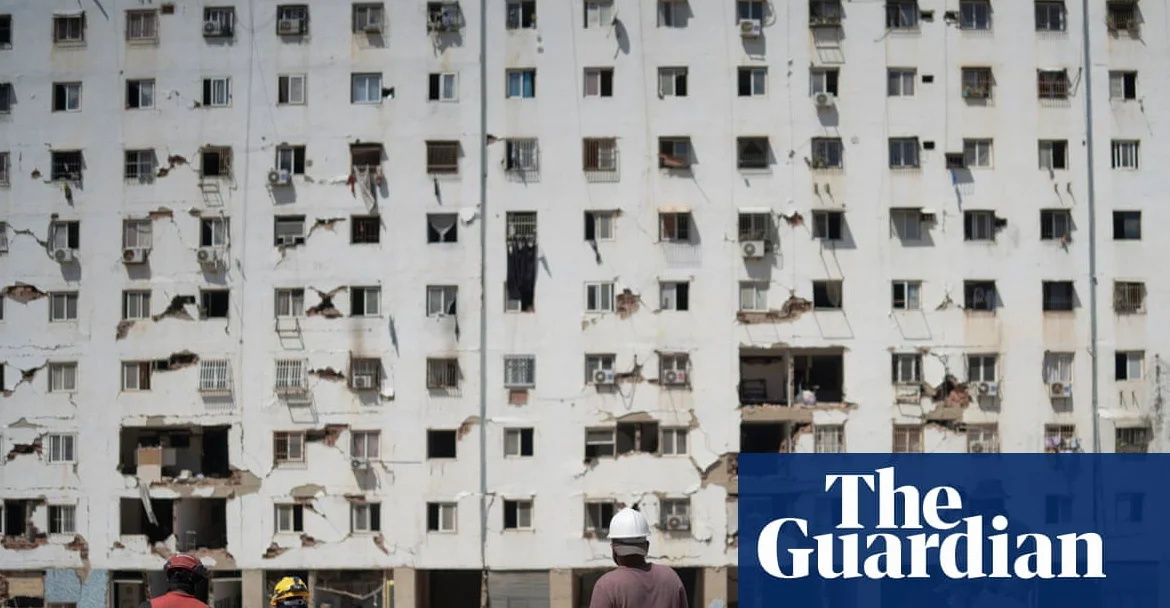
Even before two powerful earthquakes devastated the OPPE 25 government housing project, the foundations of Hugo Chávez’s populist “Bolivarian” revolution were shaking in what was once a hotbed of support.
From Hope to Disillusionment
Gabriel González, a 45-year-old construction worker, recalls his joy when he received the keys to his freshly completed apartment in 2013. The tower block, built in an affluent corner of Caraballeda, was one of the 12-floor buildings ordered by Chávez. González had spent two years in an emergency shelter after losing his home in deadly mudslides before receiving his new home near the beach.
“It was wonderful,” González said. “The Chávez government helped the poor so much … Back then, everyone was on Chávez’s side.” But shortly after he moved in, Chávez died, and over the following years, González’s feelings, and those of many neighbors, began to sour. Years of poverty, mass migration, hyperinflation, and authoritarian rule under Chávez’s successor, Nicolás Maduro, fueled widespread discontent.
“Everyone around here said the Bolivarian revolution … was no more – that it was no longer the same,” González said. His siblings fled to the US and Brazil. “Unfortunately, what happened is that it became a dictatorship.”
Earthquake Adds to Crisis
Last month’s twin earthquakes devastated Venezuela’s north coast and revealed a revolution in ruins. Chávez’s heirs struggled to respond to a catastrophe for which they seemed woefully unprepared.
“We don’t have a government,” González said, standing by the donated tent where he now sleeps on a golf course near his obliterated home. Two weeks after the disaster, his 22-year-old son, Daniel, and mother-in-law, Esmeralda, are still missing. His family squats by the wreckage as they wait for news.
Like many residents of La Guaira, the northern state worst hit by the disaster, González criticized the sluggish reaction of Venezuela’s acting leader, Delcy Rodríguez, the former vice-president who was installed in January after Maduro was abducted by Donald Trump.
“Unfortunately, I haven’t seen anyone here. I haven’t seen a governor. I haven’t seen a mayor,” González said. He spent 24 hours buried under the rubble of OPPE 25 with his wife, Rosa, before they were rescued with hardly a scratch. The couple now depends on humanitarians and church members who visit with food parcels and prayers.
Once González had finished speaking, a local pastor, Ismael Yarves, read from Psalm 46. “God is our hope and strength, a very present help in trouble,” Yarves proclaimed. “Therefore will we not fear, though the earth be moved, and though the hills be carried into the midst of the sea.”
Experts agree few nations would have been fully prepared for the astonishing ferocity of the 24 June disaster, 7.2 and 7.5 magnitude quakes that struck less than a minute apart, toppling large, densely populated buildings such as OPPE 25 in seconds.
“It was a truly extraordinary event,” said Carlos Genatios, a structural engineer and natural disaster planning specialist who served as science and technology minister after Chávez took power in 1999. Genatios said the earthquakes released energy equivalent to 240 of the atomic bombs dropped on Hiroshima. “It was much worse than the [7.0] earthquake in Haiti, which is considered the 21st century’s greatest catastrophe,” he added.
Genatios, who went into exile after writing articles criticizing Maduro’s government, believed the government had questions to answer about a calamity that killed at least 4,333 people and injured nearly 17,000. Why, in a known seismic zone, were such large buildings erected on soft soils that shook like jelly during the earthquakes? Were social housing projects such as OPPE 25 — and other nearby luxury properties — properly built, with adequate materials and following strict building codes? Had Venezuela’s Chavista rulers been sufficiently focused on preparing the seismology, health, and emergency services for a natural disaster? Or had they been distracted by their obsession with retaining power?
Genatios believed that once the dust settled, a thorough investigation was needed to determine where blame lay. But the former minister was convinced lives could have been saved had successive governments better planned for such disasters. “It would have been impossible to have zero losses,” Genatios argued. “But the losses could have been far fewer.”
Anger and Questions
Loss was everywhere on the streets around OPPE 25 as distraught, sleep-starved families clawed and tunnelled their way through an apocalyptic area of crumpled tower blocks in search of loved ones. Occasionally, they interrupted their excavations to watch corpse collectors in yellow helmets and blue scrubs haul grotesquely disfigured bodies from the debris.
Relatives of those entombed under broken buildings had painted pleas for support on their front walls. “Precident Deisy Rodrigues [sic], please help. My son is in here,” read one message on a block of flats a few streets from OPPE 25.
Many survivors said that in the major hours and days after the tragedy, help never arrived. Alongside the mourning, there is profound anger at what many perceive as the lethargic, bungled response from Rodríguez’s officials and troops, with dust-coated civilians taking the lead in trying to extricate victims from giant heaps of concrete while security forces stood about holding guns.
“There are more rifles here than pickaxes and shovels – and what we need is pickaxes and shovels,” complained Milagri Rodríguez Guanire, one of nearly 8 million Venezuelans to have migrated in recent years, who flew in from Chile to hunt for her mother, Ymelda, in the wreckage of OPPE 25.
Fury over the government’s response has amplified longstanding grievances that have been building for years in working-class areas that were traditionally bastions of government support. The estate’s walls are adorned with propaganda celebrating the “eternal giant” Hugo Chávez and his mustachioed heir Maduro, depicted in one mural as an “iron-fisted” superhero called Súper Bigote (Super Moustache).
But many voiced sadness and indignation at how, after Chávez’s years of oil bonanza, the energy-rich South American country nosedived into one of the worst economic crises in modern history under Maduro because of plunging crude prices, inept governance, corruption, and crippling US sanctions.
“[It’s] a pile of shit … we need to get rid of these rats,” fumed Roberto Dupuy, a 65-year-old cook, whose daughter was lost when two of OPPE 25’s seven towers came crashing down. The ruins of the remaining five buildings were so severely damaged that they also seemed close to keeling over.
Other residents of Chávez-era estates along Caraballeda’s Caribbean coast spoke angrily of how they suspected they had been housed in badly built death traps, where the ceilings leaked, the lifts didn’t work, and the powdery cement walls left some wondering how sturdy the structures were. “They were poor-quality buildings, that’s why they collapsed and killed so many people,” claimed González’s father-in-law, Marciel Edilberto Llarve, who lived in a development called OPPE 33, which also disintegrated.
Llarve, whose wife remains buried there, compared his family’s transfer from a rickety hillside shack to the brand new tower block to being unwittingly sent to the guillotine. “They took us from the poverty of life to the riches of death,” he said. “This building was made of jelly.”
As Maduro employed increasingly draconian tactics to survive successive waves of protests, uprisings, and even an assassination attempt, González said many of OPPE 25’s inhabitants concealed their political opinions.



Comments
No comments yet
Be the first to share your thoughts