

 BBC
BBC 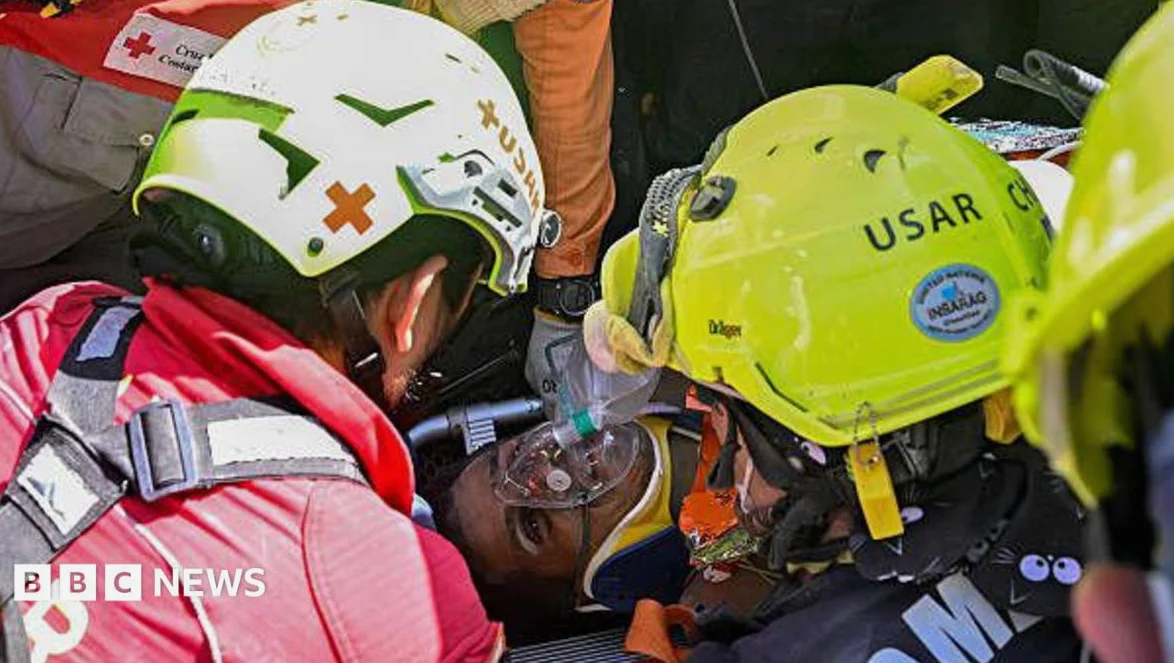
A man has been rescued alive after being trapped for eight days in the rubble of a building that collapsed after twin earthquakes in Venezuela, according to the BBC. Emergency workers managed to free Hernán Gil more than 100 hours after they had first located him under 140 tonnes of rubble.
Rescue Efforts
A Chilean firefighter had earlier described the rescue operation as ‘without doubt the most complex and technically difficult which I’ve had to tackle.’ Almost 2,300 people are confirmed to have died in the quakes which hit Venezuela on 24 June, and tens of thousands are still missing.
Allan Madrigal, a paramedic with the Costa Rican Red Cross, told journalists at the site that Gil had ’emerged just perfect’ from the ordeal — Madrigal is the rescuer who heard Gil’s faint cries for help emerging from the rubble on Sunday.
‘It was an emotional moment,’ he recalled, explaining that at first he had not trusted his own ears and asked a colleague to confirm that he ‘wasn’t just imagining it.’ From that moment on, rescuers raced to try and dig the security guard out.
Survival Conditions
Gil had been on duty in a small concrete booth in the basement of the parking lot adjacent to the Galerias Playa Grande mall in Catia La Mar when the twin quakes struck. It appears that the booth created a shell around him, protecting him from the 140 tonnes of rubble which collapsed around and on top of him.
‘He has told us that he does not even have a ended nail,’ another Costa Rican Red Cross worker said shortly before Gil was pulled from the rubble. Gil had been given water and medics had attached him to an intravenous drip while teams from Venezuela, Chile, Costa Rica, El Salvador, Mexico, Portugal and the United States worked to free him.
Parts of the access ducts rescuers built to reach him collapsed several times, highlighting the dangers the work posed to the rescuers as well as Gil. Overnight, the search teams were finally able to establish visual contact with the survivor.
Rescue Details
In footage recorded by a small camera inserted into the rubble where Gil was trapped, a Chilean firefighter could be heard asking him to turn his head towards the camera. One of his eyes was bloodshot and he was wearing a face mask, which rescuers had earlier passed to him through a small hole to protect him from the dust and debris created by their efforts to free him.
The firefighter also asked him to don goggles to protect his eyes as rescuers continued to carefully dig away at the rubble surrounding him; Marco Antonio Franco from the Mexican Red Cross described Gil as ‘a cheerful man.’
He told Mexican news site Milenio that the survivor ‘even asked for hydration drinks of specific flavours he likes,’ adding that ‘of course we indulged him.’ ‘He himself drives us on, telling us to carry on. He recognises our team members. Saying ‘how nice that you came back and that you’re with me again’.’.
According to Franco. The rescuers and Gil kept up a steady chatter about his family and about the challenging rescue. Madrigal, the paramedic who located Gil, was on his first international rescue mission and said the work he had carried out in Venezuela had changed him.
‘The lad who came here a week ago is not the same one that will return to Costa Rica, believe me,’ he told reporters. A 43-year-old security guard who survived last week’s devastating earthquakes in Venezuela thanks to a pocket of air in his workstation cabin has been pulled from the collapsed basement of a shopping centre amid huge cheers from international rescue teams.
Hernán Alberto Gil Flores had been trapped for eight days under the rubble of the Galerías Playa Grande in the hard-hit coastal port city of La Guaira since the back-to-back quakes struck. The 7.2- and 7.5-magnitude earthquakes killed almost 2,200 people, injured more than 11,000 others and left tens of thousands missing.
Gil Flores, who worked as a nightshift security guard at the shopping centre, was inside his small security cabin when the first violent tremor struck; While the surrounding concrete structure collapsed around him, his cabin shielded him from crushing debris and created a vital pocket of air.
A specialised team from the Costa Rican Red Cross (CRRC) first detected signs of life and established contact with him on Sunday. ‘When we found him, he asked us not to tell his wife that he was alive, just in case he wouldn’t make it,’ Minyar Collado, a member of the CRRC team told the Associated Press.
But, four days later on Thursday, teams carrying flags from across the world cheered as rescuers carried Gil Flores on a stretcher covered in an orange tarp through throngs of people into a Red Cross ambulance. A group of men in red CRRC uniforms embraced and laughed in relief.
Gil Flores’s wife. Gusbimar González. Said her despair had given way to hope when she heard he was still alive. ‘I saw a ray of light in the darkness,’ González said. The operation was coordinated by an urban search and rescue team of Chilean firefighters, who worked around the clock with specialist teams from the US, Portugal and Mexico, among others.
Rescuers had to handle highly unstable structural conditions, torrential rain and persistent aftershocks to tunnel down to Gil Flores. They used a telescopic camera to maintain constant contact with him, passing water and liquid nutrients through a narrow shaft to keep him hydrated during the final three days of the extraction.
María Paz Campos, a veteran firefighter from Chile, talked the security guard through the entire operation, and kept him calm during the final hours of the rescue on Thursday. In a video published by the Chilean firefighters in the hours before the rescue, Gil Flores had been seen drawing, apparently to pass the time; Campos then gently told him to look at the camera and to wear protective goggles.
‘I need you to keep the goggles on to stop the small particles that are falling from getting into your eyes,’ she told him. While there have been a few astounding rescues – including those of Gil Flores and a three-year-old boy who was pulled from the rubble on Tuesday – hopes of finding many more survivors are dwindling fast.
Yet, the families of those trapped in collapsed buildings cling to hope that their loved ones can be found. Dora Bell






Comments
No comments yet
Be the first to share your thoughts