

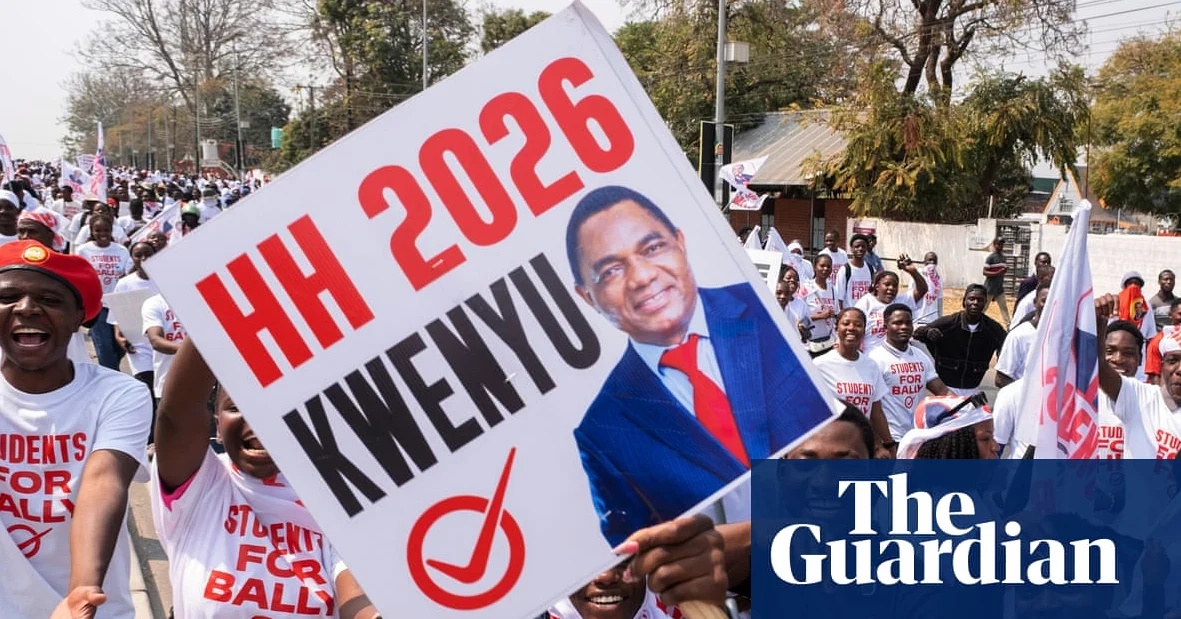
The ghost of former Zambian President Edgar Lungu looms over this year’s elections as his burial dispute resurfaces in political tensions; In June, South Africa’s supreme court of appeal ruled in favor of Lungu’s family, overturning an earlier government-backed decision. The ruling came after Zambia’s government had attempted to block Lungu’s burial by his family, who did not want President Hakainde Hichilema to preside over a state funeral.
Political Reckonings and Burial Tensions
Lungu’s burial dispute has become a flashpoint in the campaign between Hichilema and the Tonse Alliance, a coalition of opposition parties led by Brian Mundubile, 55. Mundubile previously served as government chief whip under Lungu; his running mate, Makebi Zulu, also served as Lungu’s family spokesperson during the burial row, though On the campaign trail, the two men have promised to bring Lungu’s body back to Zambia for a dignified burial.
Christopher Vandome, a senior research fellow at Chatham House, noted that burial practices hold deep cultural significance in Zambia; “Even Hichilema supporters want to see due respect given to those that have died,” he said. “When it appears things get messy, it just makes the incumbent look disrespectful.”
Allegations and Denials in the Campaign
The Tonse Alliance has accused Hichilema of employing authoritarian tactics, including raiding their offices and detaining 36 of Mundubile’s team members, as Hichilema’s team has denied the allegations, drawing comparisons to Lungu’s treatment of Hichilema during the 2021 election. “Zambians know what repression looks like,” said a spokesperson for the ruling United Party for National Development. “In 2021, the opposition leader had been arrested 15 times, Prime TV and the Post had been shut down, and on election day the internet was switched off.”
Meanwhile, the Zambian government has tightened security ahead of the election; On Wednesday, authorities announced the arrests of several individuals, including three former senior government officials, over an alleged plot to interfere with the electoral system.
Economic Concerns and Voter Sentiments
While the burial dispute captures much of the political drama, voters are also weighing in on the economy; Zambia defaulted on its sovereign debt in 2020 but has since secured a debt restructuring and completed an IMF-supported program. The government has set an ambitious 2031 target to triple copper production, a key resource in the green-energy transition.
However, over 70 percent of Zambia’s 22 million people live on less than three dollars a day, according to World Bank data; Ceshas Tembo, a 32-year-old bus driver, said, “It’s only those who are connected to politicians that are saying the economy is doing well. For many of us, it is still hand-to-mouth and even then it’s never enough.”
Voting in Zambia has traditionally followed regional lines, with Hichilema’s party strongest in the south and west, and the ruling Patriotic Front (PF) retaining pockets of support in the north and Copperbelt. Patience Mususa, a senior researcher at the Nordic Africa Institute, said voters may favor the stability of the incumbent despite criticism of his slow progress in addressing government inefficiencies and corruption.
“He is seen as a more predictable leader,” she said. Results of the presidential vote are expected by August 17. The winner needs more than 50 percent to avoid a runoff. Voters are also electing 226 parliament seats, up from the previous 156.
Comments
No comments yet
Be the first to share your thoughts