

 BBC
BBC 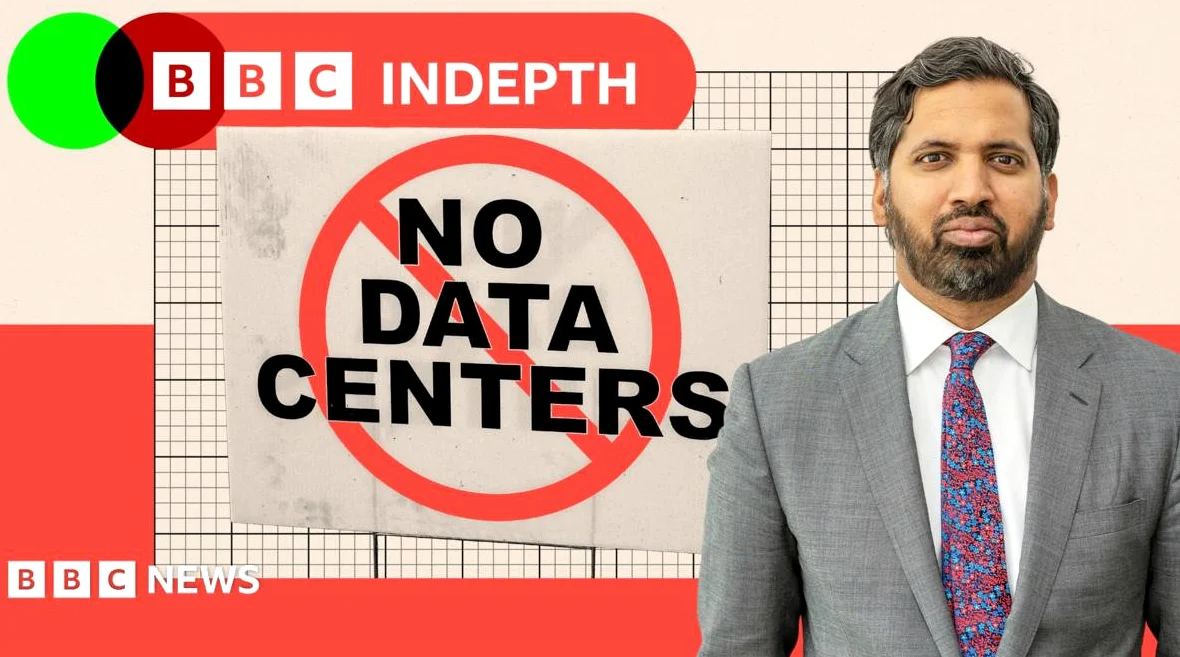
There is an eerie low hum that emanates from data centres, where tens of thousands of chips make trillions of computations a second to help drive the artificial intelligence (AI) revolution. These chips power the text, images, and video generated by the queries made by the world of the advanced AI models.
Local Concerns Over Energy and Environmental Impact
Their computations, which are in effect the switching on and off of microscopic silicon transistors that make up a chip, are actually silent. But, as with all computers, almost every watt of the significant electricity powering this process leaves as heat, and the sound you can hear is the slow whir of thousands of fans required to prevent the heat from frying the racks of servers. Depending on the size of the site, you may also hear the thrum of transformers in substations channelling electricity.
In recent days, alarming warnings of threats to humanity have created a din, but it is these low hums that have stirred a backlash in the US which now threatens to envelop its mid-term elections, and could cross the Atlantic and come to the UK.
In the US, the opposition to data centres is most overt on the political left; Democratic Senator Bernie Sanders has called for a moratorium on any new construction. “People are looking around worried about how quickly the technology is moving, how little control they have over it, how will data centres impact their community in terms of electric rates and water utilisation,” he told me.
Unpopularity of Data Centres in Polls
On data centres, 71% were opposed, including 48% strongly opposed — For nuclear power stations 53% were opposed, including 34% strongly opposed, as this unpopularity has grown over the past two years, with some polls suggesting half of Americans support a total pause on their construction. In the US, polling by Gallup published in May suggested having a data centre in your area was more unpopular than having a nuclear power station.
There has been opposition to some of these developments in the UK too, from Buckinghamshire and Berkshire to Brick Lane in east London, with locals fearing their areas will be negatively impacted. In Brick Lane, plans for a data centre likely to service the City of London’s high frequency traders face a backlash from those who would prefer to see more social housing and local business developments in the capital’s east end. Meanwhile in the shires, the sheer demand for data centres sees pressure to expand provision from Slough, into the leafy countryside.
Political and Environmental Challenges
The UK has the third highest number of data centres in the world, one spot ahead of China. The US has the most. Back in the US, this backlash is being reflected in what politicians standing in critical elections in November are saying.
The backlash is clearly more pronounced among Democrats on the left, but anti-data-centre sentiment is clear among Republican supporters too. City councils have been voted out in response to their policies on data centres, while some whole states – both red and blue – are proposing bans. Last year, in New Jersey and Virginia, Democratic Governors were elected partly because of a backlash against rising electricity prices blamed on data centre construction and operation.
Stories abound of local townspeople seeing energy bills soar when they are asked to foot the bill for the infrastructure needed to power new data centres, or finding their already stretched water supplies further diminished. Because the US energy system functions at a local level, the impact on bills can be immediate. With control of both houses of the US Congress up for grabs, the scale of the hyper-localised opposition could become a defining factor in the midterm elections and with it the fate of US policy and Donald Trump’s presidency.
Seven Big Tech CEOs appeared with Trump in March to sign the “Ratepayer Protection Pledge” saying they would “build, bring or buy” their own energy needs and ensure costs are not passed to “ordinary households.” The pledge was non-binding. This clearly did not go far enough for some. The new Democratic Governors in New Jersey and Virginia (home to the largest global concentration of data centres), went much further with legislation compelling new energy tariffs for data centres, and disclosure of energy and water use.
Perhaps the most potent symbol of all of this, is the pro-Trump Republican Senate candidate in Texas, Ken Paxton, attacking data centres, campaigning against their tax breaks and proposing that operators of the facilities should be criminally liable if the technology “empowered AI chatbots that undermine children’s safety”. Texas had been the most pro-business, pro-data centre, pro-energy state, competing ferociously for these facilities — it had, for example, won much of the multi-billion-dollar relocation investment from Elon Musk’s SpaceX AI behemoth, to produce AI chips.
It has been a dizzying flip. Jensen Huang, chief of AI chipmaker Nvidia, took to social media in August to make the case for data centres as the essential agent of US reindustrialisation. Other Big Tech CEOs have not followed, perhaps a sign of the difficult optics. The lesson from the US however, has been that talking about benefits to the overall national economy, or potentially curing cancer, does not always cut it locally. Part of the eerie sound surrounding data centres is the relative absence of actual permanent workers coming and going. While there are plenty of construction jobs, a functioning data centre tends to require just a few dozen staff, with a few hundred at the very largest new sites.
Asking local people to accept the sound, the all night security lighting and the pressure on energy and water supplies in their areas as being for the good of the country is one thing. But it’s a harder sell when the AI firms are on the cusp of trillion-dollar-plus valuations but are also expecting massive job losses, and many are asking whether the technology could wipe humans off the face of the Earth.






Comments
No comments yet
Be the first to share your thoughts