

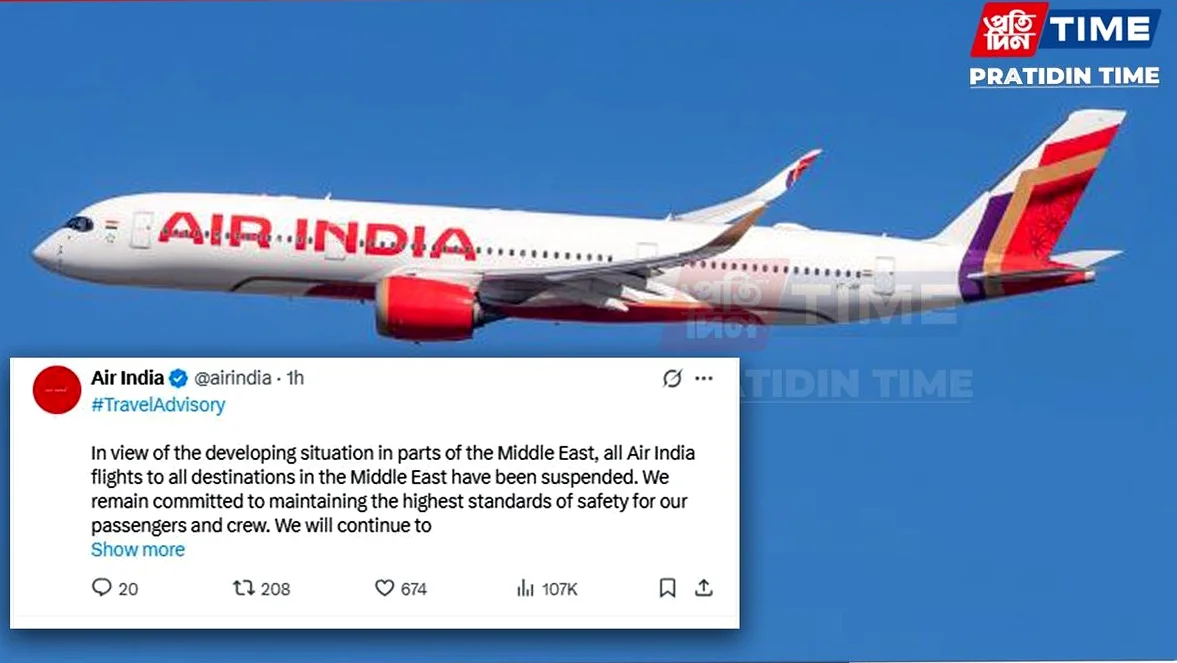
India’s leading airlines have suspended all flights to the Middle East following a sharp escalation in hostilities between Israel and Iran, with reports of explosions and security alerts across the region. Air India and IndiGo, two of the country’s largest carriers, have grounded services to key West Asian destinations, citing the deteriorating security situation.
Operational Halts and Safety Concerns
Air India confirmed in a statement that it has temporarily suspended all operations connecting India with cities across the Middle East. The airline emphasized that passenger and crew safety remains its top priority. Flight schedules will be reviewed continuously based on the evolving situation on the ground.
“In view of the developing situation in parts of the Middle East, all Air India flights to all destinations in the Middle East have been suspended,” the advisory read. “We remain committed to maintaining the highest standards of safety for our passengers and crew.”
IndiGo, India’s largest airline by passenger traffic, has also halted all Middle East-bound flights. Both airlines are closely monitoring the situation and have not ruled out further adjustments to their schedules.
Regional Instability Sparks Global Flight Adjustments
The travel disruptions follow reports of military activity and airspace disturbances across the Gulf and neighboring areas. Explosions and security alerts were reported in parts of the United Arab Emirates, Bahrain, Saudi Arabia, Iraq, and Jordan, raising concerns for global carriers operating in the region.
Earlier in the day, strikes were reported inside Iran, including near key administrative locations in Tehran. The developments have intensified an already fragile geopolitical climate marked by longstanding tensions between the United States and Iran over security and nuclear policy issues.
Airlines worldwide have begun adjusting operations in response to airspace restrictions, rerouting flights or suspending services altogether to avoid high-risk corridors. Aviation analysts warn that prolonged instability could severely disrupt international travel between Asia, Europe, and the Gulf region.
“The current situation is highly unpredictable, and airlines are taking a cautious approach to ensure the safety of their passengers and crew,” said one aviation analyst based in Dubai. “This is not the first time such measures have been taken, but the scale of this disruption is significant.”
Historical Precedents and Potential Long-Term Effects
This is not the first time regional tensions have led to flight suspensions. In 2019, following a similar escalation in violence between Iran and the United States, several airlines suspended operations in the Gulf region. The impact on international travel was significant, with flight cancellations affecting thousands of passengers and causing economic losses for the aviation sector.
According to the International Air Transport Association (IATA), the global aviation industry could face losses of up to $1 billion if the current instability persists for more than a few weeks. The potential for extended disruptions is particularly high given the interconnected nature of regional air traffic.
Airlines are also considering alternative routes to avoid the affected areas. Some carriers have already begun rerouting flights through Europe or Southeast Asia to minimize exposure to high-risk corridors. However, such adjustments can lead to longer travel times and increased fuel costs.
Passengers are advised to check with their respective airlines for the latest updates on flight schedules. The situation remains fluid, and further adjustments are expected as the geopolitical landscape continues to evolve.
The Indian government has not issued any official travel advisories, but the Ministry of External Affairs has been in close communication with regional partners to monitor the situation. Officials have emphasized the importance of maintaining diplomatic channels to de-escalate tensions.






Comments
No comments yet
Be the first to share your thoughts