

 BBC
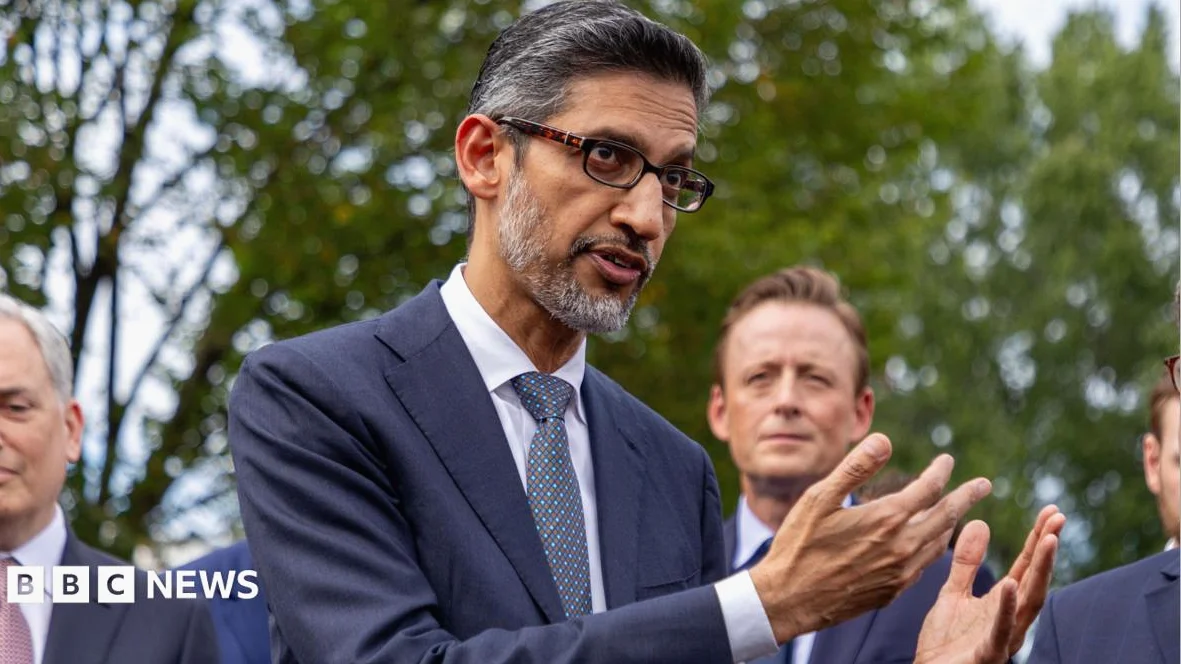
Alphabet, the parent company of Google, lost just over $500bn in market value on Thursday after its quarterly earnings report rattled Wall Street, according to BBC. The drop came as investors reacted to the company’s significant financial challenges, which stem from its large-scale investments in artificial intelligence (AI).
Alphabet’s Financial Struggles Amid AI Expansion
Alphabet reported a 25% decline in net profit compared to the same period last year, falling to $26.2bn in the July-to-September period. The company also posted an $8.7bn loss on its equity investments, which it attributed to its stake in SpaceX. Revenue rose 25% to $127.6bn, slightly below analyst expectations.
Investors were particularly concerned about the impact of AI on Alphabet’s core search business. Google now defaults to AI-generated summaries for search queries, which has reduced the number of advertisements it can sell. Advertising revenue grew by just 11% to $82bn, short of expectations.
Google Cloud, which rents computing power and AI tools to businesses, saw revenue jump 103% to $30.7bn, exceeding analyst expectations. The growth was partly driven by sales of Google’s in-house AI chips, known as TPUs, which have also attracted interest from companies like OpenAI.
Investor Skepticism and Future Outlook
Tracy Woo, a principal analyst at Forrester, noted that Alphabet’s disappointing search business results highlight the challenge of funding massive AI investments while maintaining the strength of established businesses.
Alphabet’s CEO, Sundar Pichai, described the company’s spending as part of a long-range planning process rather than a short-term allocation exercise. The company plans to continue increasing its capital expenditures, with a projected $195bn to $205bn in 2026 and even more in 2027.
Alphabet spent $51.4bn on capital expenditures during the quarter, mostly on datacenters and AI chips, more than double the $24bn spent a year earlier. The spending included a fine paid to the European Union and outstripped the cash generated by the company’s businesses, leaving a $9.1bn gap for the second consecutive quarter.




Comments
No comments yet
Be the first to share your thoughts