

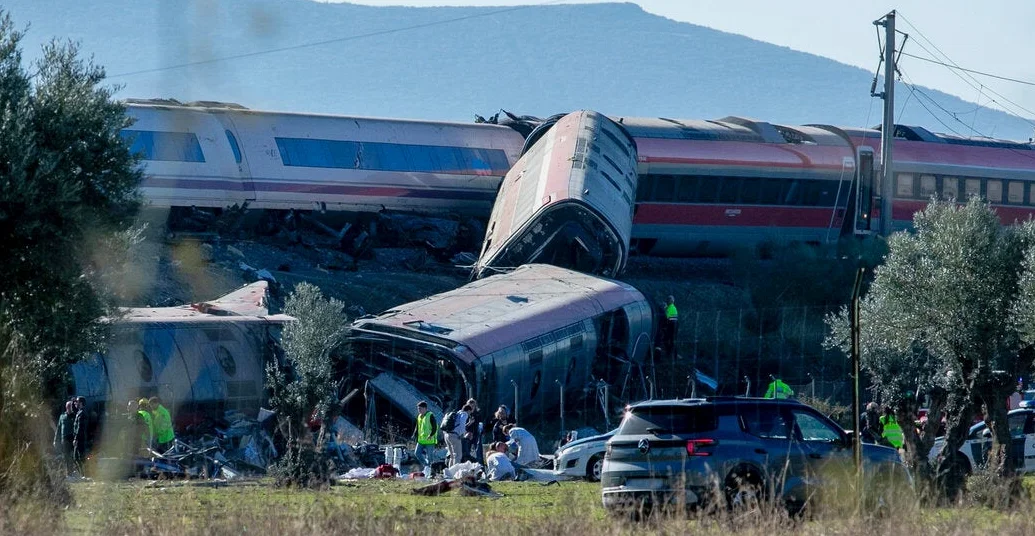
The collision occurred between two high-speed trains traveling from Madrid to Seville. One train ran into the rear of the other, which had stopped, causing two of its carriages to derail and crash down an embankment. Miguel, a passenger in the rear car of one of the trains, described the moment of impact as a “massive roar” that lasted 10 seconds. Through the right-hand window, he said he saw a wrecked train.
Emergency services, including firefighters, police, and a military emergency brigade, were deployed to the crash site. Spain’s Health Minister Mónica García said emergency workers were focusing on rescuing survivors and bodies from the two most damaged train cars. The mayor of Urda, Manuel Galán, said civil protection authorities had asked his town hall to prepare a sports pavilion to accommodate injured passengers.
Spanish Prime Minister Pedro Sánchez canceled all scheduled meetings to focus on the crash and expressed his shock on social media. He said emergency services were working on the ground to assist those affected. The conservative opposition leader, Alberto Núñez Feijóo, also voiced concern, calling for support for the victims and emergency teams. Both major political parties suspended their campaign events.
This is the second major train accident in Spain this year involving Renfe and Iryo. In January, 46 people were killed when an Iryo train derailed and collided with a southbound Renfe train near Adamuz. Iryo, an Italian-owned company, said it had activated its security protocols and was working closely with authorities.
Blood donation groups in the area are urging donors to come to hospitals in Toledo and Ciudad Real to replenish reserves. The cause of the crash is still unknown, though the Castilla-La Mancha region’s spokesperson said the Iryo train had stopped on the tracks and the Renfe train barreled into it.
Spanish media broadcast footage of the derailed trains and scattered wreckage. Regional channel CMM TV showed a derailed train with at least one carriage remaining on an elevated section of track. The regional president of Castilla-La Mancha, Emiliano García-Page, said he was on his way to the crash site.
Spain’s rail authority, Adif, said high-speed service between Madrid, Ciudad Real, and Andalusia was suspended. The crash has raised further concerns about the reliability of Spain’s rail infrastructure, which includes the world’s second-longest high-speed rail network.




Comments
No comments yet
Be the first to share your thoughts