

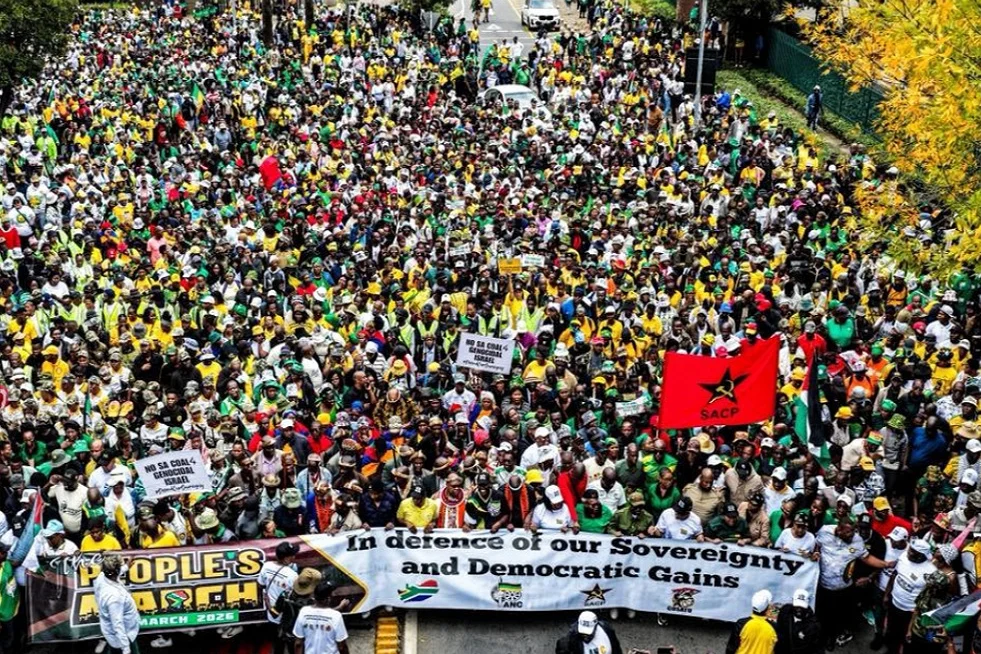
ANC National Executive Committee member Ronald Lamola has denounced the ongoing war between the United States, Israel, and Iran, stating the African National Congress officially condemns the conflict. His remarks came during the People’s March in Johannesburg, held to commemorate Human Rights Day and mark the party’s commitment to the Defence of Sovereignty and Democratic Gains.
Call for Diplomatic Resolution
Lamola emphasized that any resolution to the escalating tensions must come through negotiations and peaceful means. Speaking at the march. He said. ‘With regards to this war. Any solution should come through negotiations and through an amicable solution.’ He warned that the conflict could lead to economic and energy challenges, prompting the South African government to take proactive measures to mitigate potential crises.
The South African government has already implemented policies aimed at stabilizing the economy and energy sector amid rising oil prices. Lamola noted that the country is preparing for the potential economic fallout from the war, particularly in the energy and transportation sectors, where oil prices are a major factor.
According to Lamola. The government has rolled out a series of interventions to cushion the impact of the rising cost of fuel and energy. These measures are designed to protect ordinary South Africans from the broader economic consequences of the war, which could lead to inflation and supply chain disruptions.
Defending Sovereignty and Independence
At the same event. ANC National Spokesperson Mahlengi Bhengu reiterated the party’s stance on sovereignty, warning that South Africa will not be bullied by external forces, though he said, ‘We will not be bullied — we will defend South Africa’s sovereignty with all that we have.’
Bhengu highlighted the growing awareness among South Africans about the geopolitical tensions affecting the country’s international relations. He said that the ANC’s position reflects the concerns of the public, particularly regarding the potential threats posed by foreign policy shifts and international cooperation dynamics.
South Africa has long been a vocal advocate for multilateralism and peaceful conflict resolution; the country’s foreign policy has historically emphasized non-alignment and regional solidarity. Lamola’s comments align with this approach, emphasizing the need for diplomacy over militarization.
During the People’s March, ANC members and supporters gathered to show their solidarity with the party’s stance on sovereignty and democratic principles. The event served as both a political demonstration and a call for unity in the face of global challenges.
Broader Implications for Regional Stability
The conflict between the US, Israel, and Iran has the potential to destabilize not only the Middle East but also the broader international community. South Africa’s position on the issue has been closely watched by other African nations, many of which have expressed concerns about the geopolitical shifts in the region.
According to analysts, the war could lead to increased economic instability across the globe, with rising oil prices and supply chain disruptions expected to impact developing nations the most. South Africa, which relies heavily on imported oil, is particularly vulnerable to these effects.
Lamola’s statements have also sparked discussions within the African continent about the role of regional organizations in addressing global conflicts. The African Union has previously called for dialogue and peaceful resolutions to regional and international disputes.
South Africa’s foreign policy under the ANC has historically emphasized the importance of regional cooperation and multilateralism. This approach is seen as a way to counterbalance the influence of major global powers and protect African interests in international affairs.
The ANC’s condemnation of the US-Israel war on Iran is part of a broader strategy to assert Africa’s voice in global politics. The party has consistently advocated for stronger regional integration and the promotion of African unity in international forums.
As the war continues to unfold, the ANC’s position is likely to influence the direction of South Africa’s foreign policy and its engagement with international partners. The party’s emphasis on diplomacy and non-interference has positioned it as a key player in African and global politics.
The People’s March in Johannesburg not only highlighted the ANC’s stance on the war but also served as a reminder of the party’s commitment to human rights and democratic principles. Lamola and Bhengu’s comments reflect a growing awareness among South Africans about the impact of global conflicts on local issues such as economic stability and energy security.






Comments
No comments yet
Be the first to share your thoughts