

 BBC
BBC 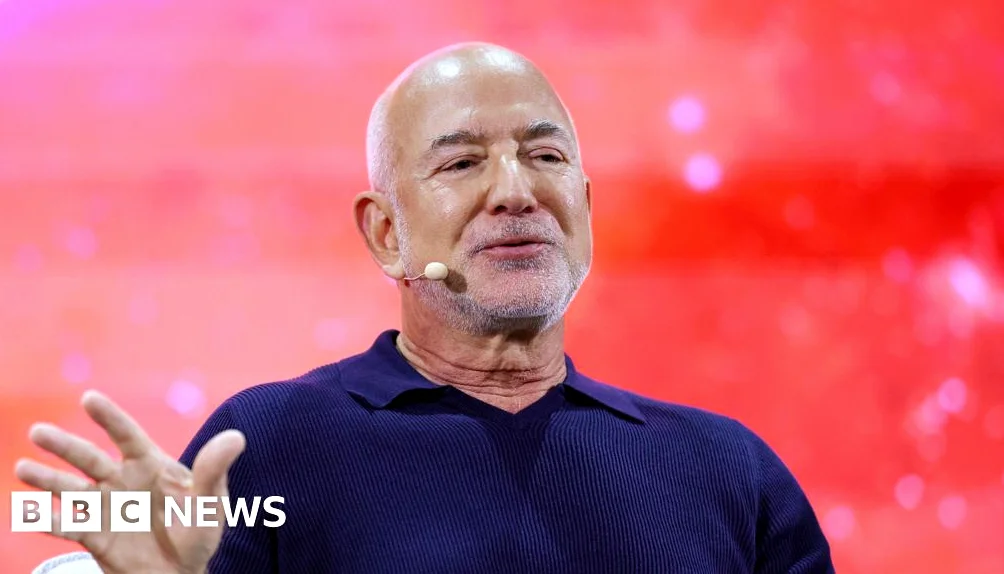
Jeff Bezos, founder of Amazon, argued that artificial intelligence (AI) will not make people redundant but instead create more jobs for humans, though During an appearance at a tech conference in Paris, he pushed back against concerns that AI will replace large numbers of workers.
Bezos’ Optimistic Outlook on AI
Bezos suggested that AI will reveal new opportunities and increase demand for human labor. This stance contrasts with some other tech and political figures, including former UK prime minister Rishi Sunak, now an adviser to Microsoft and AI firm Anthropic, who recently said AI was impacting young people’s job prospects.
“I know there’s a lot of concern that many people have, including many smart people, that AI is going to make humans redundant and so on,” Bezos said. “I totally disagree with this point of view; And I think, in fact, AI is going to create a labour shortage.”
He painted an optimistic picture of AI’s future role in society, suggesting that people are limited not by a lack of ambition, but by barriers that technology can help remove. Bezos also emphasized that AI could have significant potential if developed properly, and workers could benefit from its productivity gains.
Long-Term Vision for Space Exploration
Bezos used his appearance at Europe’s largest tech expo, VivaTech Paris, to outline his long-term vision for space exploration, but he described space as “supply constrained, not demand constrained,” arguing that access to space remains the biggest obstacle to future development.
The Moon. He said. Offers a natural starting point for humanity’s expansion beyond Earth because of its proximity and resources. “We’re going to the Moon to stay, not just to visit,” Bezos told the audience, adding that technologies such as electrolysis could eventually allow lunar resources to be used to refuel rockets and support a permanent presence beyond Earth.
Bezos also discussed another venture, space travel company Blue Origin. He described the recent explosion at a launch site as a “gut punch for the whole team.” However, he noted that several critical pieces of launch infrastructure survived the incident, including propellant and fuel systems that would have taken significantly longer to replace.
On the same stage as Bezos. Blue Origin chief executive Dave Limp said reconstruction work at the launch site is already underway and the company expects launches to resume before the end of the year. Blue Origin is in the race to establish itself as a major player in commercial spaceflight and lunar exploration, competing with Elon Musk’s SpaceX in the growing market for extraterrestrial infrastructure.
Advancements in Robotics and AI
Away from the main stage, Unitree’s humanoid robot was a highlight at the event. Constant queues of visitors wanted to see the latest advances in the robotics field. This time the robot was teaming up with French neuro-AI company HABS, which showcased technology designed to allow humans to interact with machines using cognitive signals rather than speech.
The robot responded to commands generated through brain activity, via a headband with an electroencephalogram (commonly known as an EEG) attached to it. The test uses small, metal probes called electrodes that touch the scalp. The demo offered a glimpse of how future humans and machines could work together.
It also reflected a broader trend running through this year’s event: AI moving beyond chatbots and into the physical world. Humanoid robots are increasingly becoming a reality with companies racing to develop machines capable of working alongside humans in healthcare, manufacturing, and hospitality.






Comments
No comments yet
Be the first to share your thoughts