

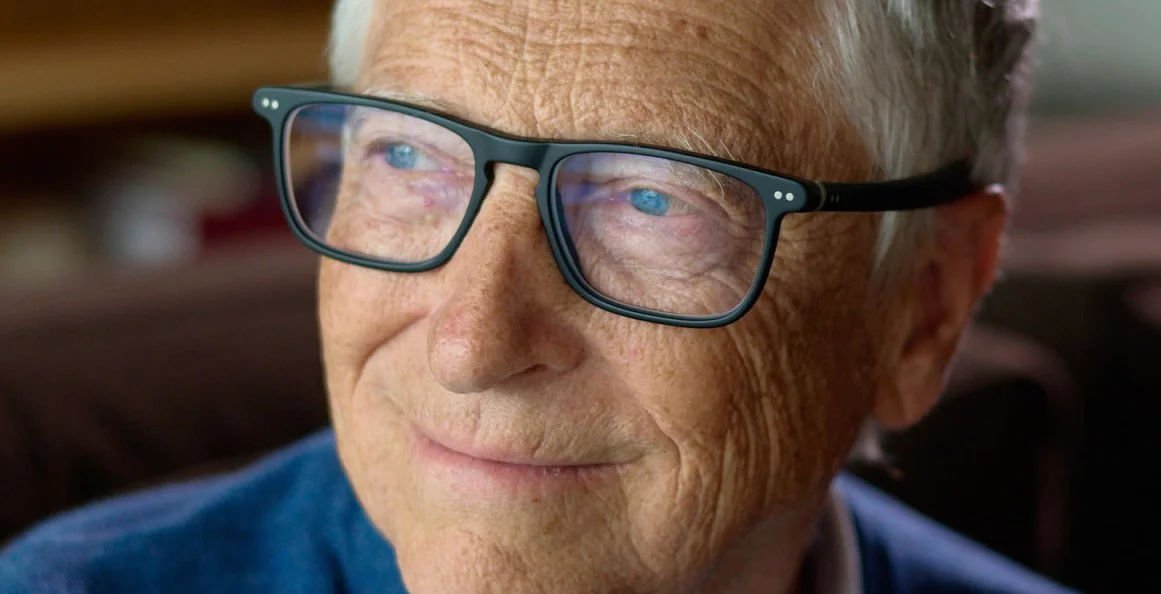
Bill Gates, the former Microsoft CEO and philanthropist, has warned that artificial intelligence has already crossed key danger thresholds in areas like cyber and bio capabilities. He argues that the speed of AI development far outpaces the creation of safeguards. “We’ve crossed the threshold in terms of [AI’s] bio-capabilities, cyber-capabilities, psychosocial capabilities, job-market-destruction capabilities, and even the lack of control,” he told MIT Technology Review in an interview accompanying a new essay published this week.
A Turbulent Transition to an AI Era
Gates sees the transition to an AI-driven world as one of the most turbulent in human history, while In an essay and an interview with the New York Times, he called it “the worst source of injustice ever invented” if left unchecked. He expressed concern that AI could deepen inequality and destabilize democracies. “The transition to the era of AI will be one of the most turbulent periods in human history,” he said. “Without action, it could be the worst source of injustice ever invented.”
Gates emphasized that AI does not just threaten routine jobs but also roles requiring cognitive skills. He challenged the optimistic view that AI will create more jobs than it destroys. “Are we joking?” he asked, referencing past technological revolutions where new jobs emerged to offset those lost. “This time is different,” he added, noting that AI can now perform intellectual tasks, reducing the likelihood of a similar rebound in employment.
Calls for Global Cooperation, But Distrusts Feasibility
Despite his concerns, Gates remains skeptical that meaningful global coordination to slow AI’s development is possible. “If someone had a credible plan to slow AI development globally, I would support it,” he said. However, he noted the strong geopolitical and economic incentives to continue advancing AI technologies. “The incentives are too strong,” he said, adding that the global race for AI supremacy seems unstoppable.
Gates also criticized technology executives for downplaying the risks. He questioned the claim that AI will create more jobs than it destroys and accused companies of concealing the true impact of automation. “They’re hiding the reality,” he said. “The comparison with past technological revolutions doesn’t hold. This is different in kind and scale.”
Visit to South Korea, SMR Discussions
While Gates is sounding alarms about AI, he is also actively engaged in other ventures. This week, he arrived in South Korea for the first time in a year, where he is scheduled to meet government and business leaders to discuss the expansion of small modular reactor (SMR) technology. During a private jet arrival at Gimpo Airport, Gates is expected to hold closed-door meetings with Prime Minister Han Sung-sook and National Assembly Speaker Cho Jeong-sik. He will also meet with HD Hyundai Chairman Chung Ki-sun to discuss SMR cooperation.
The visit follows recent progress by TerraPower, Gates’ nuclear energy company, in its next-generation nuclear project. Gates’ dual focus—on mitigating AI risks and advancing clean energy—highlights his broader vision for technological progress that is both significant and responsibly managed.
As AI systems become more powerful and pervasive, Gates’ warnings expose the urgency of global governance and ethical oversight. “We need a global action plan for AI,” he said. But with the current trajectory, he remains doubtful that such a plan will materialize in time.



Comments
No comments yet
Be the first to share your thoughts