

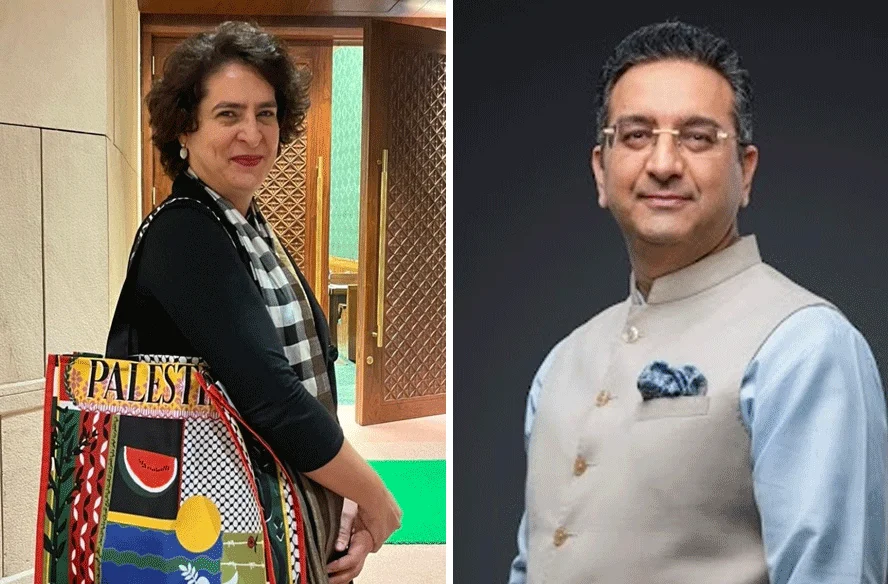
Prime Minister Narendra Modi’s upcoming visit to Israel has intensified political tensions in India, with the Bharatiya Janata Party (BJP) sharply criticizing Congress leader Priyanka Gandhi Vadra over her comments on the Gaza crisis. The controversy erupted as Modi prepares to address the Israeli Knesset and engage in high-level talks with Israeli leaders, marking his second visit to the country in nine years.
Accusations of ‘Selective Outrage’
Priyanka Gandhi Vadra, the daughter of former Prime Minister Rajiv Gandhi and granddaughter of India’s first Prime Minister Jawaharlal Nehru, called for Modi to raise concerns about the humanitarian situation in Gaza during his address to the Israeli Parliament. In a post on X, she said, ‘I hope that the Hon Prime Minister @narendramodi ji mentions the genocide of thousands of innocent men, women and children in Gaza while addressing the Knesset on his upcoming trip to Israel and demands justice for them.’
Her remarks, which emphasized India’s historical commitment to justice and truth, drew a swift and personal response from the BJP. National spokesperson Gaurav Bhatia took to X to accuse her of ‘selective outrage,’ invoking the name of the 2008 Bollywood film character Ghajini, known for short-term memory loss. Bhatia wrote, ‘The Female Ghajini of Indian politics is back!’ and alleged that Priyanka was ignoring the October 7 attacks in Israel while focusing solely on Gaza.
Bhatia shared an old photograph of Priyanka carrying a bag labeled ‘Palestine’ and claimed that she lacked the moral courage to condemn the ‘Oct 7th massacre of 1,200-plus innocents, women being abducted and raped.’
He further remarked, ‘You might carry the fake Gandhi surname but you clearly lack the conviction and the courage. #SelectiveOutrage,’ suggesting that it takes significant moral courage to rise above ‘votebank politics’ to condemn such acts.
Escalating Political Rhetoric
The Congress party has not remained silent on the issue, with communications in-charge Jairam Ramesh accusing the government of abandoning the Palestinian cause. He claimed that the prime minister was traveling to Israel even as attacks on civilians in Gaza continued ‘mercilessly.’
Ramesh’s comments come at a time when the India-Israel relationship has evolved into a strategic partnership. During Modi’s first visit to Israel in 2017, the two nations elevated their ties to a strategic level, focusing on defense and trade cooperation. Modi’s current visit aims to further consolidate these ties, even as the Israel-Gaza conflict remains a focal point of domestic political discourse.
The controversy has added a new layer of complexity to an already sensitive geopolitical situation. With Modi scheduled to address the Knesset, the focus on Gaza has raised questions about India’s stance in the ongoing conflict. Analysts suggest that Modi’s visit is not only about strengthening bilateral relations but also about signaling India’s alignment with global powers, particularly the United States.
Implications for India’s Foreign Policy
Experts say that Modi’s visit to Israel is part of a broader strategy to solidify India’s relationships with key global players, including the U.S. and Israel. The timing of the visit, however, coincides with heightened tensions over the Israel-Gaza conflict, which has drawn sharp reactions from both political parties in India.
According to a report by the Centre for Policy Research, India’s defense imports from Israel have increased by 35% since 2017, highlighting the growing strategic importance of the relationship. However, the domestic political debate over the Israel-Gaza conflict has raised concerns about the consistency of India’s foreign policy.
As the prime minister prepares to address the Knesset, the political rhetoric from both sides is likely to continue. The upcoming days will test how India balances its strategic partnerships with its commitments to global humanitarian issues.
Modi’s visit to Israel is set to conclude on April 25, with key discussions expected on defense cooperation, trade, and regional security. The outcome of these talks could have long-term implications for India’s foreign policy and its role in global affairs.



Comments
No comments yet
Be the first to share your thoughts