

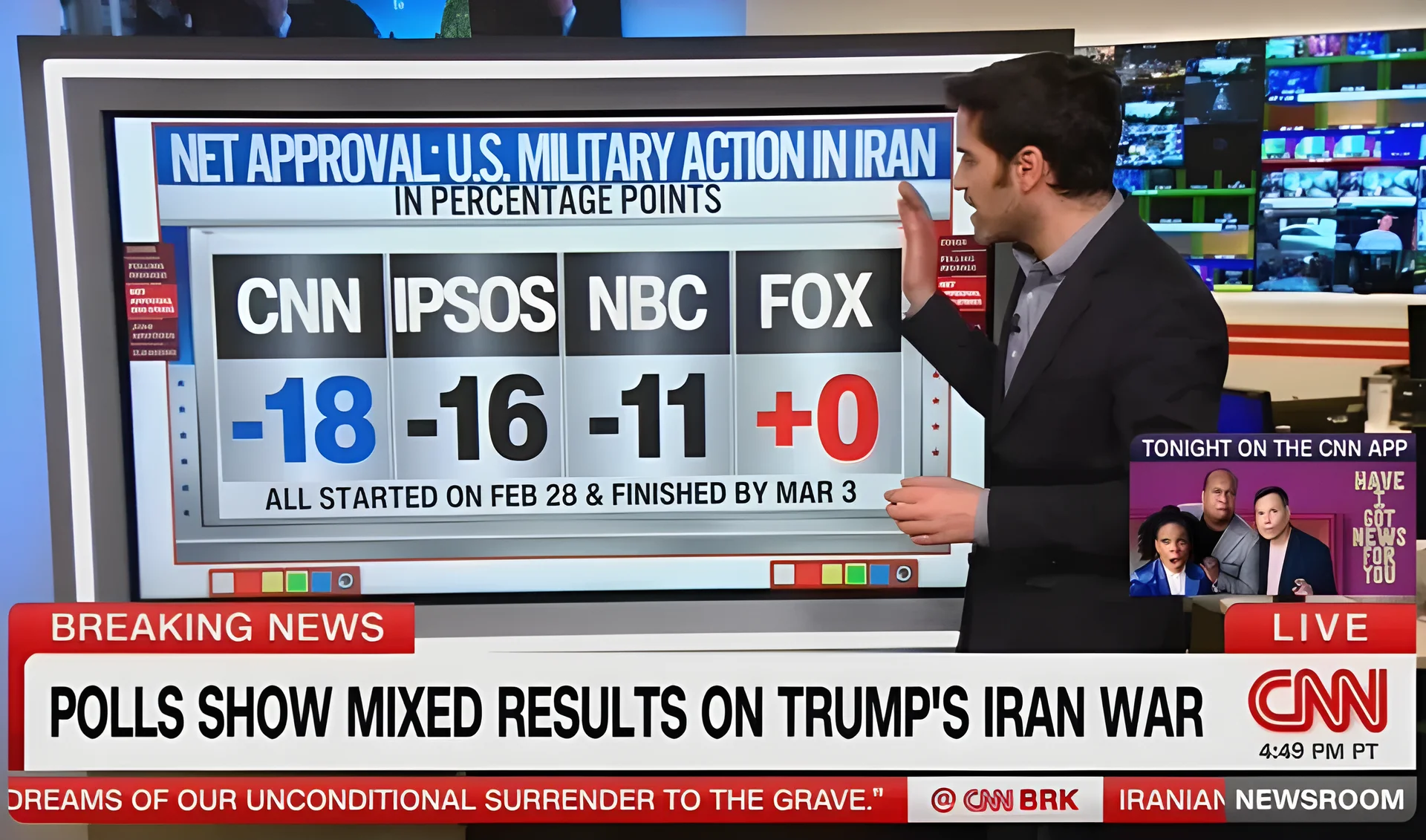
CNN’s data analyst Harry Enten has urged caution in interpreting early public opinion polls regarding the recent U.S. and Israeli airstrikes against Iran, pointing out significant discrepancies among the surveys conducted shortly after the military action began.
Conflicting Polls Spark Uncertainty
Following the U.S. and Israeli airstrikes against Iran on February 28, media outlets swiftly conducted polls that showed a majority of Americans disapproved of the military action. According to Enten, the initial results revealed that 51% of Americans disapproved of the action, while only 40% approved, creating an 11-point split.
However, Enten noted that this average figure masked significant differences in the net approval ratings across various polls. He highlighted that CNN’s own poll showed a net approval rating of -18 points, similar to the IPSOS poll at -16 points. In contrast, the NBC News poll indicated a net approval rating of -11 points, and the latest Fox News poll showed a dead-even split at zero points.
Enten expressed concern over these discrepancies, stating, ‘On average, the polling is showing that the move is unpopular, but that actually hides major disagreements between the polling.’ He emphasized that the questions used in the polls were similar and conducted at nearly the same time, making the differences in results puzzling.
Historical Precedent and Caution Advised
Enten provided historical context, referencing the June 2024 airstrikes against Iran. Initially, public approval of the military action was negative, with a net approval rating of -8 points. However, by July, the approval rating had shifted to a positive 2 points after the operation was deemed successful.
He warned that the current situation could follow a similar trajectory, stating, ‘We’re just going to have to wait and see what this current military action in Iran how exactly the polling shifts.’ Enten advised taking the current numbers with a grain of salt, noting that the initial polls may not accurately reflect future public sentiment.
During the segment, Enten’s analysis stood in contrast to the broader liberal media narrative, which has largely criticized President Trump’s decision to launch the military action. His balanced perspective highlighted the complexity of public opinion and the need for caution in interpreting early polling data.
John Berman, CNN’s host, acknowledged Enten’s insights, stating, ‘Harry, thank you very much for that. Yes, polling does often track what people think is a successful or non-successful operation.’ This response underscored the importance of Enten’s analysis in providing a more detailed understanding of public sentiment.
Implications for Public Discourse
Enten’s remarks have significant implications for how public opinion is interpreted in the context of military actions. His analysis suggests that early polling data should not be taken as definitive indicators of public sentiment, particularly when the outcomes of such actions are still uncertain.
The differing results across polls also highlight the need for more standardized methodologies in public opinion research. As the situation in Iran unfolds, public discourse will likely continue to be shaped by evolving polling data and the outcomes of military operations.
With the current military action still in its early stages, the shifting public opinion and potential changes in polling data will be crucial factors to monitor. Enten’s analysis serves as a reminder that initial public reactions may not always reflect long-term sentiments or the actual success of military operations.





Comments
No comments yet
Be the first to share your thoughts