

 The Guardian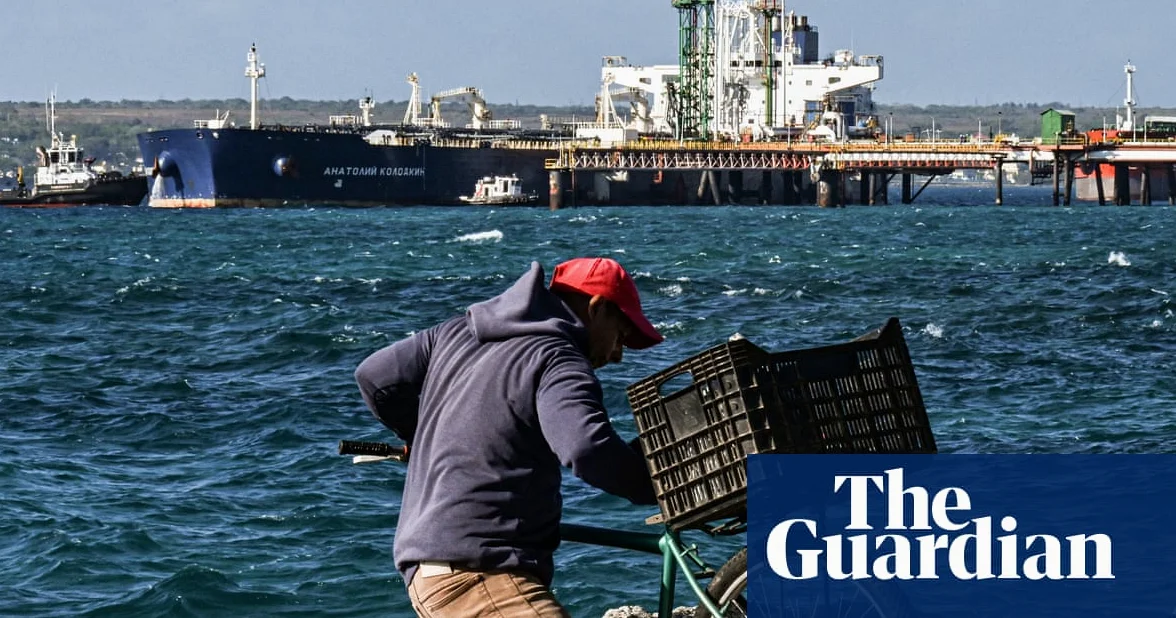
Cubans are studying the arrival of a sanctioned Russian oil tanker, the Anatoly Kolodkin, at Matanzas’ oil terminal as a potential signal of progress in secret talks with the United States. The vessel. Carrying 700. 000 barrels of crude. Arrived despite Donald Trump’s earlier declaration that no oil or money would go to Cuba. The US president had vowed in January: “THERE WILL BE NO MORE OIL OR MONEY GOING TO CUBA – ZERO!” but later told reporters that he had no problem with oil shipments to the island.
The Blockade and the Economy
The US oil blockade has placed further strain on an already struggling Cuban economy. Tourism, a vital sector, has all but collapsed after airlines from Canada, Russia, China, and France ceased operations, with Iberia set to leave at the end of May. Most petrol stations are closed. And blackouts are now a daily occurrence — the population, estimated at 9.5 million after a 2 million-strong exodus in the last five years, is exhausted by the ongoing crisis.
“Everything is collapsing – health. Education, transport, everything,” said one man outside a church in El Cobre, a famous site of pilgrimage in the east of the country, while the situation has led many Cubans to scrutinize the limited information leaked about ongoing negotiations between Washington and Havana.
Diplomatic Interpretations and Confidence-Building
One ambassador suggested that the arrival of the Russian oil tanker might be a tactical move by the White House, allowing the US to point to a specific action as the humanitarian crisis worsens. However, the diplomat also considered the possibility that the move could be a confidence-building measure, hinting at progress in negotiations. This interpretation was supported by the release of 2,010 prisoners by Cuba, which some observers linked to the oil shipment as a sign of reciprocal gestures of goodwill.
William LeoGrande, professor of government at the American University in Washington, noted that such moves resemble historical attempts at detente, though he stated that the events suggest the two sides may be making reciprocal gestures to advance their conversations.
Private Businesses and Economic Shifts
Since 2021, Cuba has seen the emergence of over 10,000 small to medium-sized private businesses known as Mipymes. These businesses have created a new class of wealthy Cubans, many of whom have ties to the regime and Gaesa, the army’s economic wing. Raúl Guillermo Rodríguez Castro, who has been involved in US negotiations, is the grandson of former president Raúl Castro and the son of the former head of Gaesa, Luis Rodríguez López-Calleja, who died in 2022.
Meanwhile, Sandro Castro, Fidel Castro’s grandson, told CNN that many Cubans want to embrace capitalism with sovereignty, stating that the majority prefer a capitalist system over communism. He also criticized the current president, Miguel Díaz-Canel, for not doing a good job. However, such statements have not led to immediate consequences, suggesting a shift in the regime’s tolerance for dissent.
A senior diplomat in Havana noted that if the Americans are offering the Cuban government the ability to keep its businesses while opening up to the US, such a deal might be possible. However, the compatibility of this approach with Marco Rubio, Trump’s Cuban-American secretary of state, who has long aimed to unseat the Castros, remains uncertain.
Pedro Freyre, a Miami attorney, suggested that while the Castro name carries historical weight, it may prove difficult to remove from power. Díaz-Canel, by contrast, is a leader by consensus without deep historical ties, making him easier to maneuver.
More concerning is the fate of the roughly 40% of Cubans who do not work in the private sector or receive money from relatives abroad. These people, often elderly, are now on the edge of starvation, having given their lives to a revolution that promised to care for them from cradle to grave.


Comments
No comments yet
Be the first to share your thoughts