

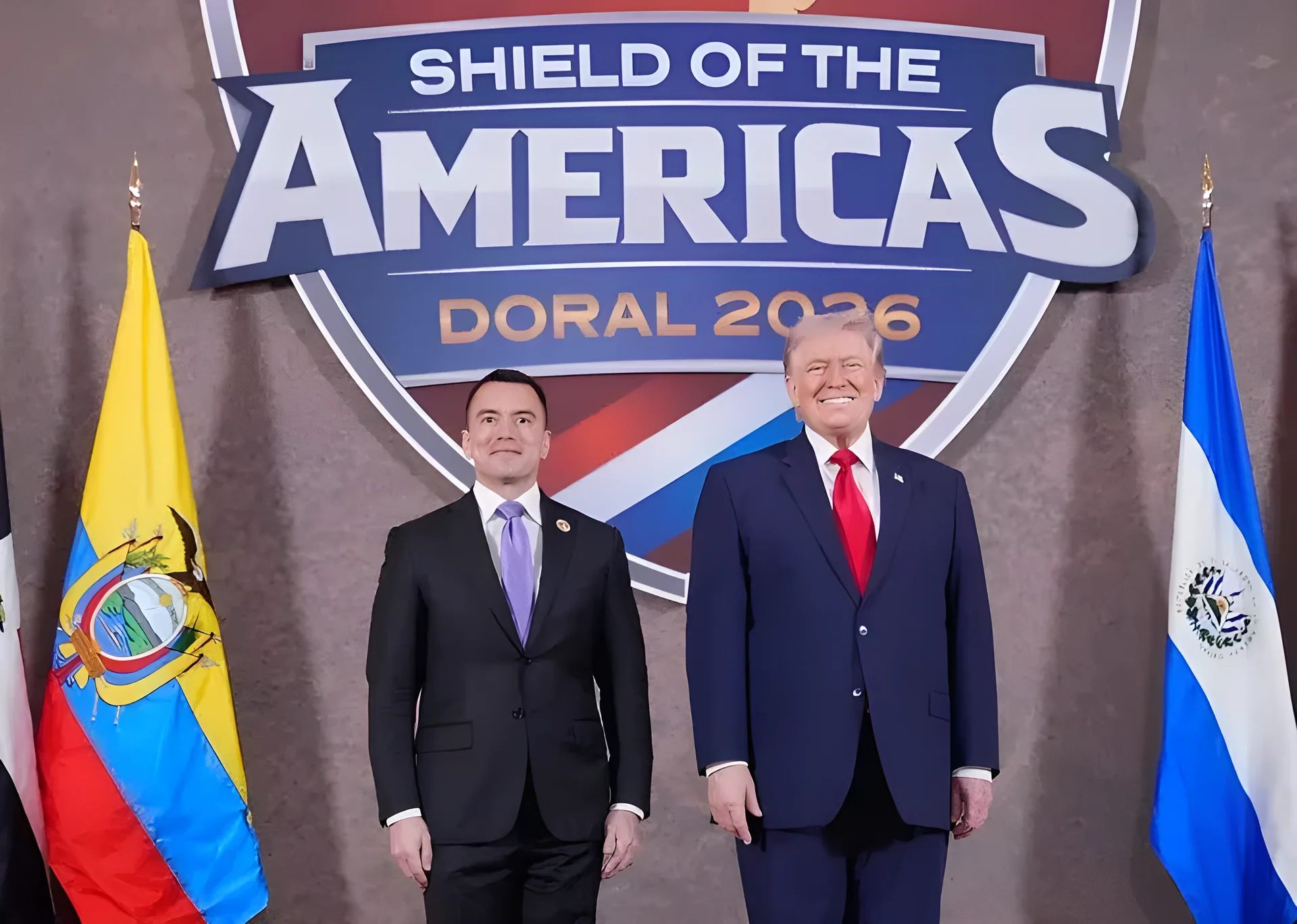
Ecuador’s President Daniel Noboa has declared ‘time has run out’ for the criminal ‘mafias’ that have long exploited Latin America, as the United States and Ecuador launched joint military operations on Ecuadorian soil against ‘terrorist’ organizations. The move marks a significant escalation in the fight against organized crime in the region, with Noboa attending a summit in Miami convened by U.S. President Donald Trump, where he denounced the groups that he claimed had for too long operated with impunity across borders.
Joint Operations Target Border Commandos
The military collaboration between the two nations was made public after U.S. and Ecuadorian forces bombed and destroyed a training camp belonging to the Border Commandos, a dissident group linked to the now-defunct Major Armed Forces of Colombia (FARC) guerrillas. The operation took place in the Amazonian province of Sucumbíos, which borders Colombia, and was carried out by Ecuadorian military forces acting on intelligence with U.S. support. The camp, reportedly led by a figure known as Mono Tole, was said to be capable of training up to 50 drug traffickers.
Ecuador has been grappling with a surge in violence, with the country holding the highest homicide rate in Latin America. Noboa has labeled the criminal gangs responsible for this violence as ‘terrorists,’ a designation the U.S. has also adopted for two of the most violent groups in Ecuador, Los Lobos and Los Choneros.
U.S. Designates Ecuador as Key Ally
At the summit, dubbed ‘Shield of the Americas,’ Noboa met with U.S. officials, including Kristi Noem, who oversees the ‘Shield of the Americas’ strategy and was recently dismissed as U.S. Secretary of Homeland Security. Noem praised Ecuador’s role in the regional fight against cartels, stating, ‘Ecuador has been a very steadfast partner for all of us. We have worked not only on security and the fight against the cartels, but also on ensuring that drug trafficking is combated.’
The summit brought together leaders from Argentina, Bolivia, Costa Rica, the Dominican Republic, El Salvador, Guyana, Honduras, Panama, Paraguay, and Trinidad and Tobago, with Chile’s incoming president, José Antonio Kast, also in attendance. The event underscored a growing regional alliance aimed at curbing the influence of transnational criminal networks.
Noboa’s remarks were made public through his Twitter account, where he shared photographs from the summit, including a signed executive order by U.S. President Trump formalizing a new ‘military coalition’ in Latin America against drug cartels. Noboa had previously stated that he would attend the summit for ‘security reasons,’ emphasizing the need for international support to protect Ecuadorians from the escalating violence.
The military operation in Sucumbíos is the latest in a series of coordinated efforts between the U.S. and Ecuador to dismantle networks responsible for drug trafficking, weapons smuggling, and the spread of violence. The U.S. has provided intelligence, training, and logistical support to Ecuador’s military in recent months, as part of a broader strategy to combat organized crime in the region.
Regional Implications and What’s Next
The joint military operation and the broader ‘Shield of the Americas’ initiative are expected to have significant implications for the region. Analysts note that the collaboration between the U.S. and Ecuador could lead to further militarization of security policies across Latin America, with potential impacts on civil liberties and regional stability.
According to reports, the U.S. has already designated Los Lobos and Los Choneros as ‘terrorist’ organizations, a move that could facilitate more aggressive law enforcement actions against these groups. The designation also opens the door for the application of U.S. sanctions and other measures against individuals and entities associated with the gangs.
With the summit signaling a new phase in the fight against organized crime, the next steps for the U.S. and Ecuador include the implementation of the new ‘military coalition’ strategy, the expansion of joint operations, and the potential for increased military and intelligence cooperation. The U.S. has also pledged to provide additional resources to support Ecuador’s efforts to combat the gangs and reduce the homicide rate, which has reached alarming levels in recent years.
As the situation unfolds, the international community will be closely watching to see how the joint operations and the ‘Shield of the Americas’ strategy evolve, with particular attention to their effectiveness in reducing violence and improving security for citizens across the region.






Comments
No comments yet
Be the first to share your thoughts