

 The Guardian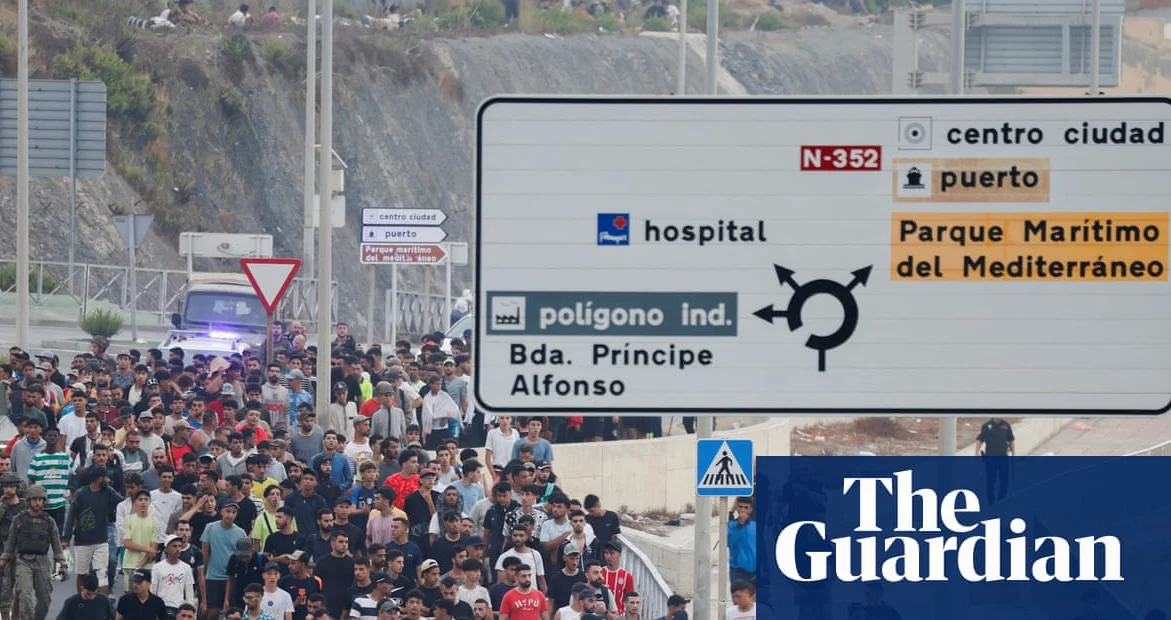
The EU will hold an extraordinary meeting of interior ministers after a breakdown of political unity over the arrival of more than 50,000 irregular migrants in the Spanish enclave of Ceuta in north Africa. Officials representing EU member states and Frontex border agency experts met at an emergency meeting on Saturday after Pedro Sánchez, the Spanish prime minister, accused some EU countries, particularly Italy, of weaponising Friday’s events instead of showing “solidarity and empathy.”
Spain Installs New Barrier After Border Breach
Andy Burnham, the British prime minister, said on Saturday: “I have been in touch with the Spanish prime minister and [we are] providing what help we can.” His comments came as Spain announced it was installing a new barrier along the breakwater into the sea after the massive border breach.
There is frustration in Spain that previous incidents of this scale, where migrants massed on the border of Poland, were labelled as a “hybrid attack” from Belarus and were met with solidarity for Poland. More than 50,000 people crossed into the territory from Morocco on Thursday and Friday, with at least 67 people dying in the attempt; some drowned, while others were halted as they tried to cross a breakwater barrier.
Political Crisis and Calls for Schengen Suspension
Although more than 48,000 people had voluntarily returned to Morocco by 6pm on Friday, the influx triggered a political crisis for the Madrid government and led some fellow EU countries to call for Spain to be suspended from the Schengen free-movement zone. Sánchez said “virtually all” of those who had crossed the border had been returned, “preventing any unauthorised onward movement towards continental Europe.”
Juan Jesús Vivas, the president of Ceuta, said that while many people had returned to Morocco, not all those who had crossed into the city had left. “We’re not back to normal because there are several thousand people who need to be returned, and there is still an atmosphere marked by unease and concern,” he said. He also called for “all the security measures deployed” in Ceuta to remain in place to guarantee the safety of the population.
Sánchez asked for the meeting after what appeared to be a breakdown of EU unity on external border policy, with Italy attacking Spain. Italy announced on Friday evening that it would suspend its Schengen arrangements with Spain for a month, even though Ceuta, and Spain’s other north African enclave, Melilla – are subject to special Schengen rules that prevent onward movement within the zone.
Italy’s foreign minister, Antonio Tajani, blamed the situation in Ceuta on the Sánchez government’s decision to offer a now-closed scheme to regularise the status of more than 1 million undocumented migrants and asylum seekers. He said the programme had incentivised human trafficking and was “profoundly wrong.”
European Leaders Respond and Call for Unity
Sánchez was forthright in a letter sent to the European Commission president, Ursula von der Leyen, the European Council president, António Costa, and Micheál Martin, the prime minister of Ireland, which holds the EU presidency. Sánchez said that while most EU countries had expressed support and solidarity over events in Ceuta, others had chosen to attack Spain.
“Such an attitude, driven by prejudice, fake news, ignorance or political interest – is … contrary to European law, humanitarian law and the principles of solidarity that bind us together,” he said. In a pointed rebuke to Italy, he noted that Spain was “according to Frontex, one of the least porous external borders of the European Union, with a number of irregular entries that is half that recorded, for example, in Italy in recent years (2021–26).”
Senior EU officials met on Saturday in a “political crisis response team” convened by Ireland’s presidency. Ireland’s prime minister, Micheál Martin, said on Saturday that, as the holders of the EU presidency, “Ireland will convene a meeting on Tuesday of the EU Justice and Home Affairs Council, chaired by Jim O’Callaghan [justice minister], to discuss developments in Ceuta. We remain in close contact with all member states and the institutions and continue to monitor the situation,” he said in a social media post.
O’Callaghan, who is leading the meetings on behalf of the EU, said he had been in touch with Spain’s interior minister, Fernando Grande-Marlaska, to express his solidarity and support. In remarks that appeared to respond to Sánchez’s criticisms, von der Leyen said she welcomed his suggestion of a video conference “to take stock of what has happened,” adding: “Fighting illegal migration requires solidarity and a united European response.”
France’s interior minister, Laurent Nuñez, said his country would not be seeking Spain’s suspension from Schengen rules, though “It’s absolutely not on the table,” he said on Saturday. “We have great cooperation with Spain.” Many of the remaining people who crossed into Ceuta returned to Morocco on Saturday morning amid a reinforced Spanish police and military presence.






Comments
No comments yet
Be the first to share your thoughts