

 BBC
BBC 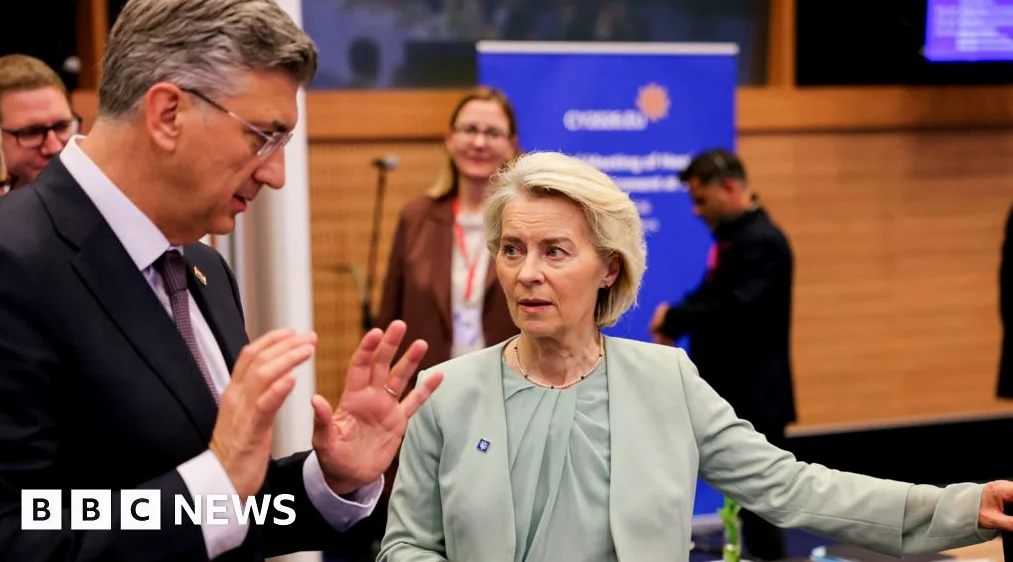
Whenever leaders meet in the EU. They often find themselves dealing with crises instead of practical matters like the new EU budget, according to Katya Adler; this pattern has emerged as leaders gather in Cyprus.
Alleged US Threat to Spain Sparks Tensions
Spain’s Prime Minister Pedro Sanchez said he was calm when he arrived at the leaders’ summit. His comments came in response to a leaked email from the US Pentagon suggesting punitive measures against Spain for its stance on the US-Israeli campaign against Iran.
There is no provision in the NATO treaties to expel a member country, and suspending Spain would require unanimous agreement from all NATO members — the email was first reported by Reuters on Friday.
European Leaders Stand by Spain
At the Cyprus summit. Fellow EU leaders and NATO members defended Spain; Dutch Prime Minister Rob Jetten emphasized that Spain is and will remain a full NATO member; he said European countries are doing much to strengthen NATO, which he stated is also in America’s interest.
A high-ranking German official affirmed Spain’s NATO membership and saw no reason for it to change; Italian Premier Giorgia Meloni criticized the tensions between Washington and Madrid as ‘not at all positive.’
Meloni, once seen as close to Donald Trump, now faces a shift in public opinion in Italy and across Europe against Trump — she denied the US permission to use the Sigonella airbase in Sicily for operations against Iran. She also criticized Trump’s recent remarks about the Pope as ‘unacceptable.’
Broader NATO Concerns and Tensions
The leaked Pentagon email also suggested reviewing the US position on the UK’s claim to the Falkland Islands, a territory also claimed by Argentina. This is due to British Prime Minister Sir Keir Starmer denying a request to use British military bases for attacks on Iran in February.
Spain’s stance on the US-Israeli strikes on Iran, which Sanchez described as illegal under international law, led to threats of trade sanctions from Trump. Sanchez also previously refused to increase defense spending by 5% of GDP, which further irritated Washington.
Spain dismissed the leaked email, with Sanchez stating they do not work based on emails but on official documents and positions taken by the US government. Camille Grande, former NATO Assistant Secretary General, criticized the Trump administration for a ‘fundamental misunderstanding’ of NATO’s purpose.
French President Macron accused Trump of ‘hollowing out’ NATO by undermining the alliance in public. Trump often calls NATO a ‘paper tiger’ and has threatened to leave the alliance, describing it as a ‘one-way street.’
These tensions raise concerns about NATO’s unity. Countries in Eastern Europe, fearing an expansionist Russia, now question if the US will come to their aid as envisioned in Article 5 of the NATO treaty. Poland’s Prime Minister Donald Tusk has openly questioned the US commitment in recent weeks.
NATO estimates that Russia could attack a NATO nation within three years. The Dutch military intelligence service MIVD warned that Russia might aim to divide NATO politically through limited territorial gains, possibly under the threat of nuclear armament.
Estonia, a small NATO and EU member, felt exposed this week when the Pentagon delayed delivering a high-tech weapons system. The US Embassy in Tallinn had previously described the purchase as ‘one of the most significant capability upgrades in Estonian military history.’
Despite being in Trump’s ‘good books’ last year, Estonia now feels vulnerable. US Defense Secretary Pete Hegseth hinted at the Trump administration dividing allies into ‘good guys’ and ‘bad guys’ in a December address.






Comments
No comments yet
Be the first to share your thoughts