

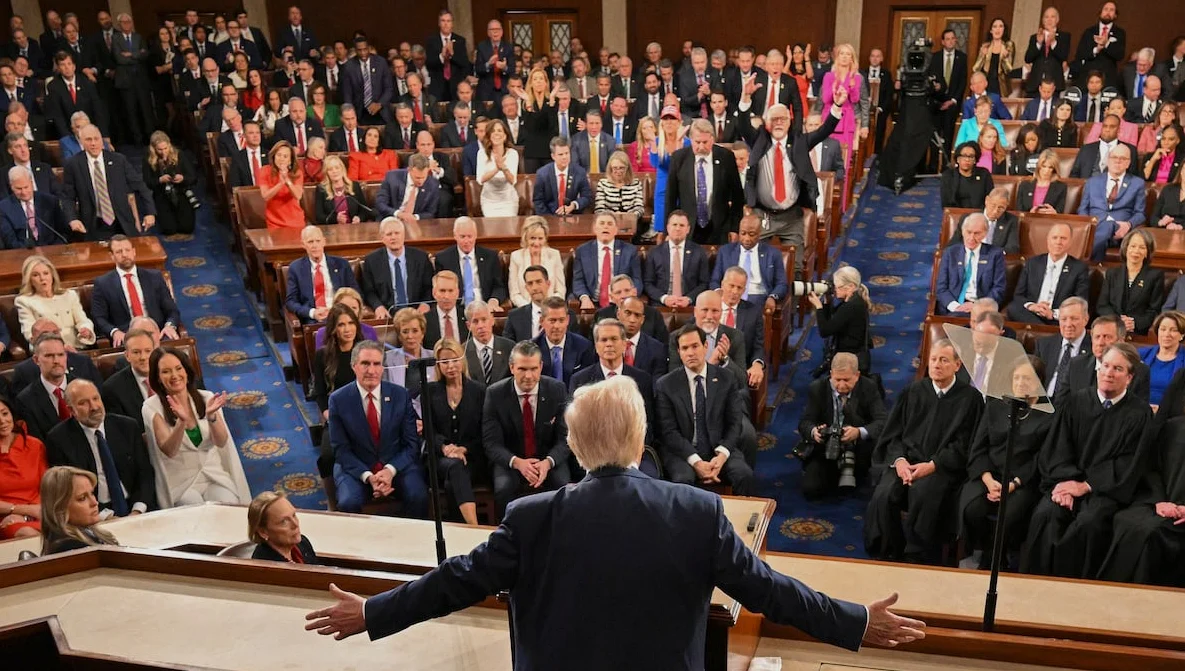
President Donald Trump delivered his first State of the Union address of his second term on Tuesday night, outlining his accomplishments and policy goals. The speech, which began at 9 p.m. ET, was closely watched by both supporters and critics. However, the claims made by Trump during the address have been under intense scrutiny from fact-checkers across the nation.
Fact-Checking Trump’s Claims on Drug Cartels and Fentanyl
Trump stated that he designated drug cartels in Mexico as Foreign Terrorist Organizations and labeled illicit Fentanyl as a Weapon of Mass Destruction. Under his administration, the State Department has indeed designated several drug cartels as FTOs. However, this is a novel use of the designation, which has traditionally been applied to overseas entities like al-Qaida or ISIS. Experts have raised concerns that responding to criminal narcotics enterprises, which operate for profit, is fundamentally different from disrupting networks that pose ideological or violent opposition to the U.S. government.
Fact-Checking Claims on Iran’s Crackdown on Protesters
Trump claimed that Iran’s security forces have killed at least 32,000 protesters in recent months. This figure is significantly higher than the estimates from human rights groups and Iran’s government. The Human Rights Activist News Agency has reported more than 7,000 deaths, while Iran’s government acknowledged over 3,000 fatalities, including both protesters and security personnel. Trump’s assertion appears to be an overstatement.
Fact-Checking the Case of Iryna Zarutska
Trump referenced the murder of Iryna Zarutska, a 23-year-old woman who was fatally stabbed in Charlotte, North Carolina. He claimed that the perpetrator, DeCarlos Brown Jr., was an immigrant who entered the country through an open border. However, local media has reported that Brown was born and raised in Charlotte and had a history of incarceration in North Carolina. There is no evidence to support Trump’s claim that Brown was an immigrant released through an open border policy.
Fact-Checking Trump’s Claim on Ending Wars
Trump has repeatedly claimed that he has ended eight wars, but this is an exaggeration. His most notable diplomatic success was brokering a ceasefire in the Israel and Hamas war in Gaza in October. However, Israel has continued airstrikes in the region, killing hundreds of Palestinians since the truce was announced. Additionally, Trump has not resolved longstanding issues with Iran, and he is currently considering new attacks on Iran’s nuclear program, despite his previous claim that it was ‘obliterated’ in June.
Fact-Checking Economic Claims
Trump claimed that he secured commitments for more than $18 trillion in global investment within 12 months. He also stated that American oil production has increased by more than 600,000 barrels a day and that natural gas production is at an all-time high. According to the Energy Information Administration, U.S. crude oil production rose about 400,000 barrels a day from 2024, but it is expected to drop by about 100,000 barrels a day in 2026 due to low oil prices. Natural gas production has indeed increased, but this is partly due to technological advancements rather than a drilling spree as Trump suggested.
Fact-Checking Claims on Election Integrity
Trump has long claimed that noncitizens are voting in large numbers in American elections. However, research has found that noncitizens have never been found to vote in anything but microscopic numbers. In the 2024 election, an audit in Michigan found only 16 alleged noncitizen votes out of the state’s roughly 5.7 million cast, while in Iowa, it was 35 out of 1.67 million. Experts argue that it is highly unlikely that immigrants without legal status would risk deportation to vote, given the paper trail involved.
What Analysts Say
David Becker, an election expert, said that states have been looking extensively for noncitizen voters but have found very few. ‘Even states that are looking everywhere to try to amplify the numbers of noncitizens … when they actually look, they find a surprisingly, shockingly small number,’ Becker stated.
As the debate over the accuracy of Trump’s claims continues, the focus will shift to the potential implications for future elections and policy decisions. The upcoming mid-term elections in 2026 could be a key test for the accuracy of Trump’s claims and the impact they may have on public perception and voting behavior.






Comments
No comments yet
Be the first to share your thoughts