

 The Guardian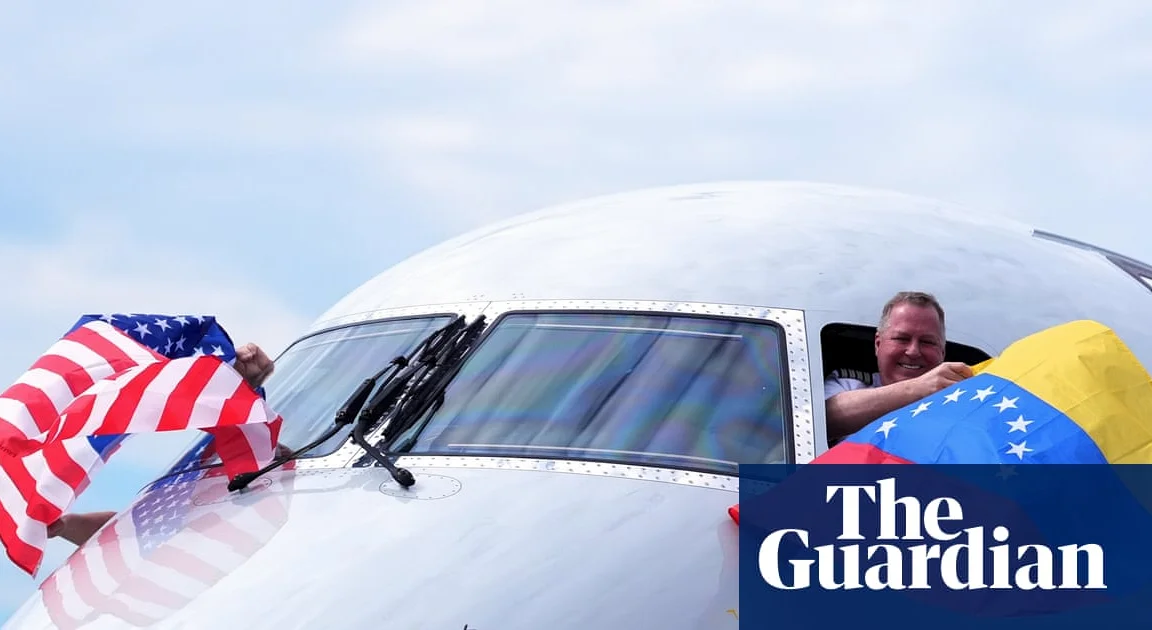
US and Venezuelan officials have hailed a new era in diplomatic relations as the first direct commercial flight between the two countries in more than seven years landed in Caracas. The flight marked a significant development after years of strained ties.
Historic Flight and Symbolic Gestures
Nearly four months ago. US special forces attack helicopters and planes swept into the skies over Venezuela’s capital after Donald Trump ordered the capture of its president, Nicolás Maduro. On Thursday afternoon. An American Airlines passenger jet from Miami landed at Venezuela’s Simón Bolívar international airport, signaling a strange new chapter in the long-toxic ties between Caracas and Washington.
“This is a historic day,” José Freig, the carrier’s vice-president of international operations, declared before handing Venezuela’s transport minister, Jacqueline Faría, a model of one of his company’s planes. Speaking in Spanish, the US chargé d’affaires in Venezuela, John Barrett, hailed a “historic milestone,” saying: “We are witnessing the reconstruction of our economic ties, Venezuela’s reopening to global commerce and the reconnecting of our peoples.”
Economic Reforms and Political Transition
Barrett called the new flight “a direct result” of Trump and secretary of state Marco Rubio’s three-phase plan for post-Maduro Venezuela: stabilising Venezuela, rebooting its moribund economy, and eventually securing a political transition back towards democracy. “We are only just getting started,” Barrett told dozens of journalists who had assembled by the runway before Flight 3599 touched down at 1.15pm local time.
Faría said: “This country wants to connect itself to the world and it is a great pleasure for us to once again open the doors to the entire world.” The airport has long been a symbol of Venezuela’s devastating migration crisis, with millions fleeing abroad due to the country’s economic meltdown under Maduro and political repression. Foreign journalists and Venezuelan activists have frequently been deported or interrogated while trying to enter or leave the country.
On Thursday, the mood was lighter as the US flight approached Venezuela’s northern coast and Venezuelan passengers queued up to travel on the return flight. A Venezuelan saxophonist celebrated the moment with muzak renditions of Frank Sinatra’s “New York, New York,” Bill Withers’ “Ain’t No Sunshine,” and Hotel California by the Eagles.
Skepticism and the Future of Democracy
Oliver Blanco, a senior Venezuelan diplomat, said: “We are writing a new chapter in coexistence [and] economic opening.” Félix Plasencia, Venezuela’s top diplomat in the US and a former ambassador to London, told journalists: “We are thrilled to have you here for this very first flight … and this should be the first one of many.”
As he prepared to check in, Eloy Montenegro, a 71-year-old civil engineer flying to Miami, said the new route would make travel between the US and Venezuela easier. Of the years-long breakdown of relations between the two countries, Montenegro said: “That should never have happened but it happened. And things are much better now.”
The last US commercial flight to take off from Caracas did so in March 2019, in Trump’s first term, as relations collapsed amid Trump’s effort to force Maduro from power through sanctions and threats. Other US airlines had already halted their flights as a result of the political and social turmoil sweeping Venezuela amid one of the world’s worst economic collapses outside a war zone.
The new partnership between the White House and its longstanding anti-imperialist foes in Caracas represents a once improbable diplomatic handbrake turn. Since Maduro’s capture, his vice-president, Delcy Rodríguez, has assumed power with Trump’s blessing and has overseen a series of major economic concessions involving Venezuela’s oil and mining industries.
Trump has repeatedly praised the actions of Rodríguez, who he warned would face an even worse fate than Maduro if she refused to toe the line. “I see it as a viceroyship,” said John Feeley, a veteran former US diplomat in Latin America and ambassador to Panama, of Venezuela’s highly unusual new relationship with the US. “It’s a powerful king-like figure that extracts rent from overseas territories and the person in charge who makes sure that the king or the crown, or in this case Washington, gets its due is Delcy.”
Many are skeptical that the third phase of the plan – a political transition back towards democracy – will happen, with Rodríguez’s administration apparently in no rush to give up power or hold fresh elections. “It’s not time for elections,” the powerful interior minister, Diosdado Cabello, said on the eve of the flight’s arrival.
Feeley, who resigned from the foreign service during Trump’s first term, did not completely rule out that the US intervention in Venezuela might eventually benefit the people of that country, after years of economic chaos, international isolation, and increasingly centralized rule. “We can never predict the future with any accuracy and I don’t … want to foreclose the possibility that this unconstitutional and, by international law, illegal action by the United States could not still result in a net positive for the Venezuelan people in terms of their democracy. I want to believe that can happen,” Feeley said.
“[But] I’m pessimistic because of the track record of the Trump team and Donald Trump himself and his own attitudes towards democracy. If Donald Trump is an centralized-style president internally in the United States, what leads one to conclude he would be promoting democracy in another country?”





Comments
No comments yet
Be the first to share your thoughts