

 The Hindu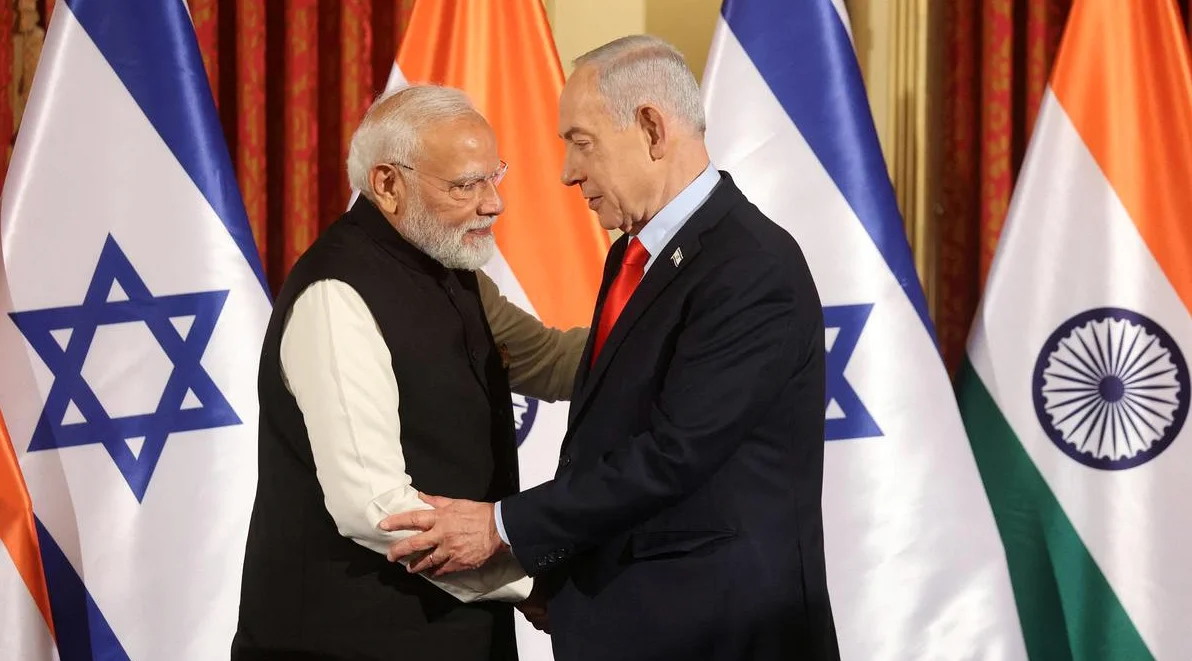
India and Israel have elevated their long-standing relationship to a ‘special strategic partnership,’ a move that marks a significant deepening of their diplomatic and economic ties. This decision was announced following high-level talks between Prime Minister Narendra Modi and his Israeli counterpart, Benjamin Netanyahu, during Modi’s two-day visit to Israel, which began on February 25, 2026. The two leaders also agreed to expedite the conclusion of a free trade agreement, aiming to boost bilateral trade and investment.
Expanding Strategic and Economic Cooperation
During their meeting, Modi and Netanyahu signed a series of agreements covering trade, agriculture, energy, cyberspace, and digital payments. A key point of discussion was the expansion of the existing defense partnership, with both nations vowing to work toward joint development and production of military hardware under the framework of technology transfer.
Modi highlighted that India’s national security interests are closely tied to peace and stability in West Asia, expressing full support for the Gaza Peace Initiative. ‘India’s stance is clear: humanity must never become a victim of conflict,’ he said in a media statement. ‘A path to peace has been created through the Gaza Peace Plan. India has fully supported these efforts.’
Modi emphasized that the relationship between India and Israel is built on ‘deep trust, shared democratic values, and human sensitivities,’ noting that it has ‘stood the test of every trial of time.’ He also announced the establishment of an India-Israel critical and emerging technologies partnership, focusing on artificial intelligence, quantum technology, and critical minerals. ‘I am pleased that an agreement has been reached for the use of UPI in Israel,’ he added, referring to India’s Unified Payments Interface.
Combating Terrorism and Strengthening Regional Ties
The two leaders reaffirmed their shared commitment to countering terrorism in all its forms. ‘India and Israel are completely clear that there is no place for terrorism in the world. In any form, in any expression, terrorism cannot be accepted,’ Modi said. ‘We have stood shoulder-to-shoulder in opposing terrorism and its supporters, and we will continue to do so.’
The talks also included discussions on the India-Middle East-Europe Economic Corridor (IMEC), a proposed trade and infrastructure initiative aimed at connecting India with Europe through the Middle East. Modi and Netanyahu also outlined cooperation under the I2U2 framework, which includes India, Israel, the United Arab Emirates, and the United States.
Modi’s visit to Israel marks his second in nine years, highlighting the growing strategic alignment between the two nations. His previous visit was in 2017, and this latest trip follows a period of increased diplomatic engagement and economic collaboration.
Looking Ahead: Implications for Trade and Technology
Analysts suggest that the elevation of the India-Israel relationship to a special strategic partnership could have far-reaching implications for regional stability and global trade. According to a report by the India-Israel Business Council, bilateral trade between the two nations reached $13.7 billion in 2025, up from $11.2 billion in 2024. The projected free trade agreement, if finalized, could further boost this figure by eliminating tariffs and streamlining customs procedures.
The agreement on the use of India’s UPI system in Israel is expected to facilitate cross-border digital transactions and enhance financial integration. ‘This move will not only benefit businesses but also ordinary citizens who can now access a wider range of financial services,’ said Ravi Shukla, an economic analyst with the National Institute of Economic Research.
Looking ahead, both countries are expected to finalize the free trade agreement by the end of 2026. Additionally, the India-Israel critical and emerging technologies partnership is anticipated to yield concrete results in the next 18 months, with initial projects in artificial intelligence and quantum computing likely to be launched by mid-2027.
The elevation of the bilateral relationship to a special strategic partnership is expected to further solidify India’s role as a key player in the Middle East and enhance its strategic partnerships with other global powers. ‘This is a landmark moment in India-Israel relations, one that reflects the deepening of our ties across multiple domains,’ Netanyahu said in a joint press conference with Modi.






Comments
No comments yet
Be the first to share your thoughts