

 Xinhua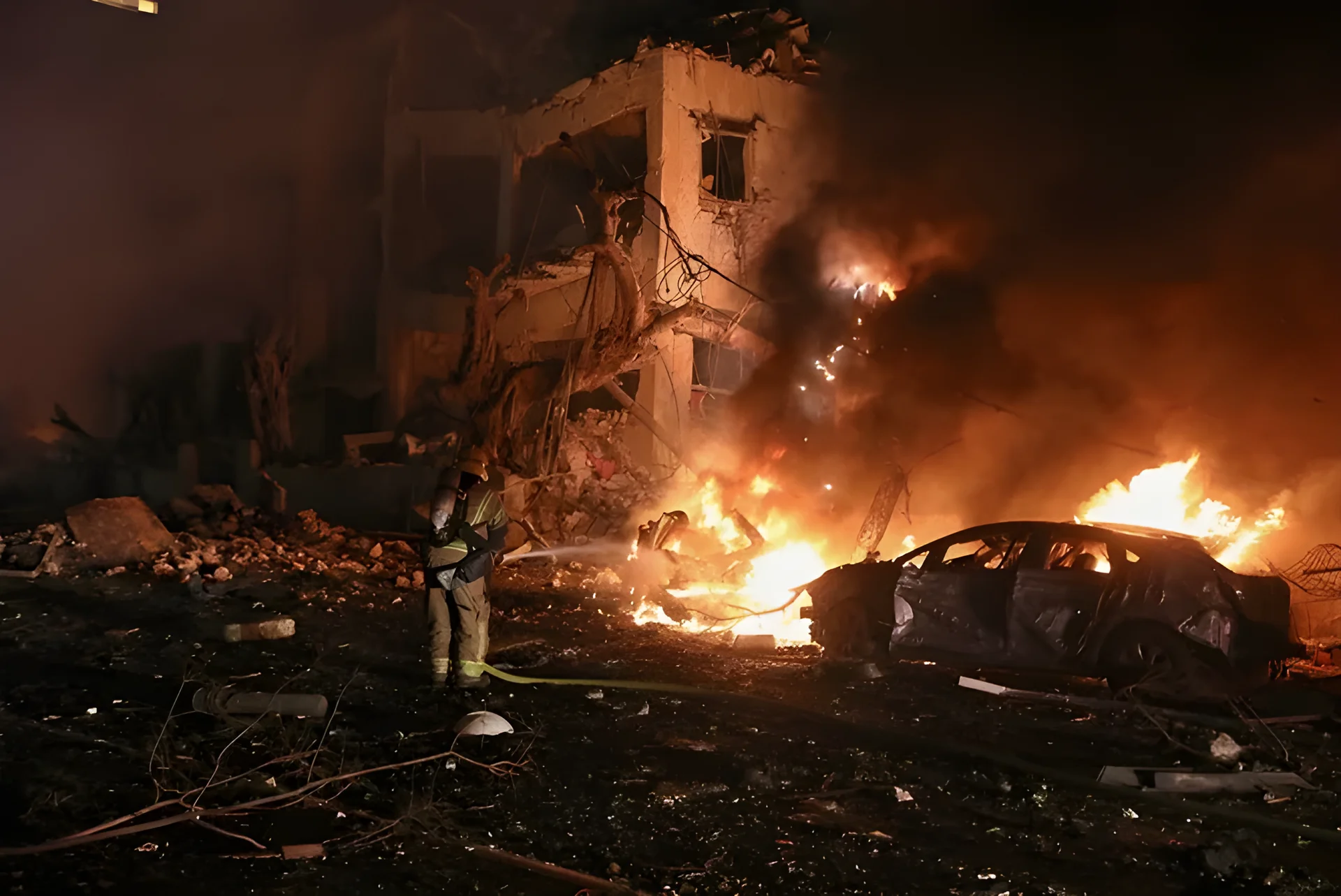
Iran’s Islamic Revolution Guards Corps (IRGC) announced Saturday night that it launched attacks on a refinery in Israel’s Haifa in response to the targeting of an oil depot in southern Tehran, according to Xinhua. The IRGC said the Haifa refinery was hit by Khyber-Shakan missiles in retaliation for the Israeli attack, which was carried out by U.S. and Israeli warplanes.
Israeli Air Strikes on Iranian Missile Sites
The Israel Defense Forces (IDF) confirmed that it struck two main ballistic missile production sites in Iran, located in Parchin and Shahrud, using hundreds of fighter jets guided by intelligence, the IDF stated. In the Parchin strike, southeast of Tehran, the IDF targeted infrastructure used for the production of essential components for various weapons, the statement said. In Shahrud, north-central Iran, the IDF struck a ballistic missile production site of the IRGC.
Israel’s President Isaac Herzog told CBS News that Israel is not calling for a ground invasion of Iran. ‘Let me be clear, I’m not calling on any boots on the ground. I’m not asking any American or anyone else,’ Herzog said. The strikes, which began on February 28, have marked a significant escalation in tensions between Israel and Iran, with both sides accusing each other of aggression.
Iranian Threats to U.S. and Israeli Assets
An Iranian military spokesperson warned Saturday that ‘enemy ships’ entering the Gulf would ‘end up at the bottom’ of the waterway, according to multiple media reports. The IRGC stated it had hit a Marshall Islands-flagged oil tanker, the ‘Louise P,’ with a drone around Saturday noon, identifying it as a U.S. asset in the middle of the Gulf.
The IRGC previously announced that all Israeli and U.S. assets in the West Asia region would be considered legitimate targets for the Iranian armed forces. Earlier that day, Iran’s official news agency IRNA reported that the IRGC had hit an oil tanker in the Strait of Hormuz, which the agency described as a ‘violating’ vessel that failed to heed warnings about the prohibition of movement due to security concerns.
A senior Iranian official, Abolfazl Shekarchi, stated that Iran has not and will not attack regional countries that do not provide their airspace, land, or facilities to the ‘enemies.’ He emphasized that any state providing space for U.S. or Israeli actions against Iran would become a target. ‘However, any state that provides the United States and Israel with space or a place to be used for action against us, that space and place will naturally be among our targets,’ Shekarchi said.
Regional Fallout and Escalating Tensions
The U.S. embassy in Baghdad was targeted by rockets Saturday evening, with explosions heard, according to an anonymous Interior Ministry source. No immediate casualties or losses were reported. Iraqi Prime Minister Mohammed Shia’ al-Sudani ordered military and security commanders to pursue those responsible for the attack and bring them to justice.
In a separate incident, one member of the Iraqi paramilitary Popular Mobilization Forces (PMF) was killed and three others wounded in airstrikes in northern Iraq’s Nineveh province. The strikes targeted the PMF’s 40th Brigade and 33rd Regiment, with the group blaming U.S.-Israeli bombs for the attacks.
Meanwhile, in eastern Lebanon, 26 people were killed and an unspecified number wounded during clashes following Hezbollah’s claim that it repelled an attempted Israeli commando landing. The clashes occurred near the Lebanese-Syrian border after Israeli military helicopters conducted a landing operation in the area.
Amid the escalating tensions, Israeli Prime Minister Benjamin Netanyahu vowed that Israel’s attacks on Iran would continue with ‘full force and uncompromising momentum.’ Netanyahu said Israel has a ‘well-prepared plan with many surprises’ to undermine the ‘Iranian regime’ and ‘enable change.’ Addressing the Iranian people, he said, ‘The moment of truth is approaching. We do not seek to divide Iran, but to liberate it and live with it in peace.’
Netanyahu also condemned the United Nations for ‘condemning us without reason in our just war against Iran’s murderous proxies in Gaza and doing nothing about the massacre in Iran.’ He demanded that the Lebanese government enforce a ceasefire agreement and disarm Hezbollah.
In addition, Iran’s Foreign Ministry spokesman Esmaeil Baghaei called on the United Nations to ‘bear its legal and moral responsibilities regarding the ‘illegal war’ on the country.’



Comments
No comments yet
Be the first to share your thoughts