

Israel has deployed additional troops along its northern border with Lebanon as tensions with Iran-backed Hezbollah continue to rise, following a series of attacks and retaliatory strikes. The Israeli military confirmed the move as part of a ‘forward defence’ strategy to protect border communities from potential attacks.
Israeli Military Strengthens Border Defenses
According to the Israeli military, soldiers have been positioned at several points along the border in southern Lebanon to strengthen defensive positions. Lieutenant Colonel Nadav Shoshani, an Israeli military spokesman, stated that the deployment is intended to safeguard civilians and prevent Hezbollah from launching attacks.
‘This is not a ground operation. This is a tactical measure to ensure the safety of our people,’ Shoshani said during a briefing with journalists.
Defense Minister Authorizes Strategic Expansion
Israel’s Defence Minister Israel Katz confirmed that the government had authorized the military to expand its presence in Lebanon after attacks from Hezbollah. ‘Prime Minister Benjamin Netanyahu and I have authorized the Israel Defense Forces (IDF) to advance and take control of additional strategic positions in Lebanon in order to prevent attacks on Israeli border communities,’ Katz said in a statement.
The escalation comes amid regional tensions following US and Israeli strikes on Iran, which killed Supreme Leader Ali Khamenei. In response, Hezbollah joined Iran in attacking Israel, leading to a series of retaliatory strikes across Lebanon.
Hezbollah Strikes Israeli Military Sites
Hezbollah claimed it conducted attacks on several Israeli military sites in response to Israeli air raids on its strongholds. The group said it launched attack drones at the Ramat David airbase and the Meron monitoring base in northern Israel. It also claimed to have fired a rocket barrage targeting the Naffakh base, also known as Camp Yitzhak, in the occupied Golan Heights.
‘These attacks were conducted in response to the criminal Israeli aggression on dozens of Lebanese cities and towns,’ Hezbollah said in a statement.
The militant group also claimed that Israel had struck two of its media outlets overnight. Hezbollah’s Al-Manar television network reported that its Beirut headquarters had been targeted, while Israel reportedly struck the offices of Hezbollah’s Al-Nour radio broadcaster.
In a separate statement, Hezbollah condemned the attacks on what it described as ‘two civilian media outlets,’ saying they were intended to silence ‘the voice and image of the resistance.’
Israeli Air Strikes Continue in Beirut
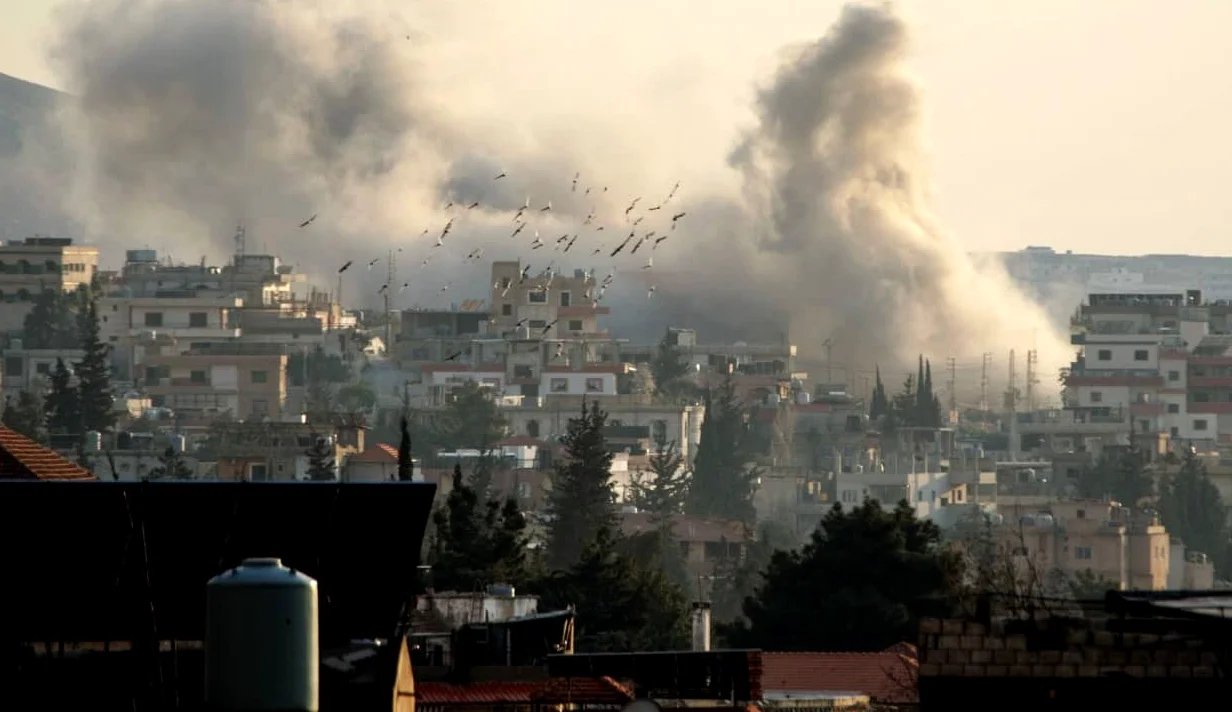
Israeli air strikes continued across Lebanon on Tuesday, particularly in the southern suburbs of Beirut. Residents had earlier been issued evacuation warnings before the attacks. AFP photographers reported seeing large plumes of smoke rising above the capital’s southern districts after several buildings were hit.
The Israeli military also said it had begun a new round of ‘simultaneous strikes in Tehran and Beirut’ as the regional conflict expanded.
Lebanon Redeploys Troops Amid Escalation
As tensions escalated, the Lebanese army redeployed troops in the border region following what officials described as an Israeli escalation. A Lebanese army source told AFP that the move was in response to increased Israeli military activity in the area.
The conflict has also triggered a humanitarian impact in parts of Lebanon. Lebanese authorities said around 29,000 people have been displaced from areas affected by Israeli strikes.
Lebanon’s Response to Hezbollah Attacks
Lebanon was drawn further into the regional war after Hezbollah launched an initial attack on Israel on Monday. The group said the assault was meant to ‘avenge’ the killing of Iran’s Supreme Leader Ali Khamenei during the recent US and Israeli strikes.
Israel responded quickly with intensified air raids across Lebanon, while the Lebanese government announced an immediate ban on Hezbollah’s military activities in an effort to limit further escalation.
The exchange of attacks marks a new phase in the rapidly expanding conflict involving Iran, Israel, Hezbollah, and the United States, raising fears that the fighting could spread across multiple fronts in the Middle East.






Comments
No comments yet
Be the first to share your thoughts