

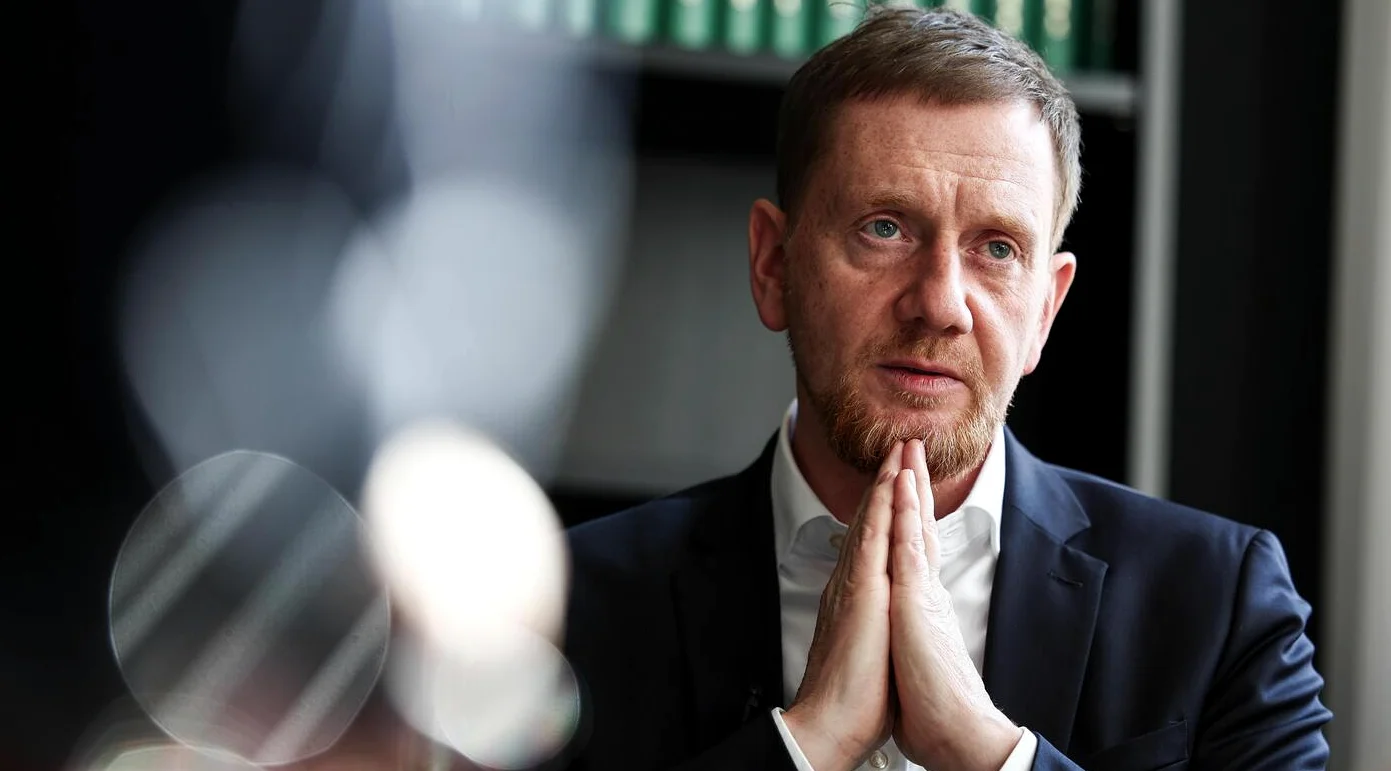
Saxony’s Minister-President Michael Kretschmer has warned that Germany is in a ‘downward spiral’ that could lead to economic disaster, according to Frankfurter Allgemeine Sonntagszeitung — he criticized the government’s failure to implement tangible improvements that benefit citizens in their daily lives and urged a shift in energy and labor policies.
Concerns About Competitiveness and Rezession
Kretschmer, a member of the CDU and the vice-chair of the party, emphasized that Germany is not delivering the ‘positive momentum’ it needs. He pointed to Poland as a contrast, noting that the country has achieved over three percent economic growth, while Germany is in recession. ‘We must examine Poland’s energy costs, labor costs, and working hours, and draw conclusions from them,’ he said.
The former prime minister of Saxony warned that the current path in energy and climate policy is leading Germany through a ‘valley of death,’ and that the country’s industry cannot survive under the current conditions. ‘Electricity must not become an expensive, scarce good,’ he said, pointing to the high cost of brown coal and CO2 levies as problematic.
Industry and Investment in Dresden
At the same time. Major investments are being made in Dresden, where Bosch recently opened a state-of-the-art wafer fab; the facility, which opened on June 7, includes participation from German Chancellor Angela Merkel and EU Vice-President Margrethe Vestager. Bosch is investing approximately 1 billion euros in the plant, marking the largest single investment in the company’s 130-year history.
The new wafer fab will begin production in July, with chips initially used in Bosch power tools and car manufacturing set to start in September. The facility, spanning 72,000 square meters, currently employs 250 people and is expected to grow to 700 by full operation. Bosch has invested over 2.5 billion euros in its Dresden and Reutlingen facilities since 2010 and has spent tens of billions more on microelectronics development.
Broader Policy Challenges
Kretschmer also highlighted broader policy concerns, including immigration. While Germany has succeeded in reducing the number of asylum seekers, he noted that the return of rejected applicants is not progressing at the same pace. ‘It will take some time before the changes become visibly clear in the cityscape,’ he said.
He reiterated the importance of price competitiveness, a stance he said was shared by CDU leader Friedrich Merz. Finance Minister Lars Klingbeil (SPD) appears to recognize that budget consolidation through spending cuts alone is not feasible and that economic growth must be the focus. Kretschmer stressed that Germany needs to avoid political debates that stall progress, particularly on energy policy, where concerns over climate goals should not prevent necessary adjustments for industrial survival.
Comments
No comments yet
Be the first to share your thoughts