

 BBC
BBC 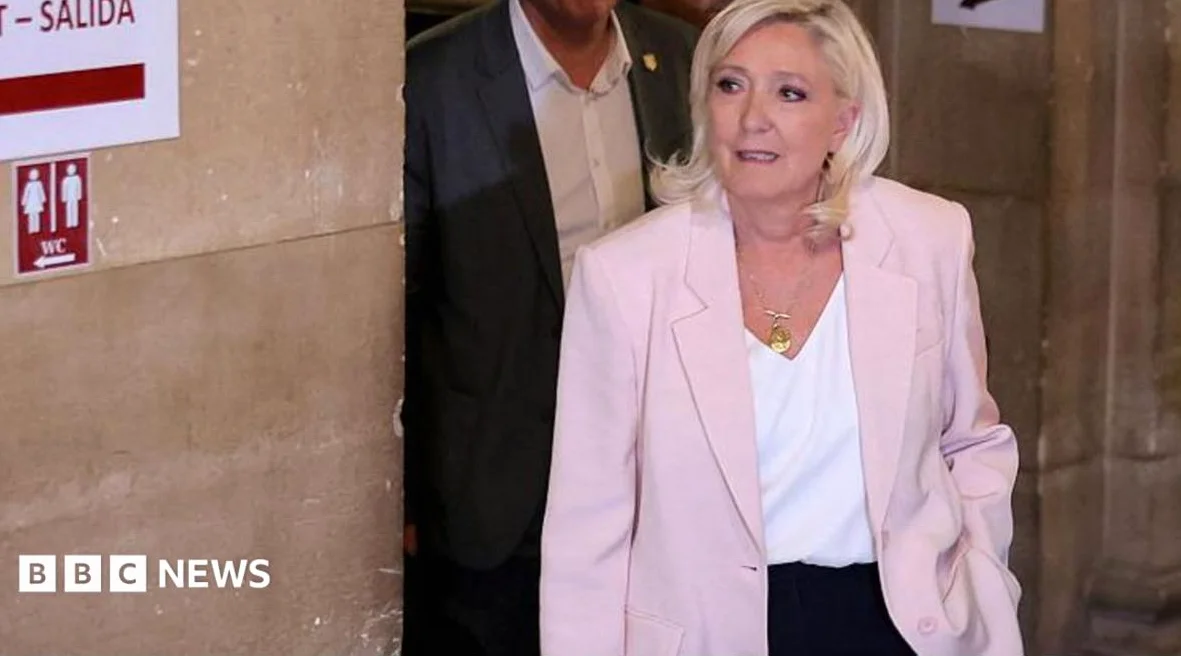
Campaign Begins as Appeal Proceeds
“The campaign begins tonight,” Le Pen told French TV during a combative primetime interview. She said she will “pursue all legal avenues” to defend her innocence and appeal to France’s top civil court, the Court of Cassation.
The appeal means the order to wear the electronic tag is suspended until the Court of Cassation delivers its verdict on the case—likely early in 2027. Hours before Le Pen’s TV appearance, a Paris appeal court found her guilty of misusing €2.8m (£2.4m) in EU funds in a fake jobs scheme but ruled she could still stand for the presidency while wearing the tag.
Political Gamble and Party Leadership
The decision is a political gamble and ends months of speculation that Le Pen would hand the candidacy to the 30-year-old president of her party, Jordan Bardella. Bardella did not immediately respond to Le Pen’s announcement, but the two are scheduled to appear together at a market in the Sarthe region of north-west France on Wednesday.
Public prosecutors have also said they will appeal the decision to reduce the sentences against Le Pen. Asked whether there was a scenario in which she might not run, Le Pen said: “No, there isn’t. I am here tonight to tell you I am a candidate for the 2027 election.”
She said her campaign would start immediately to “begin the rebirth of France” and that she would not change her mind. Although Le Pen continues to maintain her innocence, she and a number of party colleagues have now been found guilty twice of a scam that she denied organizing but did admit earlier to being “a mistake.”
Legal and Political Implications
The Paris appeal court confirmed the initial ruling that between 2004 and 2016 she and others had embezzled funds meant for members of the European Parliament and used the money to pay for party staff. Her decision to announce her candidacy comes less than 10 months before the first round of the French presidential elections on 18 April and 2 May 2027.
The Court of Cassation is likely to take a few months to reach a decision. If it does confirm the verdict, Le Pen could find herself having to wear an electronic tag as the election campaign moves into its most important period early next year. This would risk becoming an embarrassment as well as a handicap.
In the hours after Tuesday’s court verdict, Le Pen was locked in talks with Bardella, as well as lawyers and party colleagues. Then she and Bardella were driven to the studios of TF1 TV for her decision.
If elected, she stated she and Bardella would work together—she as president and he as prime minister. “We have a solid partnership, we complement each other… We have offered the French a duo… that I believe is complementary, balanced, coherent, solid,” she said. She added that Bardella had been with her for years and the cause was greater than the two of them: “The tests we have gone through have made us stronger, both in will and in the quality of our work together.”
Ahead of Tuesday’s verdict, Le Pen had said several times she would not run for president if she had to wear a tag, as she would not feel “totally free” to campaign. Political opponents criticized Le Pen’s decision to run for president despite her guilty verdict. “Her candidacy, despite her conviction, is yet another reversal that damages the French people’s trust in politics,” Othman Nasrou, secretary-general of the right-wing Republicans, told AFP.
Former Prime Minister Gabriel Attal noted there was a “moral dimension to the decision to run despite one’s criminal record and a sentence for embezzlement of public funds.” One of Le Pen’s main rivals for the presidency, ex-Prime Minister Edouard Philippe, said it was up to Le Pen to make the decision to run, but she had been convicted twice and would have to explain herself to the French people.
When asked what would happen if her appeal to the Court of Cassation did not go her way, Le Pen said: “We will see, and the French will be the judge, because the good news from this evening is they will be free to choose.” She was reminded that she had said last year she would be cleared on appeal, and yet that had not happened. “Everyone can be mistaken,” she replied. “Let us hope that the Court of Cassation is not mistaken.”






Comments
No comments yet
Be the first to share your thoughts