

 BBC
BBC 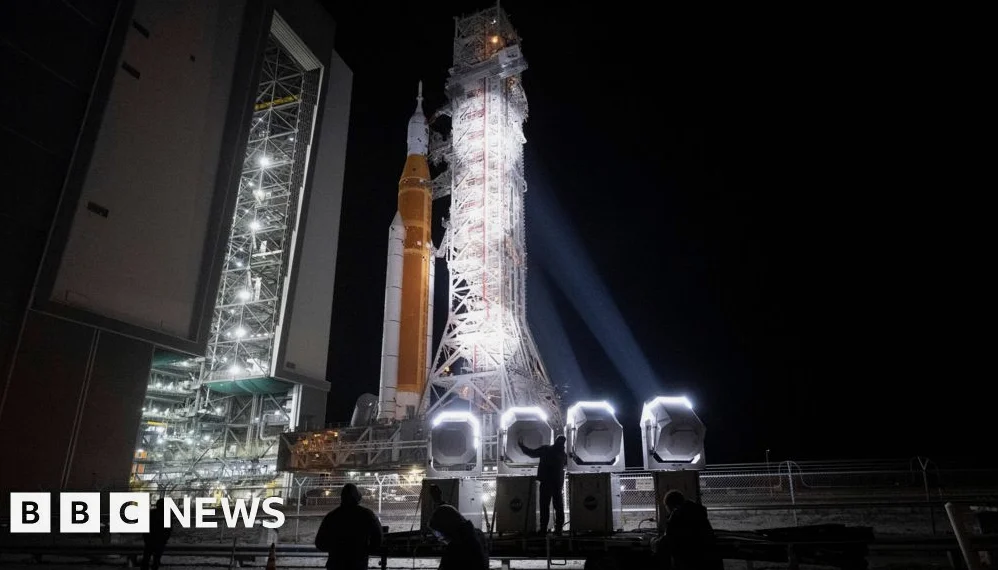
NASA’s Artemis Moon rocket has rolled back to its launch pad for the second time, with engineers aiming to conduct final tests ahead of a possible April launch. The 98-meter-tall Space Launch System (SLS) and Orion spacecraft made a four-mile journey from the Vehicle Assembly Building (VAB) at Kennedy Space Center in Florida to Pad 39B. This move follows a problem with the rocket’s helium system that forced NASA to abandon a March launch attempt and return the vehicle to the VAB for repairs.
Slow Journey to the Pad
The SLS and its launch platform. Weighing about 5. 000 tonnes. Were transported by the Crawler-Transporter-2, a low-slung, tank-like vehicle built in 1965 for moving Saturn V rockets to the launch pad. The journey. Which can take up to 12 hours, is done at a maximum speed of about 1 mph (1.6 km/h), with even slower movement on bends and inclines. This slow crawl helps reduce stress on the rocket and allows flight teams to monitor any unexpected movement.
The VAB. One of the largest buildings in the world, housed the rocket after a problem with the helium system was detected during a fueling test in March. Engineers identified an interruption in the helium flow to the upper stage, which is used to pressurize propellant tanks, while a fault in this system could affect the performance of the upper stage engine or the safe draining of the fuel.
Fixing the Problem and Preparing for Launch
Inside the VAB. Work platforms were raised around the upper stage to give engineers access to the helium circuit — they replaced suspect components, swapped batteries in several critical systems, and repeated tests to confirm the fault had been cleared. After reviewing the data, NASA managers approved a second rollout to the launch pad for further checks.
Now at the pad, engineers will spend several days verifying that the repairs were effective and that no issues arose during the journey. They will reconnect the launch tower to the rocket, run pressure tests on the helium system, and rehearse parts of the countdown using the same computers and networks that will be used on launch day, without filling the tanks with fuel.
The Artemis II crew—Reid Wiseman, Victor Glover, Christina Koch, and Jeremy Hansen—have entered pre-flight quarantine and will travel to Florida closer to launch to participate in rehearsals, including suiting up and traveling to the pad. NASA is targeting the first launch opportunity for Artemis II on 1 April at 18:24 Eastern Daylight Time (23:24 in the UK), with additional windows on 2, 3, 4, 5, and 6 April. If these are missed, the final chance in April would be on 30 April.
Significance of the Artemis Mission
The Artemis II mission, which will last about 10 days, is a major step toward returning humans to the Moon’s surface. This goal was first announced by President Donald Trump in his first term, but the mission has faced numerous delays due to technical challenges. In late March, NASA detected a liquid hydrogen leak that cut short a “wet dress rehearsal” for the launch, adding to the list of obstacles.
If Artemis II launches successfully, it will be the first crewed mission in the Artemis program. The mission will involve a flyby of the Moon, circling its far side before returning to Earth. This will pave the way for Artemis III, a crewed test flight in Earth orbit scheduled for 2027, and Artemis IV, planned for 2028, with the aim of landing astronauts on the Moon.
For the general public, the Artemis program represents a renewed commitment to lunar exploration and the development of technologies that could support future missions to Mars. The successful launch of Artemis II will not only be a milestone for NASA but also a significant moment in the history of space exploration.
The mission’s success could have far-reaching implications, including advancements in space technology, international collaboration, and the potential for long-term human presence on the Moon. If the April launch is delayed, the next opportunity will be in May, but NASA is hopeful that the first launch window will be used.






Comments
No comments yet
Be the first to share your thoughts