

 BBC
BBC 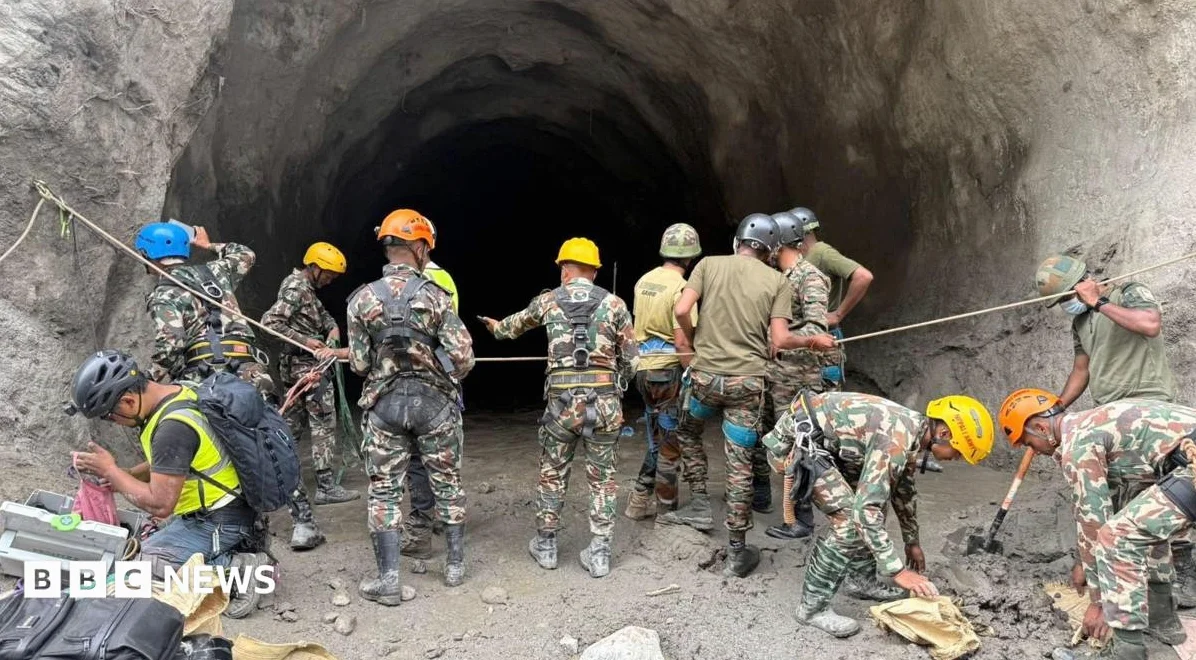
The death toll from a catastrophic flood on the Nepal-Tibet border has reached 939, with 3,925 people still missing, according to Nepal’s disaster management authority — Among the missing are 592 foreign nationals, and roughly one in seven are believed to be workers at hydropower plants. Prime Minister Balendra Shah reported that 279 people had been rescued from the sites as of Monday.
Rescue Efforts Intensify
Rescue operations involve an international team of Chinese and Nepalese military personnel, with support from experts from India, Korea, and Australia, Rescuers began pumping air into a tunnel over the weekend, but some families of the trapped say the operation should have started earlier. A team was able to enter a tunnel leading to one hydropower plant on Monday but withdrew after finding no survivors.
“The longer it takes, the more our hope dies. This operation must move much faster because every second is meaningful to us,” said Jiban Khadka, whose relative is still trapped. “It’s a frustratingly slow operation,” he added.
Scientists and Governments Assess Risks
Scientists are working to determine the exact sequence of events that led to the disaster. According to Mike Searle, a professor of Earth sciences at Oxford University, the glacier could have collapsed hours or days before the flood hit Nepal and Tibet. He suggested a landslide first dammed the river, leading to a massive flood when the dam broke.
China has warned that a lake formed by the landslide is at risk of bursting its banks, which could cause further flooding downstream. As of Friday, an estimated 2.5 million cubic metres of water had accumulated in the lake, according to Chinese state media. Rescue operations were briefly suspended after the lake overflowed, though water levels have since dropped slightly. Heavy rain is expected in the coming days, increasing the risk of secondary flooding.
The International Centre for Integrated Mountain Development (ICIMOD) has warned that debris in the river systems could lead to additional flooding. The organisation is assessing whether the Trishuli River has been temporarily blocked in narrow sections, which could lead to the formation of a landslide dam and a second flood.
Impact on Hydropower Projects
Nepal relies heavily on hydropower, and at least 11 projects,either completed or under construction,were damaged in the floods, according to authorities. Anushila Bhandari, the wife of a missing 33-year-old engineer, expressed her anguish: “I wish we could find him. I wish he would come home.”
Sita Pandey, another family member, said she still had a 50% hope that her husband was alive because of an oxygen system inside the plant. Meanwhile, the number of people killed or missing is still being clarified as search and rescue efforts continue in challenging conditions.




Comments
No comments yet
Be the first to share your thoughts