

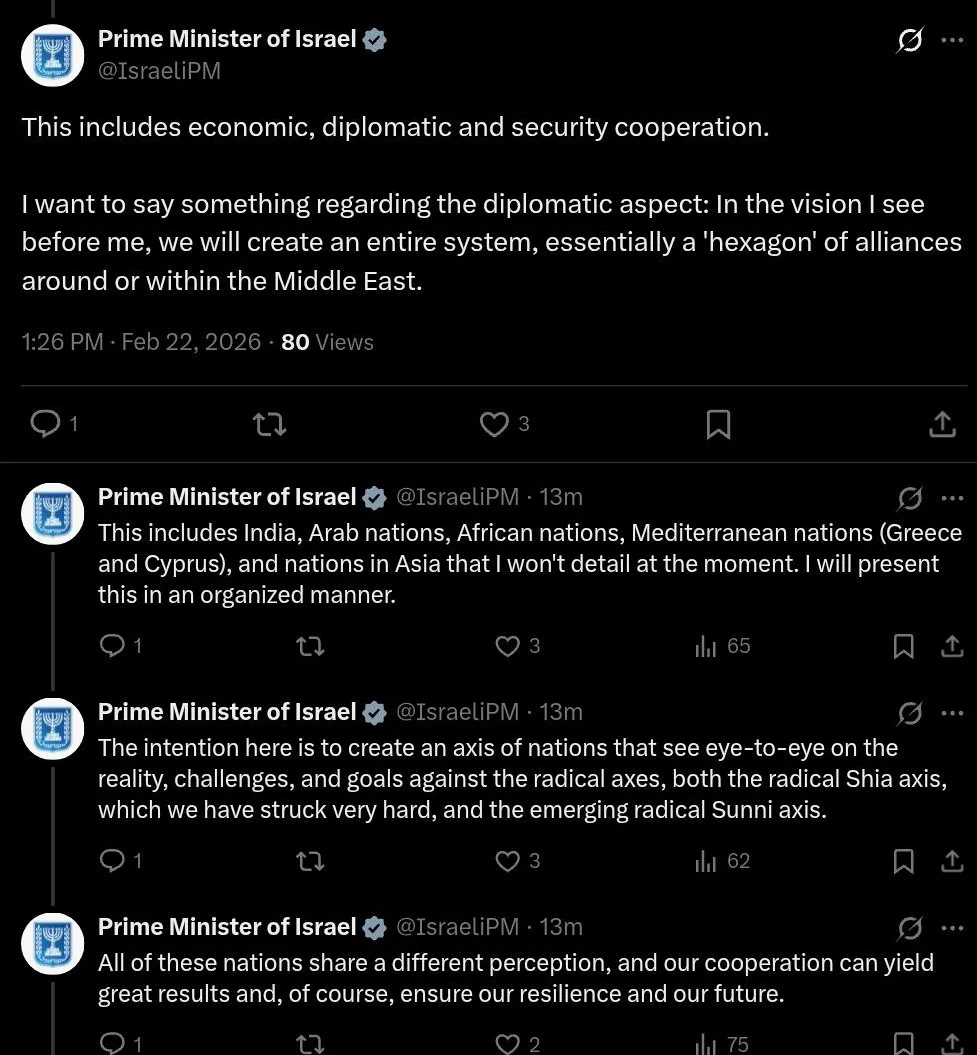
Israeli Prime Minister Benjamin Netanyahu revealed plans for a new strategic bloc designed to confront threats from what he described as a ‘radical Shia axis’ and a rising ‘radical Sunni axis.’ Speaking in Jerusalem, Netanyahu said the alliance aims to unite nations facing common security challenges in the Middle East and beyond.
The coalition, Netanyahu explained, will incorporate India, Greece and Cyprus as key partners. Several African countries, Arab states and additional Asian nations are also expected to join, though he did not name the others. ‘This is a response to the growing dangers we all face,’ Netanyahu stated during a press briefing.
Netanyahu pointed to Iran’s influence as the core of the Shia axis, which he accused of fueling proxy conflicts across the region. On the Sunni side, he highlighted emerging extremist groups that could destabilize allied states. Officials in Jerusalem emphasized that the bloc focuses on defense cooperation, intelligence sharing and joint military exercises.
India’s involvement signals a deepening of ties with Israel, building on recent defense deals and technology exchanges. Greece and Cyprus, both Mediterranean neighbors, have strengthened security pacts with Israel amid tensions with Turkey. Arab states, likely including those from the Abraham Accords like the United Arab Emirates and Bahrain, represent a shift in regional alignments.
African participants could include nations such as Kenya or Ethiopia, which have expanded relations with Israel in recent years, according to diplomatic sources. The unnamed Asian countries might encompass U.S. allies in Southeast Asia wary of Chinese expansion, though details remain under wraps.
Netanyahu’s announcement comes amid heightened regional tensions. Israeli forces have traded strikes with Hezbollah in Lebanon, a key Iranian proxy, while Houthi attacks from Yemen have disrupted Red Sea shipping. Sunni extremist threats persist in the Sinai Peninsula and Sahel region.
Critics in Israel question the bloc’s feasibility. Opposition leader Yair Lapid called it ‘ambitious but vague,’ urging specifics on commitments. Internationally, reactions varied. A Turkish foreign ministry spokesperson dismissed the plan as ‘provocative,’ while Greek Prime Minister Kyriakos Mitsotakis welcomed closer cooperation.
Israeli officials said planning for the bloc accelerated after October 7, 2023, Hamas attacks that killed 1,200 people and sparked the Gaza war. The alliance builds on existing frameworks like the Negev Forum, which unites Arab states, Israel and the U.S. against Iran.
Netanyahu plans to host initial talks in Jerusalem next month. Participants will discuss cybersecurity, counterterrorism and energy security. The prime minister framed the bloc as essential for Israel’s survival. ‘We stand together or fall alone,’ he declared.
Analysts see the initiative as Netanyahu’s bid to reshape Middle East alliances post-Gaza war. With U.S. elections looming, the bloc could bolster Israel’s position regardless of Washington’s stance. Details on leadership and funding remain unclear.





Comments
No comments yet
Be the first to share your thoughts