

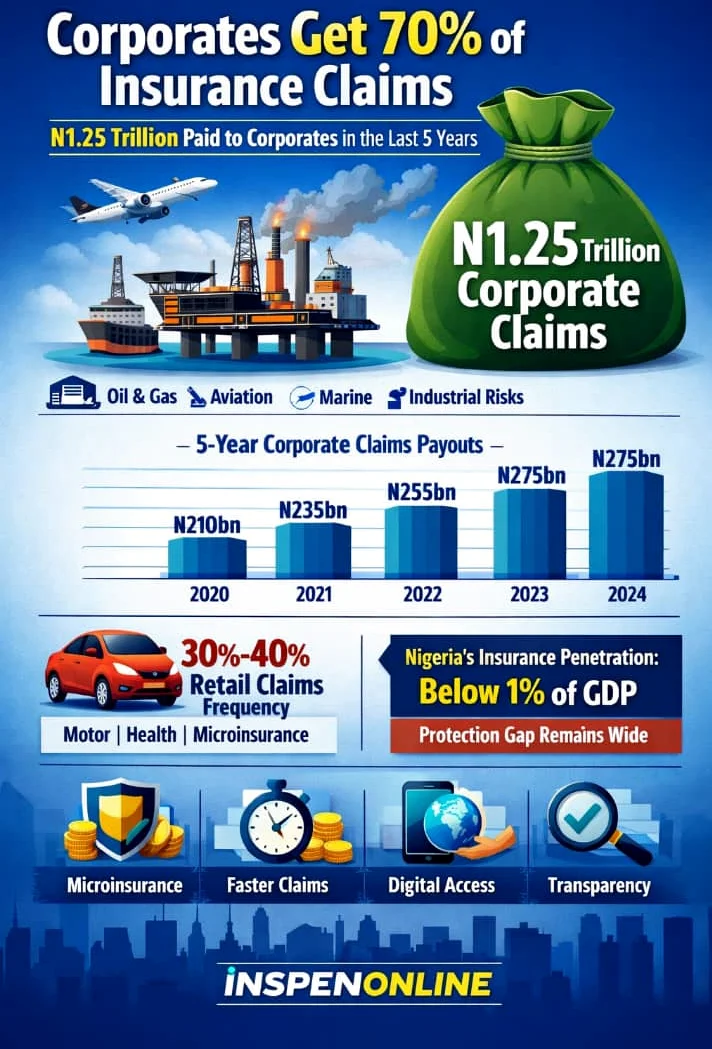
Nigeria’s insurance sector funneled the lion’s share of claims payments to corporations over the last five years. Industry data shows insurers disbursed N1.85 trillion total between 2020 and 2024. Corporate entities took home N1.25 trillion of that amount across key sectors.
Claims from oil and gas, marine and aviation, fire and industrial risks, engineering, and group life led the pack. These capital-intensive lines feature high-value assets and exposures. Payouts trended steadily upward during the period, according to a review of sector figures.
Retail insurance tells a different story. Personal lines, especially motor coverage, produce far more claims than corporate ones. Individual payouts stay smaller by comparison. Market analysts point to this split as a defining trait of Nigeria’s insurance landscape: premium- and claims-heavy on the corporate side, with retail driving everyday public engagement.
Retail business generates 25% to 35% of total premium income. Its frequent claims signal rising individual interest in shielding against routine hazards, observers say. “The data reveals a significant protection gap,” one industry source noted. “Corporates dominate claims value, but retail—especially motor claims—is where Nigerians interact most with insurers.”
Stakeholders see the claims pattern changing conversations. Skepticism over payouts is giving way to debates on efficiency, transparency, and service. Insurers aim to boost retail uptake through microinsurance, faster settlements, digital sales platforms, and data-backed trust-building.
Insurance penetration lingers below 1% of GDP. Operators push for public campaigns, stricter enforcement of mandatory policies, and user-friendly retail options to widen coverage. Corporate deals will anchor the market for now. True expansion, players agree, demands deeper retail involvement to narrow the protection gap.
The disparity highlights broader challenges. With most Nigerians uninsured, corporate dominance limits sector growth. Recent data offers a roadmap: blend high-value business stability with mass-market reach.






Comments
No comments yet
Be the first to share your thoughts