

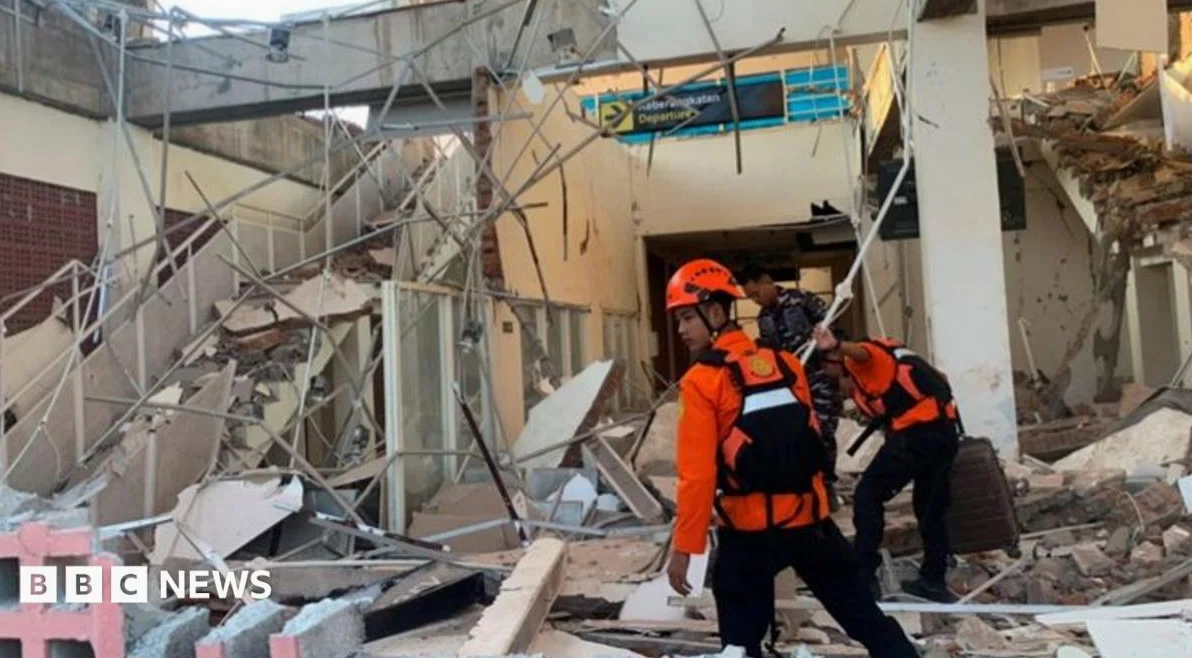
A powerful 7.7-magnitude earthquake struck off the coast of Indonesia early Saturday, killing at least 38 people and damaging infrastructure, according to multiple sources. The U.S. Geological Survey said the quake hit Indonesia’s Flores region with a depth of 10 kilometers (six miles) at 5:58 a.m. local time, while Indonesia’s geophysics agency recorded the depth as 15 kilometers (nine miles).
Quake and Aftermath
The initial quake was followed by several aftershocks, including one of magnitude 6.1. Authorities issued a tsunami warning, urging coastal residents to move to higher ground, but later lifted the warning when monitoring showed no significant sea-level changes that would pose a threat to coastal communities. Tsunami waves of less than 1 metre (3ft) were recorded in several areas.
Rescuers have recovered at least 38 bodies, mostly in the three devastated regencies of Sikka, Manggarai, and East Manggarai, according to Suharyanto, head of the National Disaster Management Agency. Eight of those dead in Maumere had been killed in a landslide; At least 13 people were rushed to nearby hospitals, including two with serious injuries.
Evacuations and Damage
About 2,000 villagers in Nagekeo regency fled their homes to temporary shelters. The epicentre of the quake was located 68 km (42 miles) north-northwest of the city of Ende in East Nusa Tenggara province, according to the U.S. Geological Survey. Teams have yet to reach Nagekeo, the region closest to the epicentre, and communications signals there have been affected; Attempts to reach Nagekeo by car were blocked by landslides.
The ground began to shake at around six in the morning local time (midnight in Spain), followed by dozens of aftershocks — Authorities have issued several tsunami warnings in anticipation of a larger catastrophe, leading to the evacuation of about 2,000 people from coastal areas. The alarm was lifted after waves no taller than a metre reached the shore.
Response and Logistics
Three helicopters and a rescue vessel were deployed to assist with logistics and support emergency response operations, according to Suharyanto, as Two helicopters and a plane were also prepared to support rescue efforts and damage assessment. Rescuers found about twenty bodies beneath the debris of collapsed houses in Maumere, a major port city on Flores Island, while the island is part of Indonesia’s vast archipelago and is home to about two million people.
Fathur Rahman, the head of the city’s rescue agency in Maumere, said eight of those dead had been killed in a landslide. “I have never felt an earthquake this big,” said Yulian Juita Ekalia, a 37-year-old university professor who lives more than 60 miles from the centre of the quake. “It felt like we were on a trampoline, it was really scary.”
A video on Facebook, verified by Reuters as being at a port in Maumere, shows parts of a building collapsed into dust and rubble as people scream and run in the street.
The head of the city’s rescue agency said rescue teams were heading to Nagekeo, another region hit hard by the quake, but roads were blocked by landslides. Rescue groups have only been able to access the area via cross-country paths or by sea, though In addition to homes, dozens of warehouses, schools, and a hospital have been severely damaged.
Indonesia is no stranger to such events, with Flores known for its susceptibility to earthquakes and tsunamis. The main alert has extended to regions including East Nusa Tenggara, South Sulawesi, West Nusa Tenggara, and Southeast Sulawesi, particularly due to the risk of large waves.





Comments
No comments yet
Be the first to share your thoughts