

 BBC
BBC 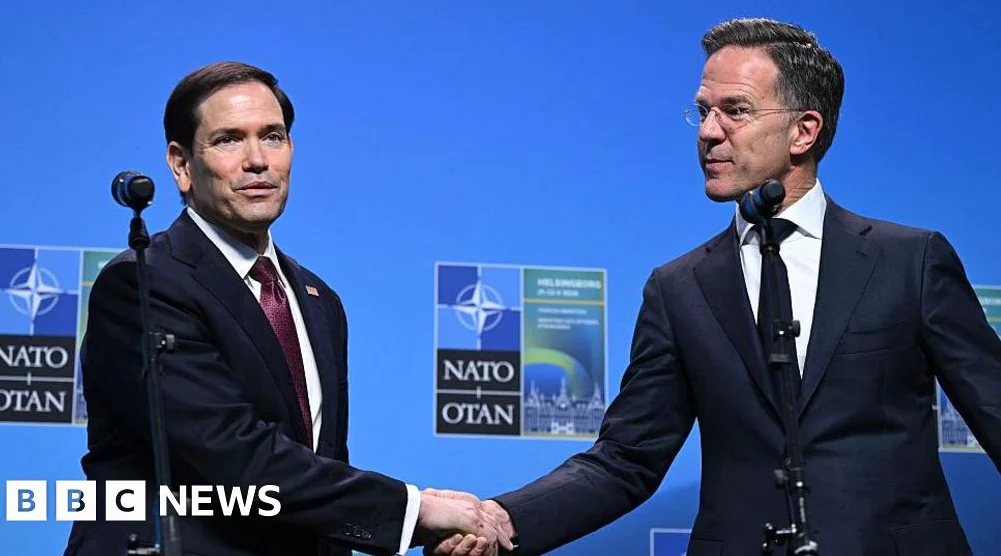
US Secretary of State Marco Rubio has tried to reassure allies over US decisions on troop deployments in Europe, following a series of recent announcements that have caused uncertainty among Nato members.
Confusion Over Troop Changes
Rubio’s intervention at the end of a Nato foreign ministers’ meeting in Sweden came after President Donald Trump said the US would send an extra 5,000 troops to Poland. That decision was a week after a planned deployment of 4,000 troops to the country was cancelled and days after an announcement that US troops would be pulled out of Germany.
The announcements have caused confusion among the allies of the trans-Atlantic defence organisation. However, at a news conference after the Nato meeting on Friday, Rubio said the US was constantly reevaluating its troop presence in view of its global commitments.
Recent Geopolitical Developments
Some US troops are currently involved in the Middle East, following the US and Israeli conflict with Iran; Trump made the announcement about the new Polish deployment as Nato ministers were in Sweden for talks.
Writing on his Truth Social platform on Thursday, Trump said the decision was based on the US’s relationship with Polish President Karol Nawrocki, whom he backed during presidential elections last year and who is a long-time supporter of his. The US leader did not elaborate on whether the additional troops were part of the previous planned deployment or a different operation.
The US defence department abruptly said last week it was cancelling the deployment of 4,000 troops to Poland; it is unclear whether the additional troops for Poland were part of those withdrawing from Germany or a separate group.
Reassurances and Reactions
The Nato foreign ministers’ meeting in Helsingborg was held in the aftermath of the seemingly contradictory US announcements; “It is confusing indeed, and not always easy to manage,” Swedish Foreign Minister Maria Malmer Stenergard said as she hosted her colleagues.
However, her US counterpart said it was “well understood in the alliance that the United States troop presence in Europe is going to be adjusted.” That work was already ongoing and it’s been done in co-ordination with our allies,” Rubio said. Acknowledging the unease. He added: “I’m not saying they’re going to be thrilled about it, but they certainly are aware of it.”.
The US is by far the biggest and most capable member of Nato – the Euro-Atlantic alliance that includes 30 European countries as well as Canada. It has maintained troops in European countries for decades – as a deterrent force originally meant to face off to the Soviet Union.
Since Russia launched a full-scale invasion of Ukraine in February 2022, the US’s European allies have urged Washington to remain committed to their defence — the largest US presence is in Germany, where there are more than 36,000 troops on active duty. There are some 12. 000 troops in Italy and 10,000 in the UK – and an estimated 10,000 in Poland, too.
Trump has often been critical of Nato – at times threatening to pull the US out of the alliance because of the low financial contribution of European allies and Canada compared to the US. As a result, many countries have now agreed to raise their defence spending.
However, the US president has further been angered by the refusal of Nato countries to help the US in its conflict with Iran. The White House has signalled in recent weeks that it intends to reduce its overall troop levels in Europe as part of its “America First” agenda.
Nato Secretary General Mark Rutte told reporters that the trajectory towards Europe becoming less reliant on the US “will continue.” In Sweden, the US secretary of state cautioned that there had always been a debate in American politics about the US contribution to the Euro-Atlantic alliance.
“I understand Nato is valuable to Europe, and it should be,” Rubio said in Sweden — “It also has to be valuable to the United States.”

Comments
No comments yet
Be the first to share your thoughts