

 BBC
BBC 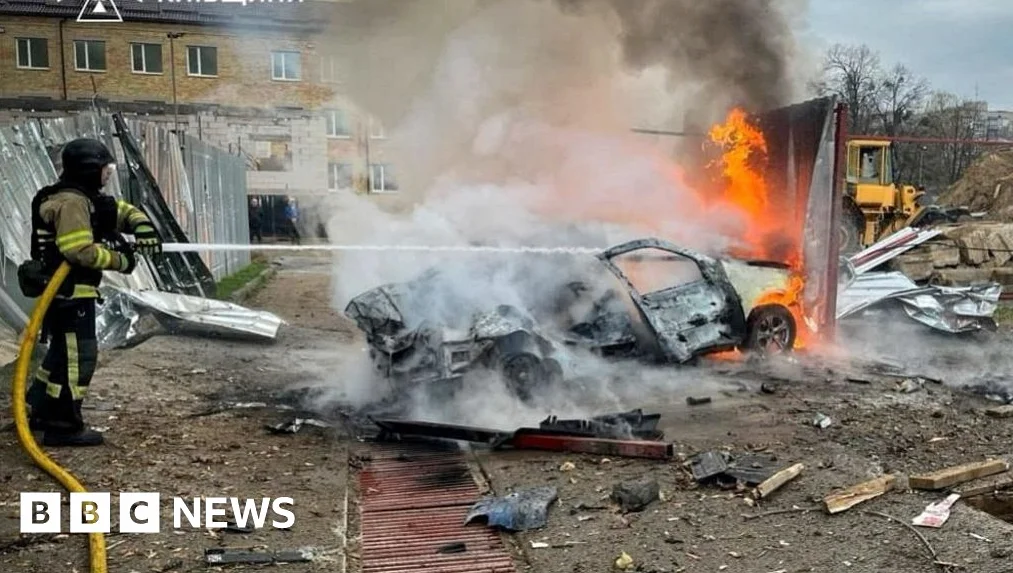
According to the BBC. Ukrainian President Volodymyr Zelensky has accused Russia of opting for ‘Easter escalation’ rather than a ceasefire, following a deadly large-scale drone and missile attack across the country. The attack resulted in six civilian deaths and 40 injuries as Russia launched hundreds of drones and missiles on multiple fronts.
Rising Attacks and Stalled Peace Efforts
Major daytime attacks. Which were once rare, have been increasing in frequency, according to the BBC. This comes as efforts to end the war, led by the US, have stalled since US President Donald Trump and his team shifted their focus to the conflict in the Middle East. Zelensky agreed with a British intelligence assessment that the situation on the frontline in the east was the ‘most favourable’ for Ukraine in 10 months, as the advance of Russian troops appears to have slowed.
However, there has been no let-up in the air raids. In the Zhytomyr region, west of Ukraine’s capital, Kyiv, rescuers had to search for survivors beneath the rubble of their homes as a whole line of houses was destroyed. In the Kyiv region, a drone was filmed careering towards a block of flats, then slamming into its side, starting a fire.
Easter Attacks and Zelensky’s Response
In Kharkiv, in north-eastern Ukraine, a woman was killed and other people were critically injured in a day of strikes the mayor called ‘one of the biggest’ on the city so far. Zelensky described the barrage as Russia’s response to his proposal of a temporary truce for the holidays: Orthodox Christians celebrate Easter next weekend both in Ukraine and in Russia.
He wrote on X, ‘The Russians have only intensified their strikes, turning what should have been silence in the skies into an Easter escalation.’ The BBC reported that in recent days, Ukraine has launched multiple deep strikes of its own, targeting energy facilities on the northern coast of Russia in particular. One port, in Ust-Luga, has been hit by drones multiple times, forcing Russia to suspend exports.
On Saturday, an adviser to the defence ministry in Kyiv said an industrial plant in Togliatti, southern Russia – that produces rubber products used in military equipment – had been struck overnight. Ukraine also reported an attack on a substation in Taganrog on the Sea of Azov and debris hitting a vessel. The local governor in Russia confirmed a ‘enemy drone’ attack in Togliatti, and said one worker of an ‘industrial enterprise’ had been injured by shrapnel. A residential building was also damaged.
Peace Talks and Strategic Concerns
Zelensky said the offer of a holiday truce was still on the table if Moscow agreed, and that message had been passed on in a call to Trump’s envoys, Steve Witkoff and Jared Kushner. Plans for further in-person talks with Russia, mediated by the US, have now been postponed twice. Moscow says they are ‘on hold.’
Zelensky said Trump’s team were welcome to come to Kyiv, then shuttle to Moscow, to keep the peace process alive. But there are doubts over whether Moscow is really looking for a deal as the global context has shifted in its favour. For Ukraine, the potential scarcity of fuel and surge in prices caused by the war on Iran is a worry: its own frontline troops need large amounts of diesel for their tanks and vehicles.
Conversely, it’s good news for Russia, which can make more money on energy exports to fund its weapons production and pay for soldiers. There are also concerns here about a potential shortage of US defensive missiles to shoot down the ballistic missiles that Russia keeps firing at Ukraine, since so many US Patriot systems are now being used in the war with Iran.
Zelensky told journalists in Kyiv in recorded messages that ‘The longer the war in the Middle East continues, the greater the risk that we will receive less weaponry.’ He added, ‘This is extremely difficult – perhaps one of the most challenging tasks.’
He did describe the situation on the frontline as ‘stable’, with small territorial gains in places and losses elsewhere, and suggested the threat of a major Russian breakthrough had receded. Even so, Ukraine’s focus appears to be on holding the line now, not major advances of its own.



Comments
No comments yet
Be the first to share your thoughts