

 BBC
BBC 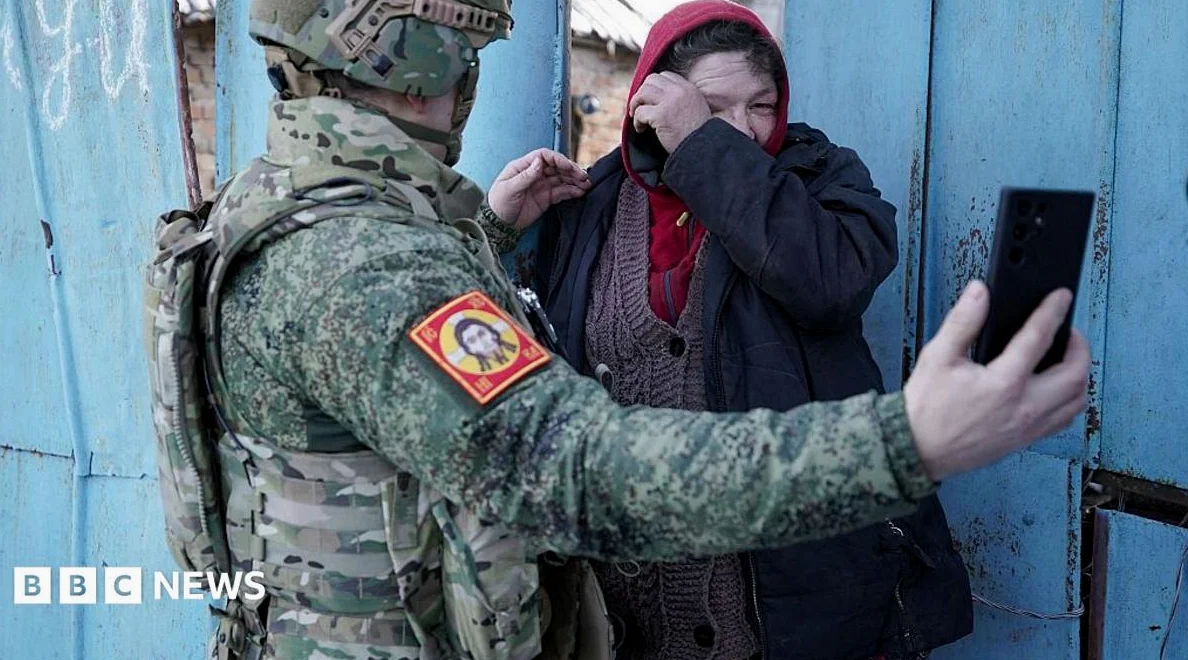
Russian citizen Lyubov expresses feelings of resentment toward the state after her mother went missing following Ukrainian forces entering the Kursk region over two years ago.
Disinformation and Evacuation Efforts
Lyubov blames Russian state TV propaganda for her mother’s decision to stay behind in the Sudzha area, where approximately 2,000 people remain in the settlements captured by Ukraine’s military.
She recalls how the state channels reassured viewers that the situation was under control and would return to normal within a few days.
Humanitarian Crisis and Calls for Action
More than 777 sq km of Russian territory was overrun by Ukrainian soldiers in August 2024, as part of an effort to divert Russian forces from their front-line offensive.
For the next eight months, mobile and internet links were down, isolating many in the region.
Nearly 200 Russians sent a letter to Ukrainian President Volodymyr Zelensky, Russian President Vladimir Putin, and the United Nations, requesting a humanitarian corridor to evacuate civilians, which did not happen.
Lyubov and others began forming groups to find missing loved ones, with one resident compiling a list of those believed to have died and their burial locations.
Failed Evacuations and Bureaucratic Failures
Lyubov wrote to the Red Cross and Kursk interior ministry for help but received no response.
In early 2025, Russia’s human rights commissioner published a list of 517 Kursk residents reported missing, but it was criticized as incompetent and disrespectful by families.
Heavy fighting in late 2024 in the village of Darino, where Lyubov and her mother were from, resulted in 90% of it being destroyed.
The Russian military regained control of the village and began evacuating survivors and removing bodies of the deceased.
Lyubov learned that her mother had died from a head injury, with circumstances remaining unclear.
Other elderly individuals also died due to the hardships of wartime conditions.
Lyubov waited in vain for her mother’s body to be brought out and learned that the bodies of her neighbors had been taken away, but her mother’s was still missing.
Regional officials met with the group searching for the missing several times, but it made little difference in the efforts to locate the missing.
Lyubov eventually found her mother’s body in a mortuary in Kursk, recognizing her from a photograph taken in April 2025.
She had provided a DNA sample in January, but it was lost, leaving her mother’s body unidentified for several months.
Lyubov was unable to bury her mother in their home village and had her cremated, with the ashes now kept in her apartment in Belgorod.
She remains bitter about the government’s failure to stop the incursion and evacuate residents when possible.
There was no response from the Kursk governor, Russia’s human rights commissioner, or the Russian Red Cross when asked to comment on the story.
Ukrainian authorities stated that all the civilians they had evacuated from the Kursk region had been handed over to Russia.
Lyubov recalls the pre-war days of crossing the border to shop in Ukraine, where villages no longer exist after the incursion.

Comments
No comments yet
Be the first to share your thoughts