

Rocket’s Journey to the Moon
The Falcon 9 rocket launched from Florida in January 2022 to deploy two lunar landers — its upper stage, which is about the size of a five-storey building, was left in orbit after completing its task. Over the next 18 months, subtle gravitational tugs from the Earth, Moon, and Sun altered its trajectory, eventually sending it toward the Moon, according to BBC reports.
Astronomers monitoring the object predicted its collision path, which culminated in an impact at around 07:35 BST (06:35 GMT). The crash was expected to produce a brief flash and a dust plume stretching up to 100 km (62 miles), but visibility was limited due to the timing and location of the impact on the Moon’s sunlit side.
South Korea’s Danuri Orbiter Tracks Event
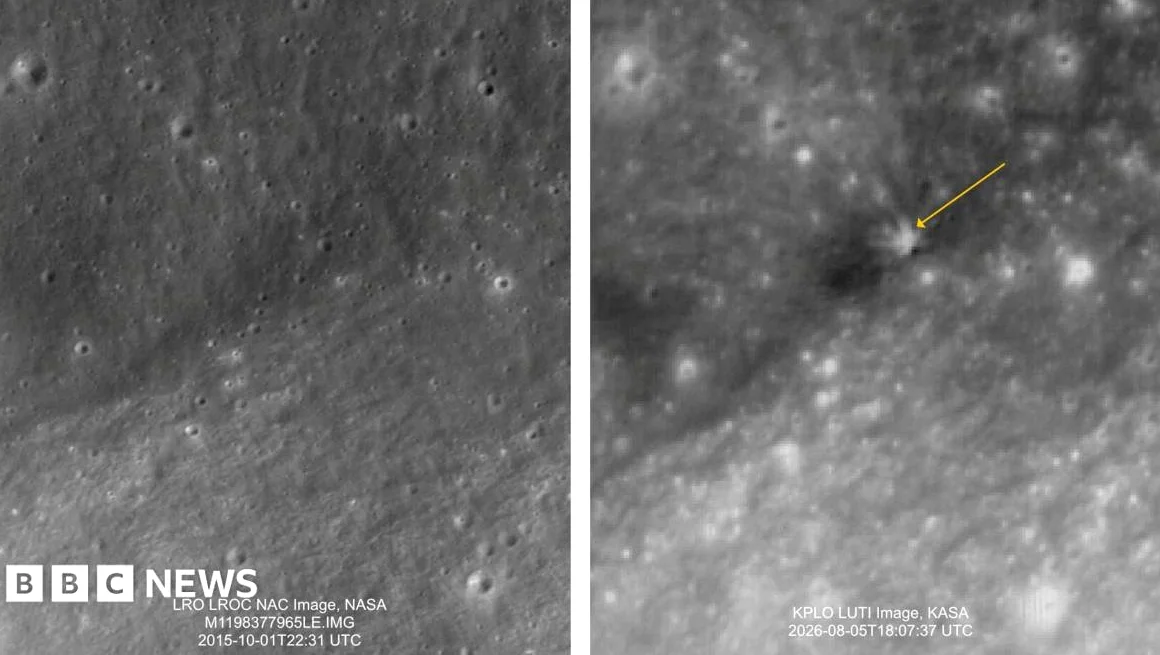
South Korea’s Danuri orbiter had the best chance of observing the impact, According to BBC, the spacecraft passed near the crash site shortly before the collision. The space agency released images of the event, marking a significant observation opportunity for scientists, the data could help improve understanding of uncontrolled space debris and its potential impacts on the Moon and other celestial bodies.
While no spacecraft were in the exact position to witness the impact live, the images and data collected by Danuri could still provide valuable insights. The South Korea space agency will analyze the debris scatter and dust patterns to better understand the mechanics of such collisions, which are becoming increasingly common in space exploration.
Scientific Value and Future Concerns
Experts suggest the event offers a rare opportunity to study the effects of uncontrolled space debris, and According to BBC, the Falcon 9 stage was not intentionally directed to the Moon, and its trajectory was the result of natural orbital forces. As space agencies increase their missions, the risk of similar uncontrolled impacts grows, raising concerns about long-term sustainability and safety in space.
The incident highlights the need for improved tracking and disposal protocols for spent rocket stages; While SpaceX designed the Falcon 9 to be reusable, the upper stage in this case was left uncontrolled and eventually collided with the Moon. The event exposes the challenges of managing space debris and the importance of international cooperation in space safety protocols.






Comments
No comments yet
Be the first to share your thoughts