

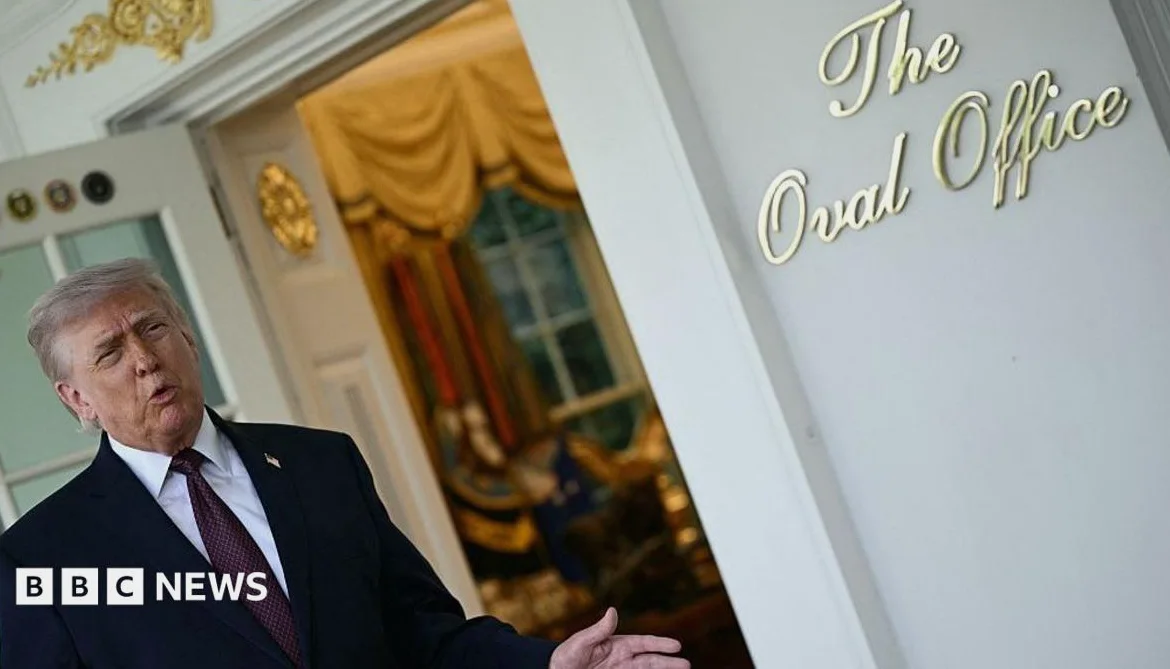
US President Donald Trump has signed an executive order designating the Oval Office and adjacent spaces as a national monument, according to the BBC and Al Jazeera. The order, signed on Thursday, aims to prevent future presidents from making significant changes to the White House’s iconic room.
Preservation and Decorative Changes
Trump, a former real estate mogul, has significantly altered the look of the Oval Office during his second term, including the addition of many gold features. The president stated that the designation would make it “impossible for anybody ever to destroy this incredible space.” The order emphasizes the importance of preserving the room’s historic character, architectural integrity, and its association with the presidency.
“We’re making it a national monument, and it will not be allowed to be touched by anybody, destroyed, ripped down by stupid people, in order to build something in a slightly different shape,” Trump told reporters on Thursday. The proclamation also notes that the Oval Office has been described by visiting world leaders as “incredible” and “beautiful.”
Legal Context and Congressional Role
While the designation prevents major alterations, the order does not restrict the president’s ability to redecorate, select furnishings, or make ordinary operational and security modifications. The White House is already a National Historic Landmark, but Trump’s order adds an additional layer of protection.
Greg Werkheiser, a specialist in historic preservation from the law firm Cultural Heritage Partners, said that temporary alterations like furniture and decor are typically up to the president’s discretion. He also noted that the Trump administration has faced criticism for its approach to other historic sites in Washington, including efforts to challenge preservation laws through lawsuits.
Congress has an exemption under the National Historic Preservation Act that allows presidents to make changes to the White House. The current Oval Office has existed since the 1930s, when it was conceived by President Franklin D. Roosevelt. The designation aims to ensure the space remains a “landmark for the ages,” as Trump described it.
Political and Public Reactions
The order was signed on Thursday, marking Trump’s first official action following his party’s losses in the midterm elections. The move has drawn mixed reactions. Some critics argue that the administration has not shown consistent respect for historic preservation, citing projects such as the proposed 76-meter triumphal arch near Arlington National Cemetery and the controversial White House ballroom construction.
During the midterm election campaign, Democrats criticized Trump’s redesigns of the Oval Office. Former President Barack Obama reportedly commented that Trump’s changes made the White House look like “Saddam Hussein opened a Cheesecake Factory.”
Trump has also pushed forward with other large-scale projects in Washington, including the demolition of the East Wing to build a nearly $1 billion White House ballroom. These initiatives have drawn sharp criticism from opposition lawmakers and the public, according to recent polls.
Trump’s order may be reversed by a future administration, as is the case with other executive actions. In a previous executive order, Trump reduced the size of two major national monuments in Utah. Following President Joe Biden’s administration, those monuments were restored to their original sizes.





Comments
No comments yet
Be the first to share your thoughts