

 The Guardian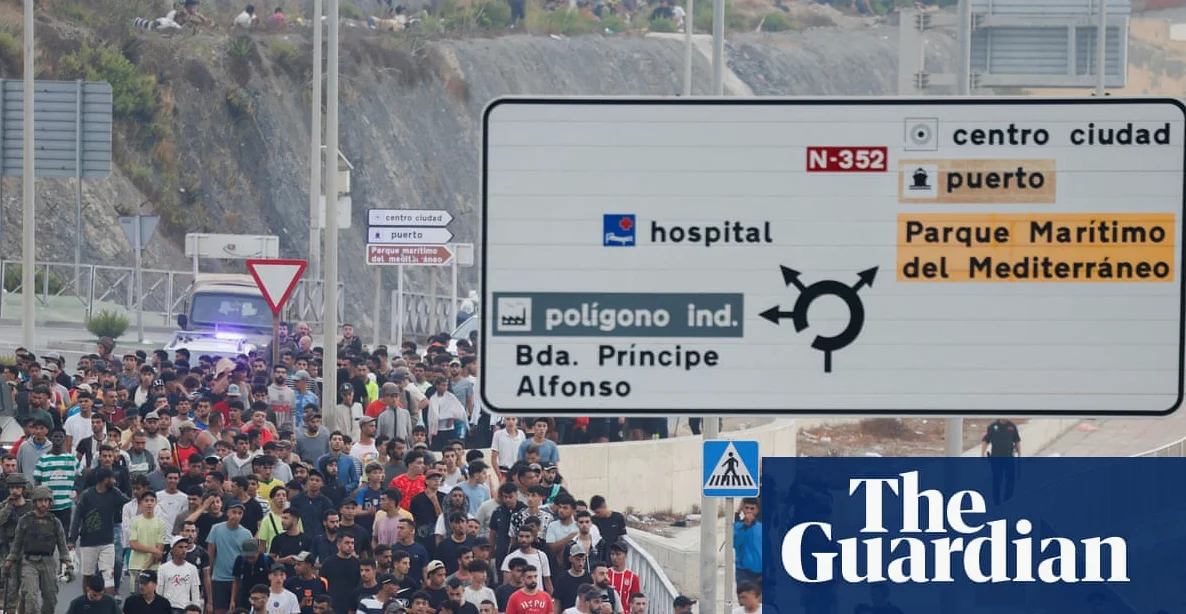
More than 50,000 people crossed into the Spanish enclave of Ceuta from Morocco on Thursday and Friday, with at least 67 people dying in the attempt. Some drowned, while others were ended as they tried to cross a breakwater barrier.
Italy Suspends Schengen Arrangements with Spain
Although more than 48,000 people had voluntarily returned to Morocco by 6pm on Friday, the influx triggered a political crisis for the Madrid government and led some fellow EU countries to call for Spain to be suspended from the Schengen free-movement zone.
Italy announced on Friday evening that it would suspend its Schengen arrangements with Spain, even though Ceuta, and Spain’s other north African enclave, Melilla – are subject to special Schengen rules that prevent onward movement within the zone.
Criticism and Counter-Criticism Between Spain and Italy
Italy’s foreign minister, Antonio Tajani, blamed the situation in Ceuta on the Sánchez government’s decision to offer a now-closed scheme to regularise the status of more than 1 million undocumented migrants and asylum seekers. He said the programme had incentivised human trafficking and was ‘profoundly wrong’.
Tajani’s remarks prompted a sharp response from Spain’s foreign minister, José Manuel Albares, who said the comments were ‘unbecoming’ and accused Italy of ‘partisan demagoguery’.
Spain Seeks EU Unity Amid Border Tensions
Sánchez was equally forthright in a letter sent to the European Commission president, Ursula von der Leyen, the European Council president, António Costa, and Micheál Martin, the prime minister of Ireland, which holds the EU presidency.
In the letter, the Spanish prime minister said he had been deeply concerned by the reaction some EU governments had shown to events in Ceuta. Sánchez said that while most had expressed support and solidarity, others had chosen to attack Spain and call for its temporary exclusion from the Schengen area.
‘Such an attitude, driven by prejudice, fake news, ignorance or political interest, is… contrary to European law, humanitarian law, and the principles of solidarity that bind us together,’ he said.
In a pointed rebuke to Italy, he noted that Spain was ‘according to Frontex, one of the least porous external borders of the European Union, with a number of irregular entries that is half that recorded, for example, in Italy in recent years (2021,2026).’
He concluded by saying the EU could not afford ‘this kind of selfish, polarising and unlawful reaction’ and asked for an urgent video conference of EU interior ministers to address the issue.
Senior EU officials are due to meet on Saturday in a ‘political crisis response team’ convened by Ireland’s presidency; the meeting is designed to help member states make clear responses using expert opinion.
Ireland’s justice minister, Jim O’Callaghan, who is leading the meeting on behalf of the EU, said he had been in touch with Spain’s interior minister, Fernando Grande-Marlaska, to express his solidarity and support.
‘I will remain in close contact with the Spanish government, member states and the EU institutions as the situation evolves,’ he said on Friday night.
Many of the remaining people who crossed into Ceuta returned to Morocco on Saturday morning amid a reinforced Spanish police and military presence.
‘We hope to go to Europe to work and earn a living – that’s it,’ Souleil Boyan, a 19-year-old from Senegal, told Agence France-Presse outside a migrant centre in Ceuta where dozens of other people from sub-Saharan Africa were waiting for officials.
‘We all know that in Africa there isn’t much opportunity,’ he added.
The Spanish government said in a statement that the situation in Ceuta remained calm and quiet.
‘Friday night passed without incident,’ it said. ‘Entries were completely halted, while departures to Morocco continued without any notable events.’
It said containment barriers were being installed at the Tarajal beach breakwater, including a 500-metre-long inflatable barrier and a line of anchored buoys.




Comments
No comments yet
Be the first to share your thoughts