

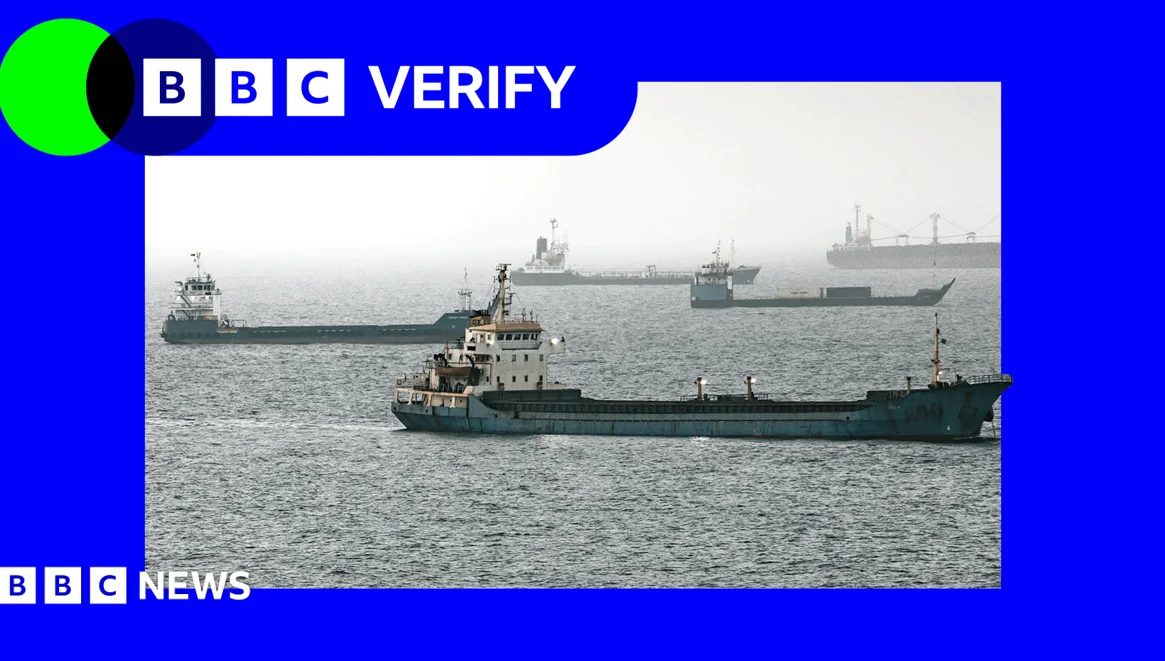
U.S. President Donald Trump said Tuesday evening he was pausing the U.S. effort to guide stranded vessels out of the Strait of Hormuz to allow time for a deal to end the Iran war, according to NPR. However, he stated that the American forces’ blockade of Iranian ports would remain in place. Meanwhile, Iran’s Foreign Minister Abbas Araghchi met with his Chinese counterpart, Wang Yi, in Beijing on Wednesday morning, the official Xinhua news agency reported, without providing further details.
Strait of Hormuz Ship Traffic Falls
The three ships that were struck this week were using a U.S.-recommended route through Omani waters; Iran has repeatedly said the only “safe” route is a separate route through its waters, according to the BBC. For decades. Vessels have been given free passage through the strait, through which more than a fifth of the world’s oil and gas supplies as well as fertilizer shipments and other vital goods flow.
Before the conflict began. An average of 138 ships crossed through the strait each day, according to the Joint Maritime Information Center (JMIC), a multinational maritime group including the U.S. After the U.S. and Israel launched its first strikes on Iran on 28 February, this fell to just a handful of ships per day. Iran effectively closed the strait by attacking ships attempting to cross and laying mines, while the U.S. responded with a blockade on all shipping to and from Iranian ports.
Efforts to Reopen the Strait
A deal to end the war. Which was signed on 17 June, included steps to re-open the strait; Washington also agreed to lift its naval blockade and ease sanctions on Iranian oil exports, according to the BBC. Following the agreement, overall traffic levels in the strait did initially increase to a peak of 72 ships on 24 June.
What led up to this latest violence? Throughout its negotiations with the U.S., Iran has insisted it has the right to control movement through the strait and introduce fees for ships to pass. The U.S. and its Gulf allies, as well as governments in Europe and Asia, oppose this and say passage through the strait must return to being free and open as it was before the conflict began. After the deal to end the war, the Iranian government set out a system of lanes through the north of the waterway close to the Iranian coast, which it said all traffic must use.
International Reactions and Diplomatic Moves
Earlier in Washington, U.S. Secretary of State Marco Rubio had expressed hope that Beijing would reiterate to Tehran the need to release its chokehold on the strait, which is a vital waterway for global energy, according to NPR. It was the first time since the start of the war that Araghchi has traveled to China, whose close economic and political ties to Tehran give it a unique position of influence.
U.S. to pause latest efforts to reopen the Strait of Hormuz. Trump announced the decision in a social media post, saying the latest effort—which started Monday—would pause for a short period to see whether an agreement with Tehran on ending the war in the Middle East could be finalized.
Iran’s effective closure of the strait, through which major oil and gas supplies passed before the war, along with fertilizer and other petroleum products, has sent fuel prices skyrocketing and rattled the global economy. Breaking Iran’s grip would deny its main source of exploit as Trump demands a major rollback of Tehran’s disputed nuclear program.






Comments
No comments yet
Be the first to share your thoughts