

 BBC
BBC 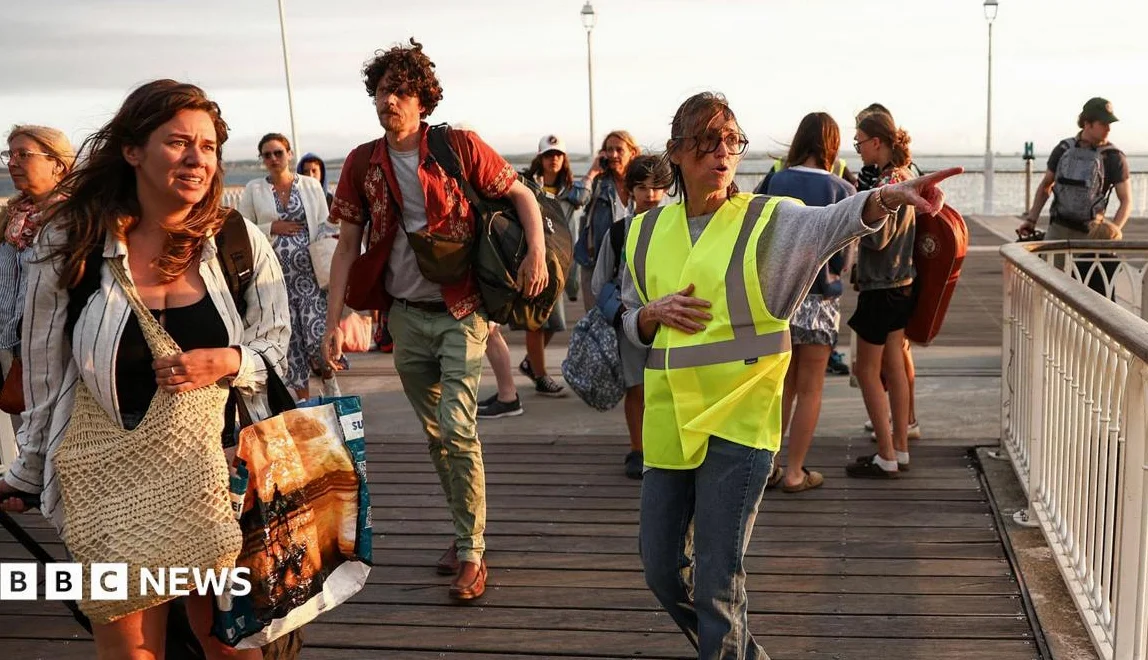
Tens of thousands of people are being evacuated from the French tourist spot of Cap Ferret, located on the south-west coast, as firefighters battle a wildfire described by local officials as an ‘XXL fire’. The fires. Which began on Tuesday, have consumed 10,000 hectares of land, or almost 25,000 acres.
Mass Evacuations and Lost Homes
French Interior Minister Laurent Nuñez stated that 40,000 people had either been or were in the process of being evacuated from the Cap Ferret peninsula; the peninsula is bordered by the Atlantic Ocean on one side and the Bay of Arcachon on the other. Local prefect Sophie Brocas reported that 53 homes and a campsite had been lost, but 2,000 houses had been saved.
A local councillor said that 2,000 evacuees had already arrived by boat in the port of Arcachon, located on the south side of the bay. Fire and rescue chief Marc Vermeulen explained that the wildfire had spread rapidly at the end of Thursday and into the early hours of Friday. Authorities then decided to begin the evacuation of the town of Arès, which lies south-east of Lège-Cap Ferret.
Additional Fires in Biscarrosse
Further down the Atlantic coast, another major fire in the town of Biscarrosse in France’s Landes region has prompted the evacuation of more than 23,000 people. About 18,000 people in Biscarrosse and 5,000 in Parentis-en-Born were forced to leave their homes, campsites, a nursing home, and a summer camp.
Landes prefect Gilles Clavreul said that the fire around Biscarrosse would not be extinguished by the end of Friday due to winds of up to 50 km/h and temperatures of 36-37°C. He added that 105 homes and other buildings had been identified as either partially or completely destroyed by the flames.
No further casualties have been reported overnight in south-west France, although two firefighters died on Tuesday while tackling a blaze near Bordeaux airport.
International Support and Public Response
French President Emmanuel Macron described the wildfire situation in the country as ‘very tense’, especially in the Gironde region. The European Union has sent three planes and two helicopters to assist the French fire effort, along with four additional planes to help in Spain, which is also experiencing severe wildfires.
Headmaster David Morton, from Gloucester, described his experience evacuating with his family from Petit Piquey on the peninsula. He said they received an emergency alert via text message at 03:00 local time and joined a slow-moving queue of traffic. He described the flames as ‘enormous’ and the evacuation as ‘well-controlled’ with people being ‘very respectful and sensible.’
Spanish Interior Minister Fernando Grande-Marlaska declared a national emergency as wildfires burned in areas near Madrid. Prime Minister Pedro Sánchez described the situation as ‘dramatic’ and urged people to take great care. Over 10,000 people have been evacuated in Spain, with some areas like Aldea del Fresno also being affected.
The Cap Ferret peninsula, which has a year-round population of just under 8,000, can swell to around 80,000 in peak season. Around 20,000 people in the Gironde region had been evacuated on Thursday, many of whom were tourists at campsites on the peninsula. Further evacuations from La Porge took place ‘calmly,’ according to prefect Brocas.
The public has been advised not to go to the affected areas, and homes in evacuated regions will be monitored to prevent vandalism. ‘Significant resources’ remain on the ground tackling the blaze, while additional ground and air reinforcements are expected to arrive in the coming hours.
According to the EU’s Copernicus Climate Change Service, Europe is the fastest-warming continent, heating at more than twice the global average since the 1980s. This rapid warming has led to hotter and drier summers, particularly in southern Europe, which increases the risk of wildfires. The European Environment Agency has stated that ‘climate change has increased forest fire risk across Europe’, with the greatest danger expected in southern regions.






Comments
No comments yet
Be the first to share your thoughts