

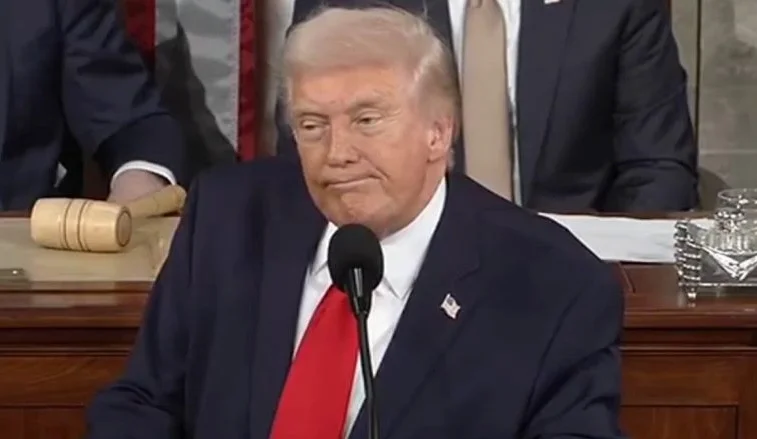
President Donald Trump on Tuesday forcefully defended his sweeping tariff policy, crediting it with driving what he described as a ‘stunning economic turnaround,’ while criticising a recent Supreme Court decision that struck down many of the measures. Speaking before a joint session of Congress during his 2026 State of the Union address, Trump pointed to trade levies as a central pillar of his administration’s economic strategy.
Trump’s Tariff Strategy and Economic Claims
The President said the tariffs helped reverse what he previously characterised as a stagnant economy and declining global use, arguing they strengthened domestic industry and compelled trading partners to renegotiate agreements. He also aimed at the Supreme Court of the United States, which recently invalidated several of his tariff actions.
‘Just four days ago, an unfortunate ruling from the United States Supreme Court. Very unfortunate ruling but the good news is that almost all countries and corporations want to keep the deal that they already made,’ Trump said, addressing four justices who were present in the House chamber.
Trump emphasized that countries that had previously taken advantage of the U.S. are now paying hundreds of billions of dollars in tariffs, and that these countries are now happy with the arrangement. ‘The deals are all done, and they’re happy… There was no inflation, tremendous growth, and the big story was how Donald Trump called the economy correctly,’ he added.
He also criticized 22 Nobel Prize-winning economists for having ‘got it totally wrong’ about the U.S. economic trajectory. Trump claimed that his tariff policies were a primary reason for the country’s ‘stunning economic turnaround,’ with the Dow Jones breaking 50,000 four years ahead of schedule and the S&P hitting 7,000, a milestone that was not expected for many years.
Economic Growth and Market Performance
The President stated that the U.S. markets had hit historic highs on the back of the tariff structures before the Supreme Court ruling. ‘I used these tariffs, took in hundreds of billions of dollars to make great deals for our country, both economically and on a national security basis. Everything was working well,’ he said.
The official theme of this year’s address is ‘America at 250: Strong, Prosperous and Respected.’ Trump is expected to focus heavily on the economy, proposing new tax cuts and highlighting what he calls a resurgence in American prosperity during the first year of his second term.
As the United States reaches this historic milestone, the 250th anniversary serves as both a commemoration and a moment of renewal—honouring its history while looking ahead to its future. The 250th anniversary commemorates the signing of the United States Declaration of Independence on July 4, 1776, marking two and a half centuries since the thirteen colonies declared independence from the Kingdom of Great Britain and began a bold experiment in self-government.
Implications of the Supreme Court Ruling
Despite the Supreme Court’s decision to invalidate several of his tariff actions, Trump remains confident that the trade deals remain intact. ‘Knowing that the legal power that I, as President, have to make a new deal could be far worse for them, and therefore, they will continue to work along the same successful path that we had negotiated before the Supreme Court’s unfortunate involvement,’ he stated.
The Supreme Court’s ruling, which was issued just four days prior to Trump’s address, has raised questions about the future of U.S. trade policy. The decision could have significant implications for international trade relations and the U.S. economy, particularly as Trump has previously threatened to impose additional tariffs on countries that he claims are ‘ripping the U.S. off.’
Analysts have noted that the ruling may lead to increased uncertainty in global trade markets, as businesses and governments adjust to the new legal landscape. However, Trump’s assertion that trade partners still want to maintain the existing deals may provide some stability in the short term.
As the U.S. prepares to mark its 250th anniversary, the focus on economic strength and prosperity is expected to remain a central theme in Trump’s State of the Union address. The President’s proposals for new tax cuts and continued emphasis on national security through economic policy are likely to be key points of discussion.





Comments
No comments yet
Be the first to share your thoughts