

 BBC
BBC 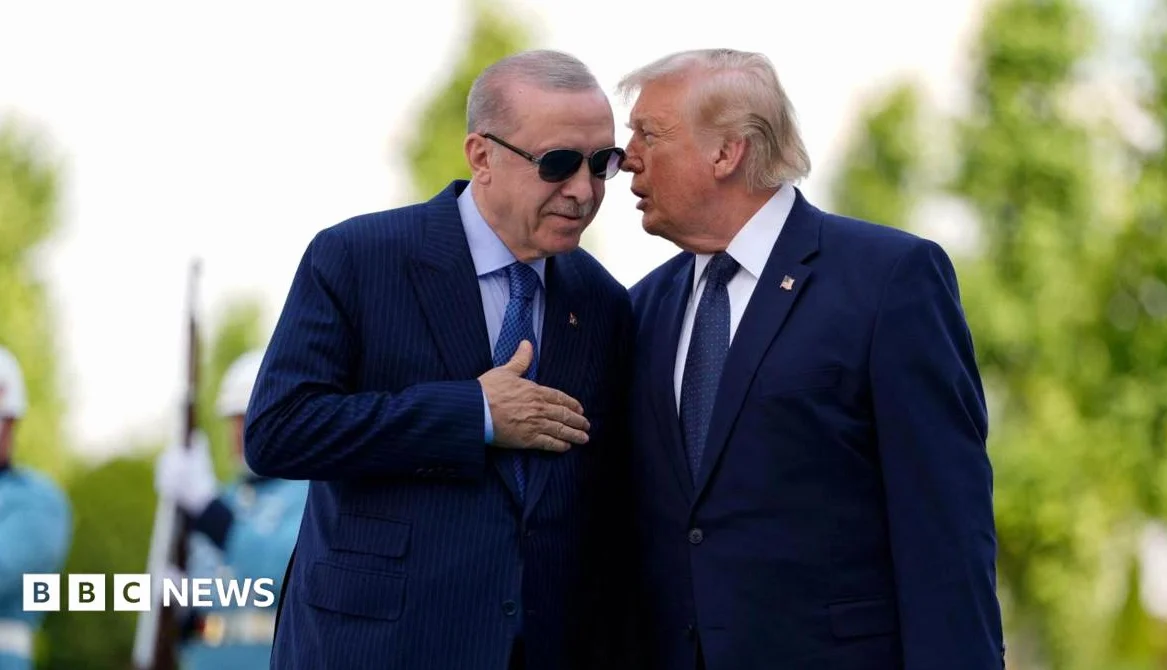
Black-clad Turkish police patrolled street corners, and giant blue banners proclaiming ‘The Key to Peace’ were displayed as U.S; President Donald Trump arrived in Ankara for the NATO summit. The event has been characterized by a ceremonial welcome for Trump, who has made his skepticism of NATO well known. According to the BBC. Trump’s decision to attend the summit was influenced by the fact that it was being hosted by his close ally, Turkish President Recep Tayyip Erdogan, who personally greeted him at the airport.
Trump’s Disruptive Presence
Trump and Erdogan walked arm-in-arm as a band played the U.S. national anthem and Turkish air force jets performed a flypast, trailing red, white, and blue smoke. Despite the show of unity, Trump’s comments have disrupted the carefully crafted image of alliance cohesion. Upon arrival, he reiterated his long-standing suggestion that the U.S. should take over Greenland, an island belonging to the Kingdom of Denmark, another NATO member.
Trump acknowledged that his previous remarks on Greenland had strained relations with NATO. Denmark’s prime minister has warned that any attempt by the U.S. to seize Greenland by force would spell the end for the alliance. This warning reveals the diplomatic tensions within NATO over the issue.
Irish Tensions and UK Criticism
Trump’s frustrations are also evident in his comments about the war in Iran, where he criticized NATO allies for not joining his unilateral military actions. He singled out the UK for its lack of support despite allowing U.S. airstrikes on Iranian missile sites from British airbases. Referring to the UK prime minister, Trump stated, ‘He said no we’ll help after the war is over. I said I don’t want that kind of help. We didn’t need any help at all. In a way I was testing people, I was testing to see whether or not they’d be there because I’ve long said that we help them but I’m not sure that they’d be there for us.’
The British delegation at the summit has emphasized its defense collaboration with European partners. However, UK Prime Minister Sir Keir Starmer, attending his final NATO summit, has been met with criticism over the UK’s Defence Investment Plan, which has been labeled as billions of pounds short of the requirements outlined in last year’s Strategic Defence Review.
Focus on Rearming Europe
Beyond the political posturing and speeches, NATO delegates have engaged in substantive discussions on rearming Europe. Large contracts have been announced for a new fleet of transport aircraft to be built by Airbus, and plans are in place to replace NATO’s aging AWACS fleet with Sweden’s GlobeEye planes. There is also considerable discussion on joint missile projects.
Ukrainian President Volodymyr Zelensky is present at the summit, highlighting the urgency of strengthening air defenses. Recent Russian ballistic missile strikes on Kyiv have killed dozens of civilians and highlighted the desperate need for interceptors. Zelensky has called for an effective anti-ballistic missile system in Europe, stating, ‘Europe needs its own effective anti-ballistic system and missiles. And this work is already under way and I urge you and all of our partners to give it the attention it deserves. And this cannot wait until 2030 or beyond, Europe needs affordable mass-produced anti-ballistic systems as soon as possible.’
His call for action is increasingly relevant as the U.S. gradually reduces its defense commitments to Europe. The challenge now is to build credible air defenses to counter Russia’s growing arsenal of missiles and drones. While all parties at the summit express a desire for an end to the war in Ukraine, there is a shared concern that once hostilities cease, Russia could launch on a rapid rearmament program, potentially threatening NATO territory within four years.





Comments
No comments yet
Be the first to share your thoughts