

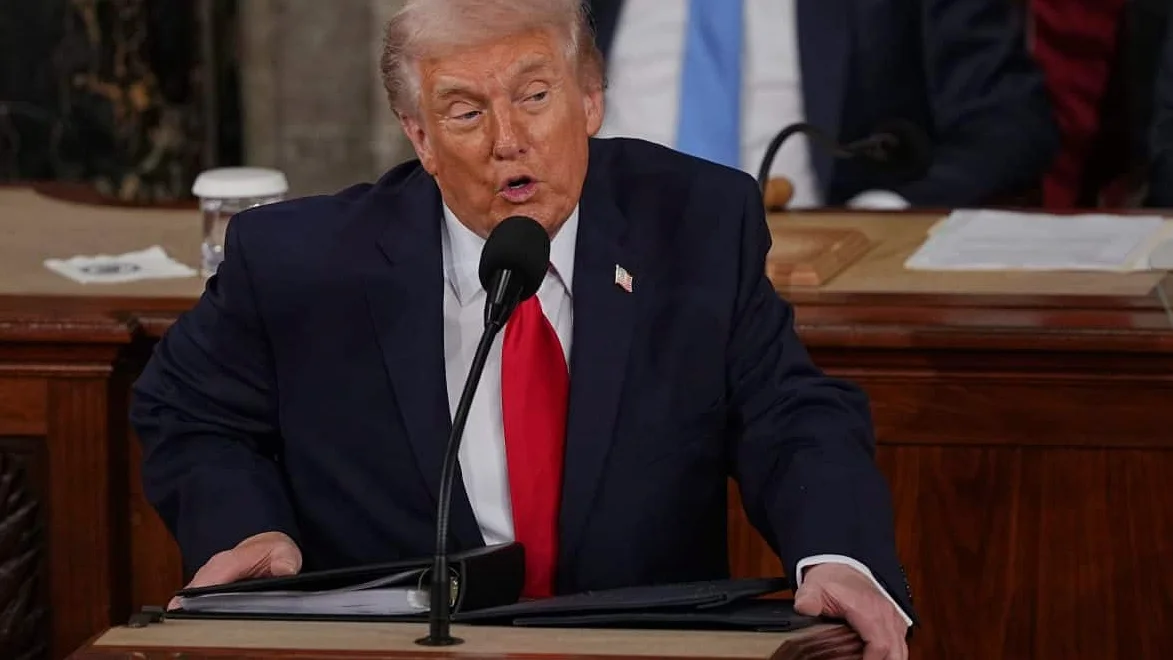
US President Donald Trump has called the current military campaign against Iran ‘massive and ongoing,’ warning that American lives may be lost as Israel and the United States continue to launch strikes against the country. In a video address on Saturday, Trump emphasized that the attacks are preventive in nature, aimed at stopping Iran from posing a threat to American interests.
Escalating Tensions in the Middle East
The strikes come amid growing tensions in the Middle East, with both the US and Israel accusing Iran of expanding its nuclear ambitions and supporting militant groups in the region. Trump claimed that Iran has been rebuilding its nuclear program since a US bombing in June targeted its nuclear facilities. ‘They rejected every opportunity to reach their nuclear ambitions, and we can’t take it anymore,’ Trump said in his video message, which he shared on his social media platform, TruthSocial.
According to officials, the recent attacks targeted Iran’s ‘shadow fleet’ and drone networks, part of a broader strategy to impose sweeping sanctions on the country. These measures are intended to pressure Iran ahead of critical nuclear talks in Geneva, which could determine the future of Iran’s nuclear program and its relations with the West.
Impact on Trade and Regional Stability
The escalation of military action has raised concerns about the impact on trade and regional stability. Iran’s economy, already reeling from years of sanctions, could face further disruption. The United States has imposed additional restrictions on Iran’s maritime operations, targeting its ‘shadow fleet’ of merchant ships suspected of smuggling weapons and other materials. These sanctions are expected to reduce Iran’s ability to export oil and other critical resources, potentially affecting global energy markets.
‘The US is targeting Iran’s military and economic infrastructure to weaken its ability to threaten our interests,’ said a US defense official. ‘This is not just about stopping a nuclear program, but about preventing Iran from becoming a regional hegemon.’
Analysts warn that the continued strikes could lead to a broader regional conflict, with neighboring countries like Iraq and Syria potentially drawn into the fray. ‘The risk of escalation is high, especially if Iran retaliates with attacks on US military bases in the region,’ said Dr. Lisa Chen, a Middle East analyst at the International Security Institute.
What’s Next for the Nuclear Talks in Geneva
The ongoing strikes have cast a shadow over the upcoming nuclear talks in Geneva, which were scheduled to address Iran’s nuclear program and its compliance with international agreements. With the US and Israel intensifying their military actions, the likelihood of a diplomatic resolution appears slim. However, the talks are still expected to proceed, with both sides hoping to find a compromise before the situation spirals further out of control.
According to a diplomatic source, the talks will focus on Iran’s enrichment activities and its compliance with the Joint Thorough Plan of Action (JCPOA), the 2015 nuclear deal. ‘The US is pushing for stricter limits on Iran’s nuclear program, but Iran is unlikely to agree to further concessions without relief from sanctions,’ the source said.
Trump’s comments have also raised concerns about the potential for civilian casualties in Iran. The US military has stated that it is taking steps to minimize harm to non-combatants, but the risk of collateral damage remains high. ‘We are committed to protecting American lives, but we cannot ignore the threat posed by Iran’s missile program,’ said a US military spokesperson.
The situation remains fluid, with both the US and Iran continuing to exchange threats. The coming weeks will be crucial in determining whether the conflict escalates or if a diplomatic solution can be found. As Trump warned, the stakes are high, and the consequences could be far-reaching.






Comments
No comments yet
Be the first to share your thoughts