

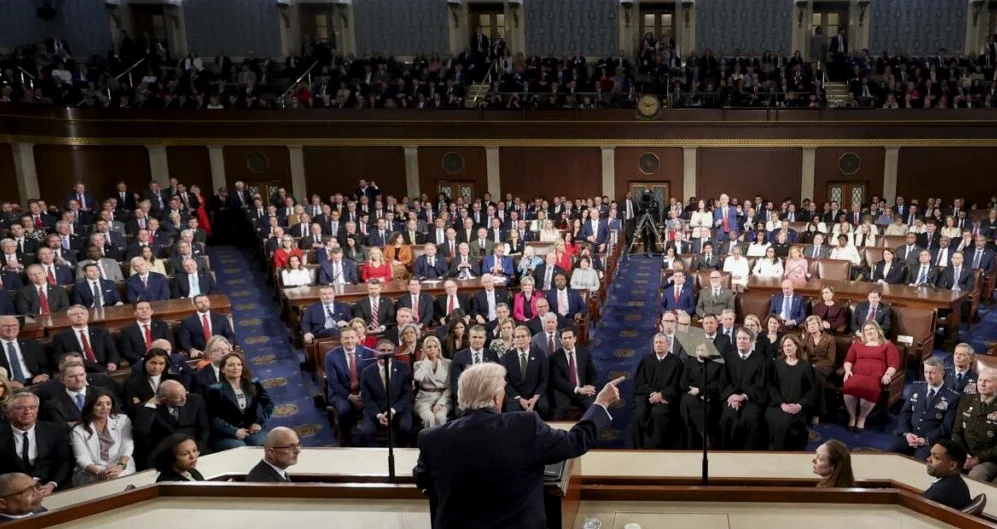
President Donald Trump announced a new policy during his State of the Union address to shield residents from rising electricity costs by requiring major tech companies to produce their own power, a move aimed at addressing concerns over energy affordability. The plan, dubbed a ‘ratepayer protection pledge,’ would shift the burden of energy production from the public grid to private data centers.
Energy Affordability and Political Implications
Trump emphasized that the current power grid is outdated and unable to handle the growing demand from data centers that support artificial intelligence and other high-energy consumption technologies. He stated that these companies should build their own power plants to meet their needs, while also lowering electricity costs for consumers.
According to the U.S. Energy Information Administration, average residential electricity prices rose from 15.9 cents per kilowatt-hour in January 2025 to 17.2 cents by the end of December. This increase has fueled public discontent, with polling showing Americans are increasingly concerned about the cost of living.
Experts warn that energy affordability could impact the outcome of the upcoming midterm elections, as seen in key races in New Jersey, Virginia, and Georgia last year. The issue has become a central concern for voters, particularly as Trump’s administration continues to roll back environmental regulations and prioritize fossil fuel production.
Rollbacks and Fossil Fuel Focus
Trump has taken significant steps to reverse policies from the Biden administration, including slashing funding for solar programs, ending federal tax credits for electric vehicles, and canceling grants for offshore wind power. These actions align with his broader agenda to boost domestic production of oil, gas, and coal.
The president has also moved to block California’s authority to set stricter tailpipe emission standards, a policy that has been central to the state’s efforts to improve air quality and phase out gasoline-powered vehicles by 2035. Trump’s administration has also slashed $1.2 billion in federal funding for California’s clean hydrogen energy projects, while maintaining support for similar initiatives in states that voted for him.
Trump’s environmental record has been marked by a series of rollbacks that prioritize corporate interests over public health, according to the Environmental Protection Network. The group criticized the administration for its efforts to undermine climate science and roll back regulations on coal plant emissions.
Data Center Focus and Environmental Concerns
Trump’s proposal to shift energy production responsibilities to data centers has drawn criticism from environmental groups. Jesse Lee, a senior advisor at Climate Power, called the plan a ‘toothless, empty promise based on backroom deals with his own billionaire donors.’
Lee argued that Trump’s policies are exacerbating the energy crisis by blocking clean-energy production, which is essential for meeting demand and preventing a surge in utility bills. The administration has also taken or proposed more than 430 actions that threaten the environment, public health, and the ability to confront climate change, according to the Natural Resources Defense Council.
Meanwhile, Virginia Governor Abigail Spanberger has focused heavily on energy affordability in her political campaigns, promising to expand solar energy projects and invest in technologies like fusion, geothermal, and hydrogen. Virginia is home to more than a third of all data centers worldwide, making energy affordability a critical issue for the state.
Trump’s Environmental Protection Agency has also made significant changes, including repealing the 2009 endangerment finding that classified greenhouse gases as harmful to human health and the environment. This move is seen as the largest act of deregulation in U.S. history and has undermined the foundation of much of U.S. climate policy.
With the midterm elections approaching, the debate over energy affordability and environmental policy is expected to intensify. The administration’s approach to energy production and regulation will likely remain a central issue in the political discourse leading up to November.





Comments
No comments yet
Be the first to share your thoughts